

Radical In-Betweenness: A Spatial Reading of Invisible String, Tangled Into Sight
by Gülistan Kenanoğlu
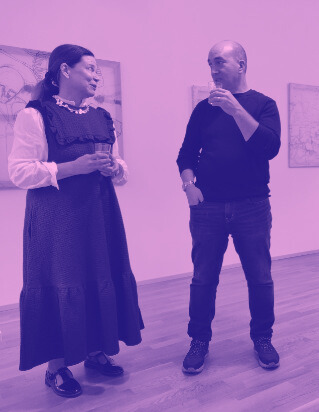
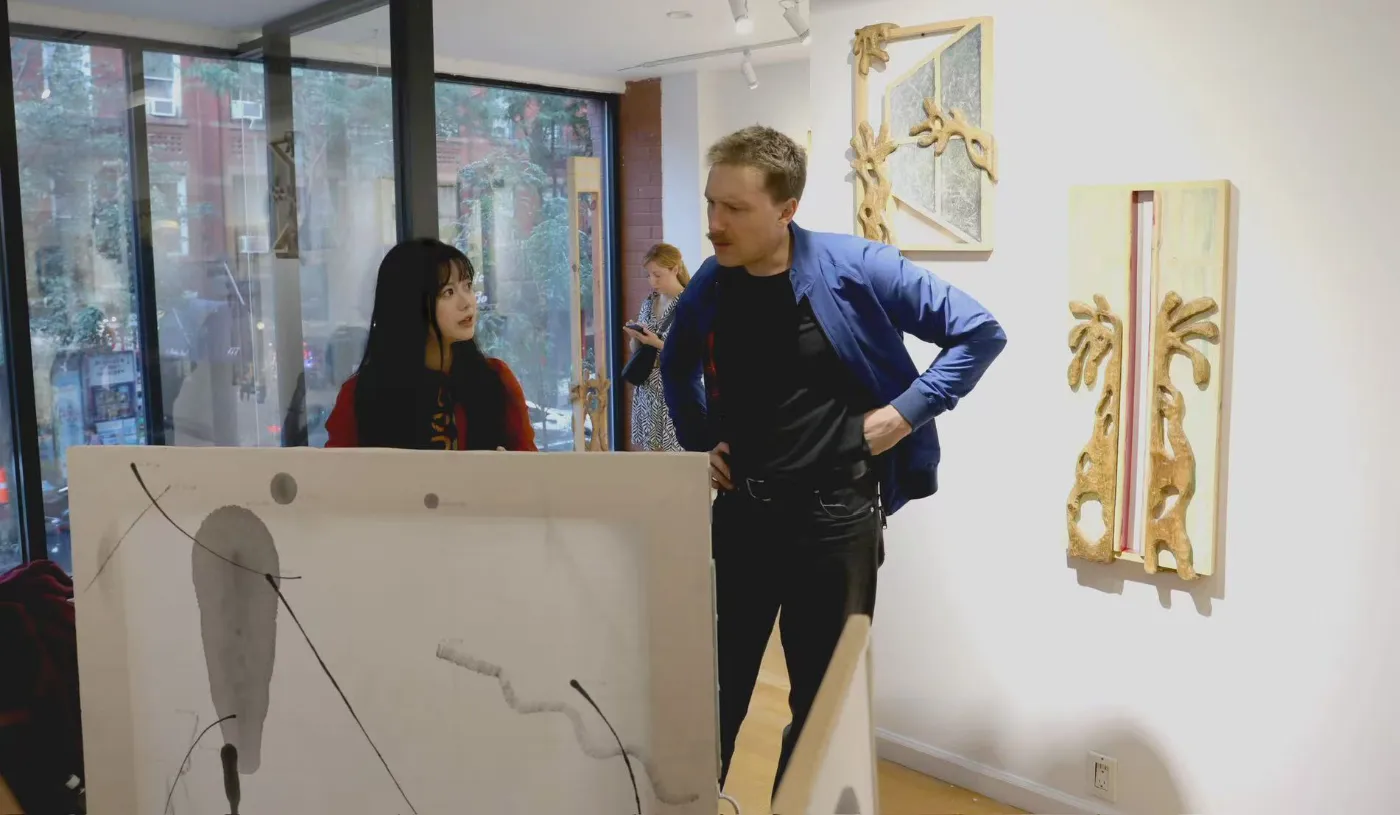
The chaotic and relentless momentum of New York’s streets comes to an abrupt halt at the entrance of the Sojourner Gallery. The metallic clamor of the outside world gives way to an unshakable silence within the white void of the gallery. Curated by Zhiheng Ashely Zhang, Invisible String, Tangled Into Sight (September 19 – October 19, 2025), features work by Jeong Hur and Nana Shimomura. As a curator and researcher whose practice emphasizes materiality, spatial dynamics, and audience engagement to foster deeper connections between art, its environment, and its viewers, Zhang’s curatorial work “moves away from the conventional white cube arrangement,” as she places the two artists’ works in close proximity with one another. “I wanted this spatial intimacy to draw viewers into a more personal encounter with the works and the connections between them,” says Zhang. For me, as an architect and curator focused on post-conflict spatial practices, the exhibition unfolds a state of in-betweenness that embodies the core of pure spatial awareness—namely, the ground for the radical reconstruction of belonging.
In the hyper-accelerated flow of modern urban life, our relationship with space often turns mechanical. As streets and buildings flatten into a mere backdrop, the individual loses direct, sensory contact with the world. Gaston Bachelard’s poetics of space offers a way back into that contact: space is never a neutral container or a geometric fact; it is a field charged with memory, feeling, and reverie—a house, a corner, a nest is not simply occupied but inhabited, dreamed, and lived.1 In my reading of Hur and Shimomura’s work in Invisible String, Tangled Into Sight, I draw on Bachelardian poetics of space, alongside a Merleau-Pontian concept of bodily space,2 to examine how the exhibition opens a dialogue around sensory detachment and spatial proximity.
Poetics of Space
Space, in this reading, is not an empty vessel into which objects are placed; it is a site where inner life takes shape, where the smallest enclosure can hold an entire cosmos of memory. Bachelard named this attentiveness a topoanalysis, but at its heart it is something closer to a poetics: not the measured space of the architect’s plan, but the felt space we have known, loved, and carried within us. This intimate, felt attentiveness grounds both the exhibition’s title and this essay’s method: the installations in Jeong Hur’s Fractured Stillness series—constructed using traditional Korean hanji paper and pine wood—do not simply occupy the gallery; they are inhabited spaces, small dwellings for memory in the Bachelardian sense.
Heidegger’s account of the boundary offers a complementary way to describe what happens at their edges: a boundary, for him, is not where something stops, but where its unfolding begins.3 For an architect striving to establish experience over mere volume, this reframes thresholds as sites where a new essence sprouts rather than lines of separation. Hur’s suspended sculptures, while exhibiting a lightness that defies gravity, simultaneously bear the traces of a fractured whole. These works evoke the lingering traces of our settled perceptions that are momentarily frozen. Yet Hur’s genius lies in his ability to present this fragmentation as a serene composition. The translucent texture of the hanji paper allows for the dissolution of the solid and the permeation of space. As rigid spatial and mental divisions increasingly isolate us, this textility serves as a reminder of the necessity of flexibility and transparency.
Bachelard named this attentiveness a topoanalysis, but at its heart it is something closer to a poetics: not the measured space of the architect’s plan, but the felt space we have known, loved, and carried within us.
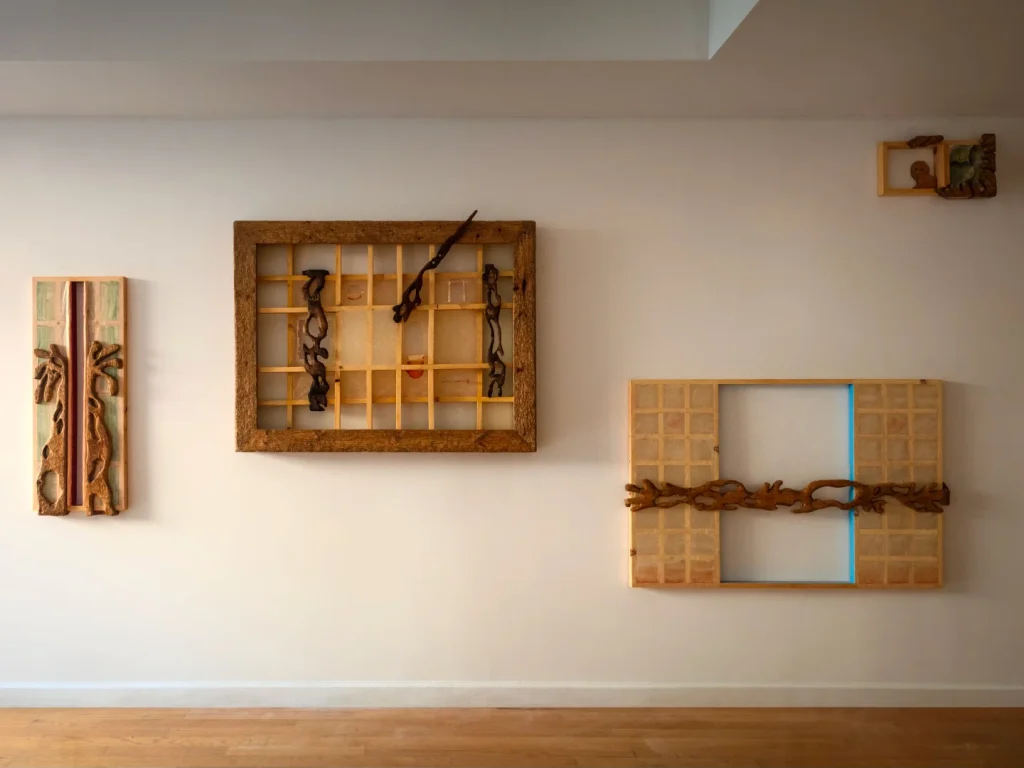
To dwell, in Bachelard’s sense, is to discover a shifting harmony between the body and the space that holds it. Hur’s works seek this harmony within the honesty of the materials themselves. The dialogue between the hardness of the pine wood and the fragility of the paper represents that tense threshold between a temporary pause and a permanent belonging. Here, the task of both the artist and the architect is to create veils of memory that allow light and air to pass through, thereby enabling existence to carve out a poetic space for itself.
Embodied Memories
Hur constructs space through the act of settling; Shimomura redefines it through movement and the body. Shimomura’s interventions in her Topos Logos series gain immense depth when viewed through the lens of Merleau-Ponty’s phenomenology of perception. In that sense, the body becomes an intentional volume existing within the world as a primary form of contact—actively producing space through its presence.
Shimomura lifts calligraphy from its traditional two-dimensional surface, transforming it into a three-dimensional form of movement intertwined with lines and voids. These lines serve as records of the body’s choreography through space. When we step away from the pre-coded, rational maps of the city, the act of wayfinding relies entirely upon intuition and bodily memory. The lines in Shimomura’s works set out in pursuit of these lost, somatic coordinates.
Shimomura lifts calligraphy from its traditional two-dimensional surface, transforming it into a three-dimensional form of movement intertwined with lines and voids. These lines serve as records of the body’s choreography through space.
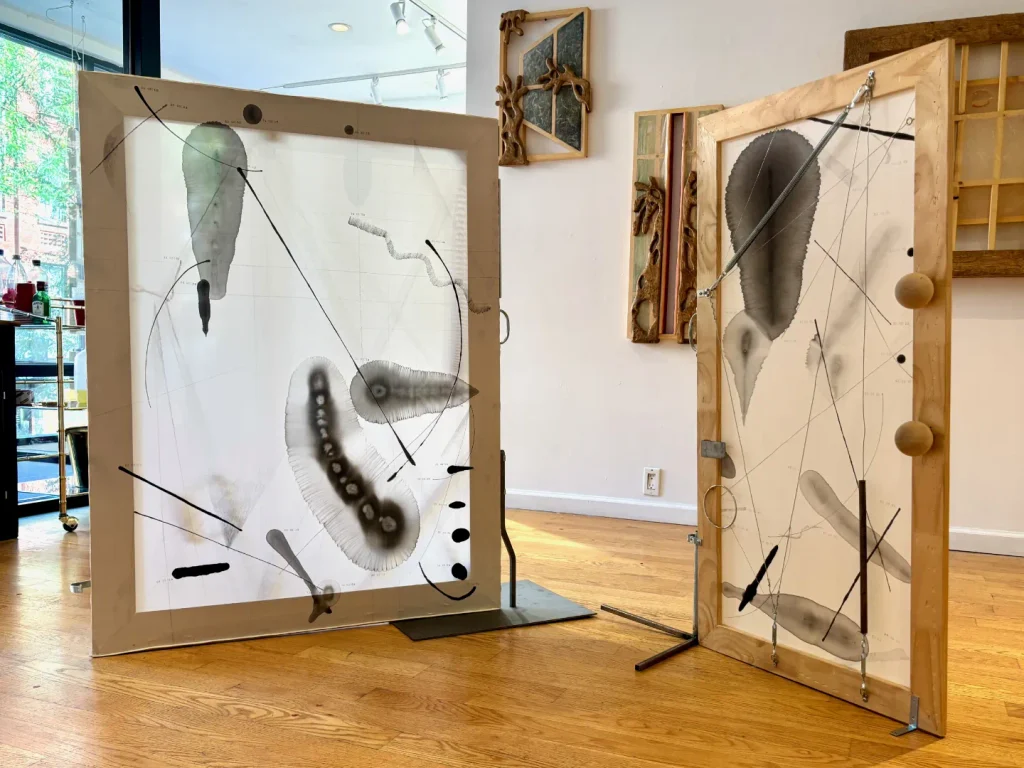
The tangled nature of these lines symbolizes the complex texture woven by collective thoughts and sensory encounters. Yet this entanglement is a basting stitch, a temporary yet vital connection. Much like Merleau-Ponty’s concept of the chiasm (le chiasme), the artist’s lines give rise to a relational network where the invisible threads connecting the “self” and the space are stitched together.4
The interplay of shadows, shifting with the subtle air currents within the gallery, is in constant flux, continually transforming in response to the viewer’s movement. This creates a perception of space that is vibrant and perpetually under negotiation, thus radically challenging the static conventions of traditional architecture. Belonging, in this context, emerges as a pure sensory awareness—one that blossoms from within dynamism.
Radical Proximity
The relationship that both artists establish with the state of in-betweenness forms the foundation of the exhibition’s curatorial success. Invisible String, Tangled Into Sight carves out a phenomenological fissure, standing poised upon that fine line between interiority and exteriority, tradition and modernity, stillness and movement. This arrangement of Zhang’s curation demonstrates how exhibition design itself can evolve into a practice of spatial care and dialogue. Invisible threads serve as the delicate joints of this interaction; they exist to foster new relationships around the void.
As I emerge from the gallery’s sheltered silence and dissolve back into the relentless clamor of New York, I begin to perceive every crack in the Lower East Side pavement, every dangling urban cable, and every unfamiliar face as an integral part of those delicate stitches binding us to the environment. Tracing these invisible threads and heeding that potent voice of shared presence resonating within the silence offers a fresh perspective for architectural and curatorial practices. What remains is the radical proximity of the in-between.
About the Author:
Gülistan Kenanoğlu is an architect, founder of the SB Arch Lab initiative with a Bachelor of Architecture, and an independent curator with an MA in Design & Curatorial Studies. Kenanoğlu’s work explores the complex relationship between deconstruction and construction practices in the architecture of post-conflict cities by zooming into oriental studies and postcolonial theory. Further, she adopts a collaborative and participatory curatorial practice – exploring exposition and fetishism – going hand in hand with her architecture practice. Her works have been awarded several grants and exhibited at different institutions including Residency Unlimited, Apexart Gallery, BAK (basis voor actuele kunst), and İKSV (Istanbul Foundation for Culture and Arts).
Website: SBARCHLAB
Footnotes:
- Gaston Bachelard, The Poetics of Space, Trans. Maria Jolas Boston: Beacon Press, 1994. ↩︎
- Maurice Merleau-Ponty, Phenomenology of Perception, Trans. Colin Smith. London: Routledge, 1962. ↩︎
- Martin Heidegger, Poetry, Language, Thought, Trans. Albert Hofstadter. New York: Harper & Row, 1971. ↩︎
- Maurice Merleau-Ponty, Phenomenology of Perception, Trans. Colin Smith. London: Routledge, 1962. ↩︎