

In Conversation with Klervie Mouho
I met Klervie Mouho on the occasion of her solo exhibition, Through Beloved Eyes, at the Botaki Factory earlier in the summer. Her faceless figures, which seemed to carry the weight of personal history, immediately struck me with their quiet intensity. Later, I invited the Ivorian-French painter, who now lives in Zurich, to learn more about the stories captured in the stillness of her silhouettes. As my eyes traced the marks left by the movement of her hands – marks that rippled like the surface of the sea in the rain – I listened to the artist speak about her practice, grounded in personal experience, everyday life, and the lingering echoes of the civil war in Côte d’Ivoire.
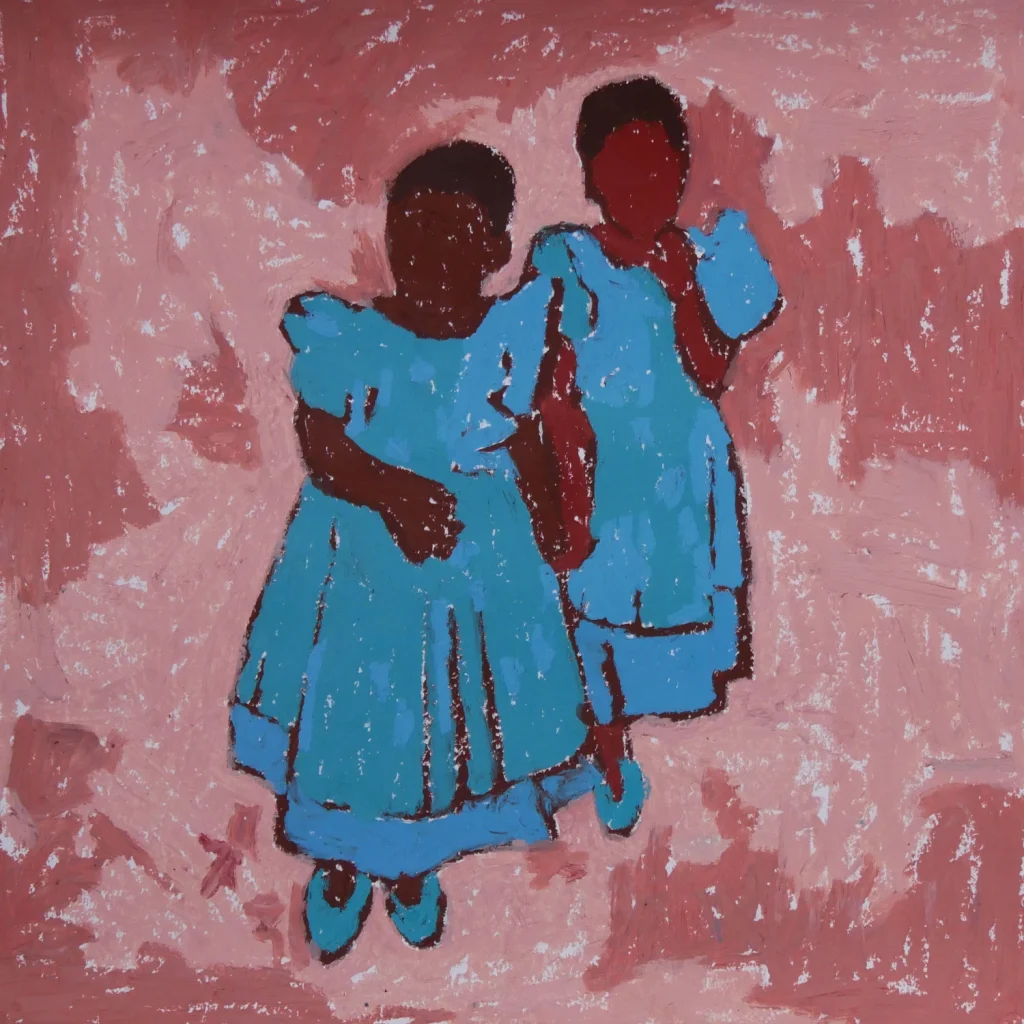
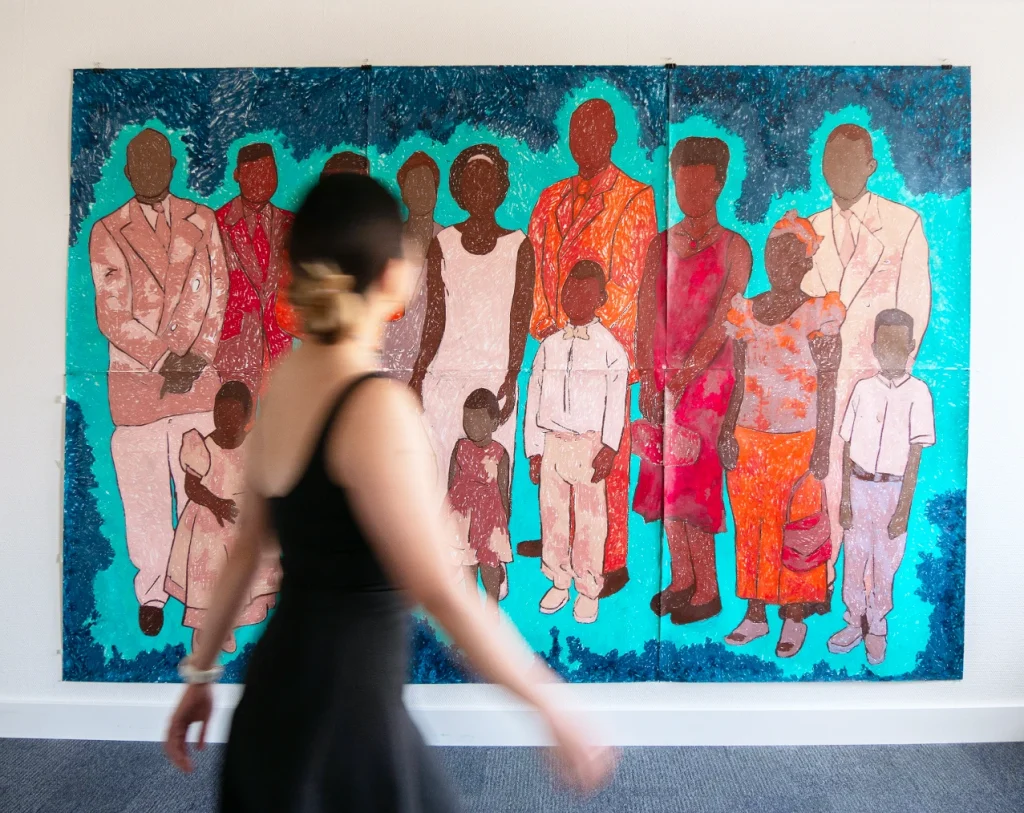
Mouho’s paintings emerge from the photo albums of her family and friends, blending past and present into textured, immersive compositions. Her approach prioritizes emotional connection, aiming to evoke a visceral response in the viewer before engaging them intellectually. Each painting begins with a photo that resonates with her and then undergoes a tactile transformation, reinterpreted through oil sticks on paper, working directly with her hands. Through this process, Mouho’s work becomes a means of processing personal history as a catalyst for healing and reflection.
In our conversation, Klervie Mouho spoke candidly about how her paintings have become a space for dialogue for herself and for those who encounter them. What follows is an exploration of her journey, her process, and the emotional landscapes she invites us to step into.
Ilknur Demirkoparan: You’ve described your work as deeply personal and emotionally engaged. To me, the personal life and the emotional connection can also be the most difficult place to create from. What was your, I need to do this, moment?
Klervie Mouho: I began creating around my own feelings and memories of the civil war in Côte d’Ivoire when I moved to France and met people who had never lived in a country at war. It was strange to interact with people who didn’t have the same experience, but that gave me a new perspective on my own experience. I realized that the people I grew up with in Côte d’Ivoire, rarely spoke about the war. They didn’t share their feelings, thoughts, or memories about it. Yet it was always on their minds every day. Many of them still have PTSD, but they never talk about it.
I started exploring these memories and emotions, and the things we weren’t saying. At first, I worked mostly with photography and screen printing, creating very dark pieces that focused on earth, death, and grief. Everything was heavy and black. Eventually, I had to take a break for my own mental health, so I did a master’s in design. I just needed space away from fine art.
After my master’s, I returned to this research but with a more positive approach and began working with color. I started to realize that even though that time was terrible, it was also my life, it was my childhood. There were still moments of sweetness and beautiful memories during those hard times.
In the beginning, my work felt very depressing and sad. Now it’s more nuanced and I feel like my work has evolved in relation to where I am emotionally. There were times I couldn’t even create without harming my mental health. Now, it actually helps me process everything.
Today, I focus more on small, simple joys that will eventually disappear. And that’s okay. I often use images of my family, my friends, and my country, but I don’t paint faces. In that way, I feel the work becomes universal; it belongs to everyone.
I started exploring these memories and emotions, and the things we weren’t saying.
ID: How did your work begin to evolve in this new direction?
KM: It started when I visited home in Côte d’Ivoire, during the pandemic in 2020. I scanned every photograph I could find at home. When I returned to France, I would call my dad on Zoom, show him the images, and ask about the memories behind them. He would begin sharing stories from his childhood, and together we would try to remember who the people were. Sometimes we had forgotten them completely, and other times a memory would suddenly come back.
In the beginning, I focused only on my dad and my immediate family, but later I started working with my own photography, with photos of my friends, and even strangers I photographed in the street. I also scanned my boyfriend’s mother’s photo albums that had been damaged by water. Some images were almost completely erased or destroyed by mold, but I kept them anyway. Sometimes there was just a fragment left. A hand in the middle of nothing, and I found that really beautiful. So, my work evolved intuitively. I followed how I feel about an image, moving through my own archive and the archives of people close to me, always searching and reinterpreting.
Today, I focus more on small, simple joys that will eventually disappear. And that’s okay. I often use images of my family, my friends, and my country, but I don’t paint faces. In that way, I feel the work becomes universal; it belongs to everyone.
ID: Are all the images from family and friend albums of the past, and mostly from your own lifetime?
KM: I also work a lot with my own photography because I take a lot of pictures. But I also use photographs taken by people close to me, like my mom or my boyfriend’s mom. These images give me a kind of personal archive to draw from. What’s interesting is how the time periods vary: my own photos are from after 2010, while my mom’s are from the 1970s, 80s, and 90s. My boyfriend’s mom is older, so she has pictures starting from 1955. So, when I’m working with these images, there’s always this question of time.
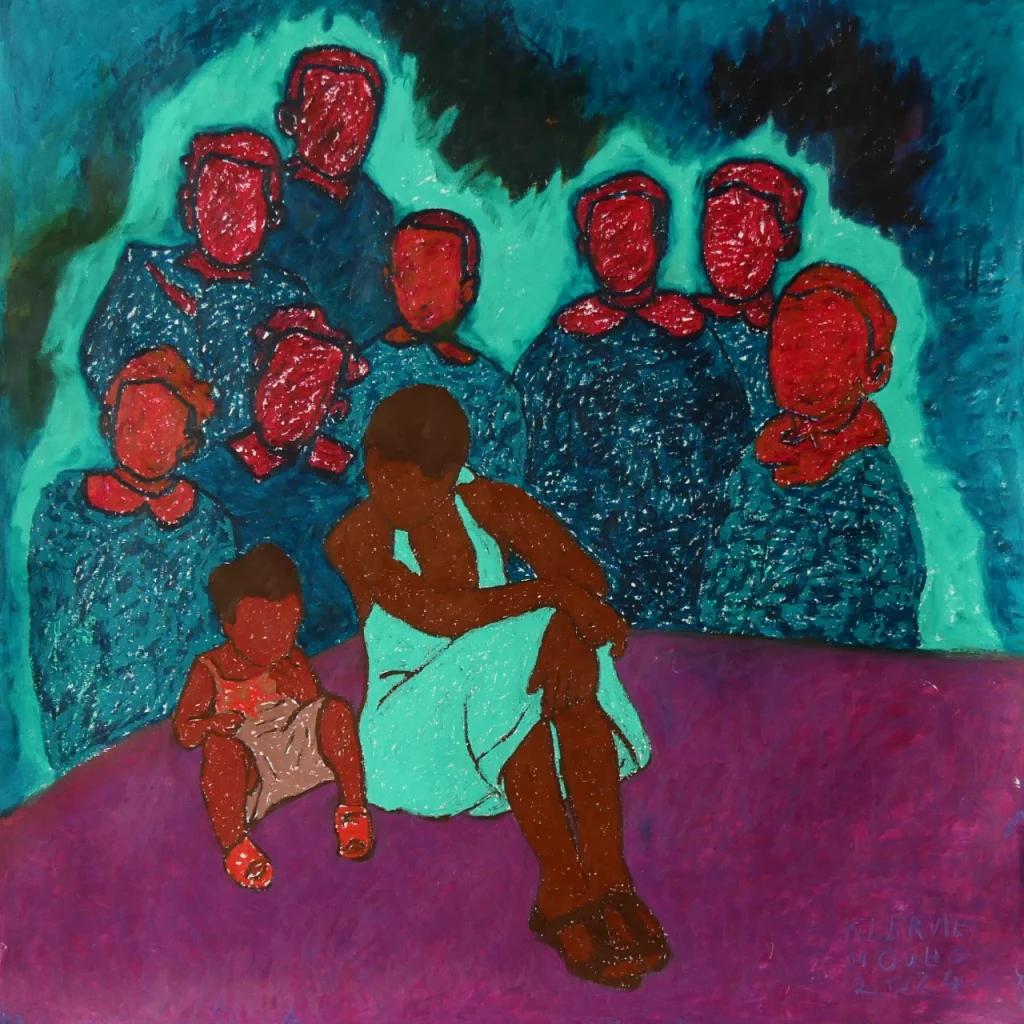
When I was studying for my Bachelor’s, I was working on really small pieces. The idea was, if I ever had to flee my country, if I had to escape, I could just put the artwork in my luggage and take it with me.
ID: There’s a sense of slowness that comes through your work. It feels like a refusal of immediacy, especially in contrast to photography, which also seems to be tied to the physicality of your work. You paint with your hands, using oil sticks directly on the surface. I remember from your artist’s talk that you don’t like having anything come between you and the material. It’s a way of staying intimately connected to the memory embedded in the image. And the large-scale nature of your work reinforces this intimacy, even though we generally think that small works are intimate, while large works are not as they require viewing from a distance. Your paintings do the opposite. You stand in front of the painting and lean in to look at the texture, and in doing so, your own presence interacts with the figures in your paintings. It really feels as though there is room for the viewer in your paintings.
KV: Yes. When I was studying for my Bachelor’s, I was working on really small pieces. The idea was, if I ever had to flee my country, if I had to escape, I could just put the artwork in my luggage and take it with me. So I had this idea of the artwork as a kind of memory. Something from home. Something that represents a feeling of security, connection, family. Something you can just take and go.
And when I started working on larger pieces, I thought, wait, this goes against that first idea, which was so important to me. But then I realized that you can’t freeze a moment. You try to keep a memory intact, but that’s not how memory works. It’s not a fixed thing. Every time you remember something, it changes a little, depending on who you are now and what you’re bringing into that moment.
Thinking back about my first exhibition in Abidjan. There was this man—very typical of Cote d’Ivoire, you know, where men aren’t really supposed to show emotion, never talk about their feelings, especially not about the war. But he was really moved by one of the paintings, the one that depicted war. He started talking to my dad about it. He said, “Oh, I see myself in this. I’ve felt that feeling of being trapped, yet still feeling a sense of safety, while violence rages outside.”
Seeing the two men talk about their feelings was powerful because I had to go through that to feel okay, to move forward with my life. I had to talk about it, and I’m still working on it.
To learn more about Klervie Mouho and her work, please visit her website at: https://www.klerviemouho.com/

ilknur Demirkoparan
ilknur Demirkoparan (b. Ankara Türkiye) is a Turkish-American artist whose research-based interdisciplinary practice spans painting, installation, sculpture, digital media, and creative programming to explore identity and memory through image-making, dissemination, and repetition. Demirkoparan is also the founding director of the MinEastry of Postcollapse Art and Culture. She lives and works in Zurich, Switzerland.