

In Black and White
Excerpts from a Dialogue Between Leonard Schwartz & Allen S. Weiss
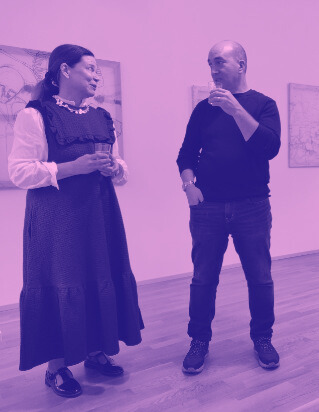
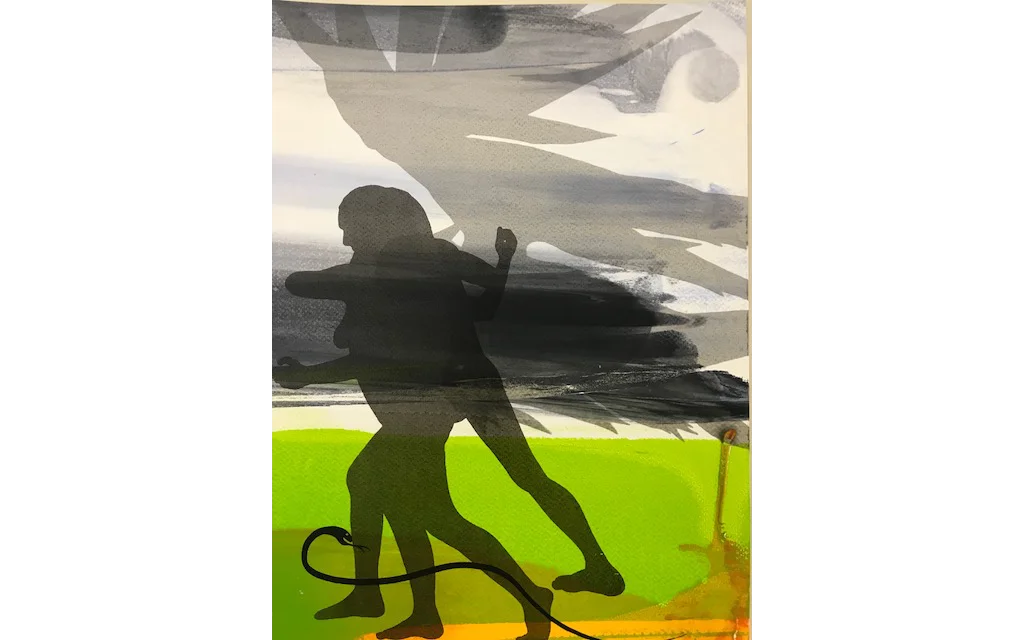
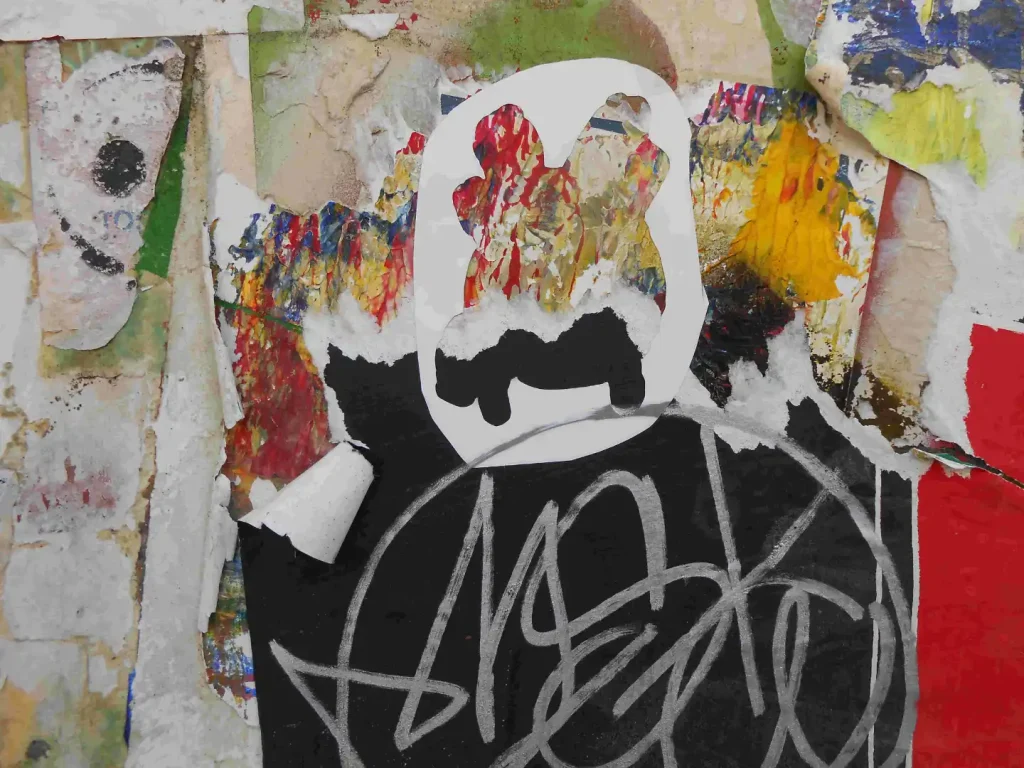
Top image: Heavy Sublimation, by Peter Hristoff, Everything and Nothing: Expulsion 2007-2016. Photo: Jean Vong.
Genealogy
to live in the world is to be a fragment of, if not a whole, then at least of a community, a history, a transcendence.
Allen S. Weiss: So many poets and artists are notoriously reluctant not just to reveal their influences, but to even admit that any influences exist. I find this to be the height of arrogance and hubris, for to live in the world is to be a fragment of, if not a whole, then at least of a community, a history, a transcendence.
In the end I cannot accept that
The whole cannot be held in a fragment.
[If, 10]
Perhaps the only way to escape the anxiety of influence is through the foreclosure of the symbolic, which was the case of Antonin Artaud during his years of madness. Fully conscious of his poetic genealogy – Poe, Baudelaire, Nerval, Lautréamont, Rimbaud, Nietzsche, all poètes maudits like himself – he found his poetic voice by suffering a gnostic curse, first losing not just poetry but all language in year upon year of madness, delirium, aphasia, during the death-in-life he suffered incarcerated in the psychiatric asylum at Rodez. There, in a theological struggle to the death, he renounced all human genealogy – as when in the funereal Ci-gît he proclaims that he has no papa-mama – and all theological transcendence, replacing a malevolent god by a pathological self as the source of creativity, thus becoming the origin of his own self and his own poetry. In doing so he transformed French poetry and the French language itself. Short of that, I do not believe that a poet can escape influence, or would even want to. For what is reading but influence!?
Might I ask for your own reflections on poetic influence, anxious or joyful, and for a hint at how you sense your own genealogy?
Leonard Schwartz: Well, I certainly agree to being “under the influence”, by which I mean beholden to the poetry that makes it possible for me to write – and deeply intoxicated by those sources! It is Jed Rasula in This Compost: Ecological Imperatives in American Poetry that spells “reading” as “wreading,” where reading and writing become a continuous act. By now I’ve appropriated that. I have also been talking for years about writing from the black of the page, meaning from language that is already there, not from the white of the page, which rarely exists. It turns out that in order to be color coordinated with the motif of “in black and white” you offer at the start of the conversation, (in other words, in Schwartz and Weiss in another tongue), for the space of this interview you must be the one who believes in the white of the page. Or in Year One of the Revolution. Or the white of the tricolour, since Schwartz writes from the black of the page. In his “Poem Beginning With The Word The,” Zukofsky cites particular sources for each line, and for the one he can’t, he writes that it was “quoted from the English.”
I have also been talking for years about writing from the black of the page, meaning from language that is already there, not from the white of the page, which rarely exists.
Iconography
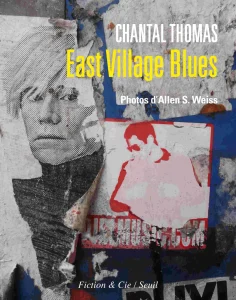
ASW: As I write these words, my most recent project arrived: East Village Blues, an autobiographical volume by Chantal Thomas for which I did the photography. I am particularly pleased with this book as an object (an argument among others for the continuation of publishing on paper), and I think of the cover image (a wall covered with images and graffiti, including a portrait of Andy Warhol) as a sort of visual epigraph for the tale. Perhaps I can appropriate one of your phrases out of context, and say that this is precisely and literally where,
“…street means event.”
[“Monuments to the Not Yet Lived,” in Words Before the Articulate, 37]
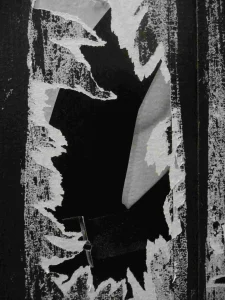
The event in question for me is the photographic capture of a moment and an image – an entire sensibility – which will have certainly disappeared by the time the image was published, a cruel tale of time (and neighborhood) lost. This goes back to the issue of the genius loci – who is often cruel, ironic, sarcastic, hermetic and mercurial – as it points to the ineluctable ephemerality of place. In this regard, I think of the cover image of A Message Back and Other Furors by analogy. I have always thought that one of the most poignant, heart-wrenching of all images is Pieter Breughal the Elder’s tiny painting of 1592, Two Monkeys, in the Gemäldegalerie (Berlin). We see two monkeys chained onto a deep window sill, with a view of Antwerp in the background where two geese fly over the horizon. This political and existential allegory of bondage and freedom is one for the ages. It instantiates your view, in Ear & Ethos, of poetry as simultaneously revelation of ideology and sounding of lament. Here I need compare the cover image of A Message Back and Other Furors, also depicting a deep window ledge or gateway, itself in ruins, beyond which we see Kabul in ruins. If the Breughal is a summit of poignancy, this image is beyond poignancy, touching upon sheer despair. I would like to ask about the relation between this image and the poems in the book. For in “The Ghetto of Gaza and the Angel of History” (The New Babel, 97-98) you contrast the imagery of Walter Benjamin with the textuality of Somaya El-Sousi, showing how they both work to the same effect in their historical function. And yet, even if an image is worth a thousand words, it is much, much different in what it communicates.
LS: You know for Ibn’ Arabi, and for the pre-Islamic Arabic poets before them, the poet’s primary topos is the edge of the ruin, lamenting the destroyed city or the departed encampment. Now we lament the ruins we ourselves have made. In Ear and Ethos and The New Babel I wanted to explore the Mid-East crises specifically, and the circumstance, incredibly, that the Palestinians are the Jews of the second half of the 20th Century and the foreseeable 21st. It is my great honor to have been able to call the Palestinian poet Somaya el-Sousi at her home in Gaza City, and air on the radio our conversations and poetry reading together, she in the original Arabic, me in the English translation, in the midst of the most unspeakable circumstances in her city. But she found the words.
By the way, the cover photograph for A Message Back and Other Furors is by an extraordinary artist Afghan-American, Lida Abdul, who splits time between L.A. and Afghanistan. She is a friend, but I haven’t seen her in years.
for Ibn’ Arabi, and for the pre-Islamic Arabic poets before them, the poet’s primary topos is the edge of the ruin, lamenting the destroyed city or the departed encampment. Now we lament the ruins we ourselves have made. In Ear and Ethos and The New Babel I wanted to explore the Mid-East crises specifically, and the circumstance, incredibly, that the Palestinians are the Jews of the second half of the 20th Century and the foreseeable 21st.
Poetry
ASW: Finally, I have to ask what, for you, is poetry. From almost all of your poems I could cull a phrase that would offer a definition, but given this range of possibilities no one of them would be adequate, and perhaps no such definition is even possible. For example:
…to order the chaos yet leave the astonishment blaze.
[“Form,” in Words Before the Articulate, 18]
Sometimes the genius of language is profound, sometimes silly: both can make for good poetry, as we know from the many juxtapositions of the sublime and the ridiculous in Victor Hugo, and as the Surrealists taught us time and again. This is clearly articulated in your dictum, “No ideas but in irony.” [“Book of J,” in Words Before the Articulate, 82], echoing, perhaps ironically, William Carlos Williams’ oft cited phrase from Paterson: “No ideas but in things.” The very beginning of Ear and Ethos offers one of the richest moments of your work concerning the constitution of a contemporary poetics, where, writing of the “particular transcendental,” you suggest a “mystery without belief” and an “ethics of ambiguity,” this couched in a “transcendental lyric.” This page alone could be the subject of a long interview, but might it not disclose the core of your poetics?
LS: Well, thank you, Allen. I am glad you arrived at that particular line of mine, for that particular purpose, in this particular conversation. To order the chaos yet leave the astonishment blaze. As you may have suspected, I don’t want to be definitional on this point, for fear of generalizing. Instead I will respond with two new fragments. The first of these references the aforementioned Merleau-Ponty:
An individual nuzzles
The cosmos
In another individual
And is carried away by that.
Wild logos means
The sensate thinks.
Or else, Allen, I can offer this:
Non-Self Identical
Half-meaning, because it calls into question
Its own methods for generating meaning.
Half-hawk, because the other wing
Flies in the void and is a shadow.
Demi-gods, among the boulders,
Recognizing one another, now and then.
Actualities, not identities
Ceaselessly unaware of themselves.
And a bench of stone
In an excited state.
[Actualities: Transparent, to the Stone]
It seems to me that at this particular moment what poetry needs to demonstrate, in as many ways as possible, is that consciousness is indeed non-self-identical.
About the authors:
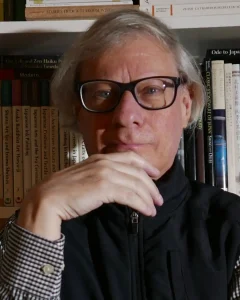
Allen S. Weiss is the author and editor of over forty books in the fields of performance theory, landscape architecture, gastronomy, sound art, experimental theater, and ceramics, most recently Unpacking My Library, or, The Autobiography of Teddy (K. Verlag); Illusory Dwellings: Aesthetic Meditations in Kyoto (Stone Bridge Press); Philosophie de Teddy (Éditions Gallimard). He directed Theater of the Ears (a play for electronic marionette and taped voice based on the writings of Valère Novarina), and Danse Macabre (a marionette theater for the dolls of Michel Nedjar). He has been the recipient of Fulbright, Japan Society, and Étant donné grants, and is Distinguished Teacher in the Tisch School of the Arts at New York University. For more information, visit https://tisch.nyu.edu/about/directory/performance-studies/93123442
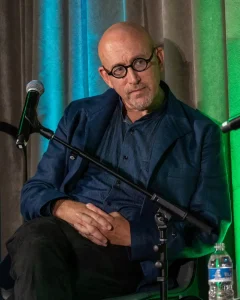
Leonard Schwartz is the author of numerous books of poetry, including, most recently, Flacofolio (with artist Heide Hatry), Actualities I: Transparent, to the Stone, Actualities II and III: Two Burned Hotels, and Actualities IV/V Comic Earth (2021, 2022, 2023, Goats & Compasses). Heavy Sublimation (Talisman House, 2018) and Salamander: A Bestiary (Chax Press, 2017), with painter Simon Carr, are also out and about. His work in poetics The New Babel: Toward a Poetics of the Mid-East Crises (University of Arkansas Press, 2016), is inclusive of poetry, essays, and interviews. Other titles include If (Talisman House, 2012), and At Element (2011), which explore the idea of an eco-poetics, as well as The Library of Seven Readings (Ugly Duckling Presse, 2008). He edited and co-translated Benjamin Fondane’s Cine-Poems and Other, with New York Review Books. From 2003 to 2018 he produced and hosted the radio program Cross Cultural Poetics. Many of his performances and readings can be heard at https://writing.upenn.edu/pennsound/x/Schwartz.php