

In Conversation with Tetiana Kartasheva
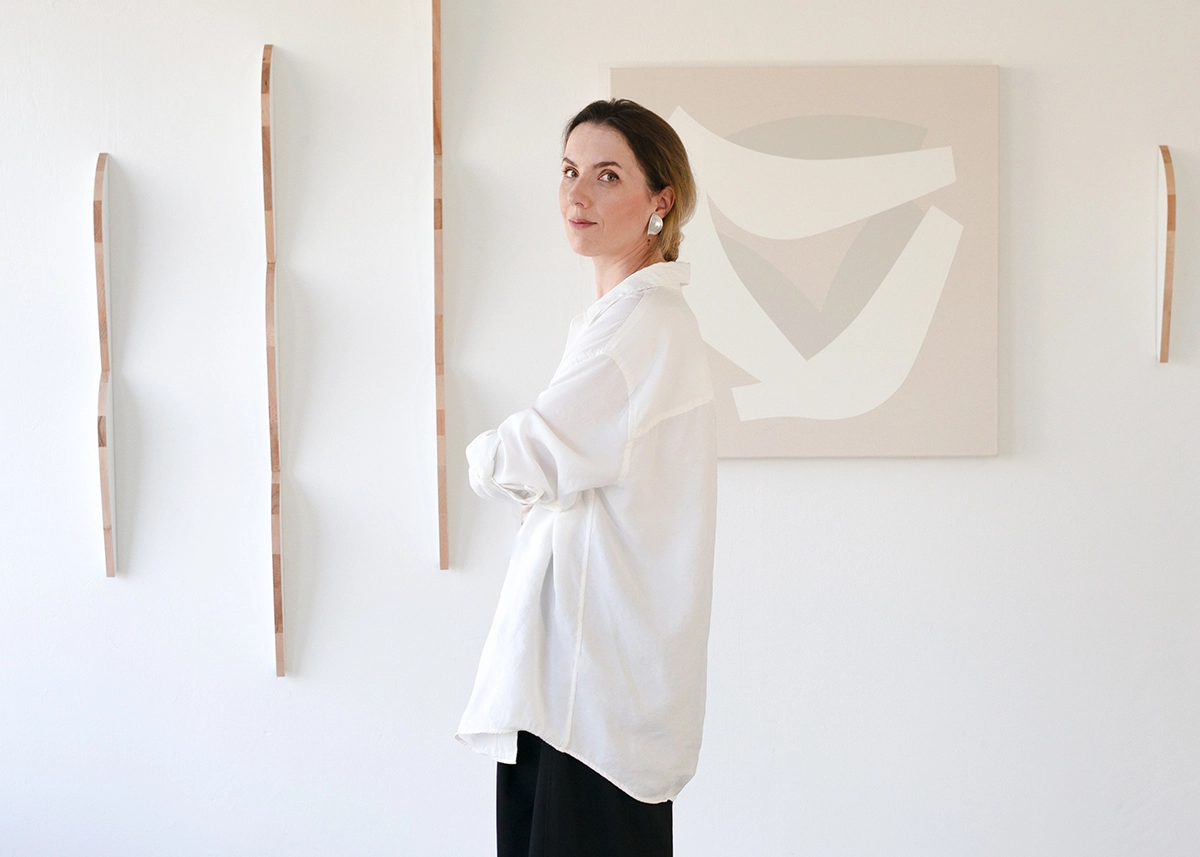
On a rainy Zurich morning, I met with the Ukrainian‑born artist Tetiana Kartasheva in her studio. As she laid out more snacks on the coffee table than we could eat, I sipped my tea and let my eyes wander around the various works on paper, paintings on canvas, and sculptural objects – each calling quietly and gently, for a closer look. Kartasheva identifies herself first and foremost as a visual artist, focusing on how forms can be combined into a visual syntax that shapes experience. As a result, her work is situated within broader questions of intentionality, chance, and embodied encounter, drawing connections to architecture, materiality, and the spiritual dimensions of art.
Kartasheva’s practice foregrounds slowing down as a mode of presence: a way of making space for reflection and inviting viewers into encounters that are both deliberate and fluid. In our conversation, Kartasheva shared with me her take on color, balance, and the contrasts between nature and architecture to construct environments that resist distraction and instead cultivate clarity, sincerity, and depth.
Ilknur Demirkoparan: Paring down and slowness come to mind when I look at your work. Can you tell me a little about your approach?
Tetiana Kartasheva: I believe that art, or at least the art I’m interested in practicing, is the kind that provides space for slowing down. I wouldn’t say “slowness” exactly, but slowing down. Paying attention, being present in the moment, and finding ways to step away from the anxieties. We live in a world saturated with images more than ever before. We have photos everywhere; we take pictures every day; and we watch videos constantly. There’s so much information. With my projects, I want to create points of encounter in settings that inspire clarity, invite people to stay longer, and encourage them to slow down.
ID: Would you say there’s a difference between slowing down and slowness?
TK: Yes. Chaos can also be slow-brewing. Slowing down, on the other hand, is about creating space in between things, space within yourself. You slow down to be present, to be aware.
Chaos can also be slow-brewing. Slowing down, on the other hand, is about creating space in between things, space within yourself. You slow down to be present, to be aware.
ID: So, slowing down is a deliberate act, whereas slowness can bear chaos. That’s an interesting distinction I did not think about. Is this the point of distinction your work mediates?
TK: Yes, in a way. I intend to create those spaces for introspection. I can’t fully control the outcome, which is also beautiful. I consider my immersive installations co‑creations. I set an intent and work with the space, visual language, and lighting, but it’s in the presence of people that the work truly comes alive.
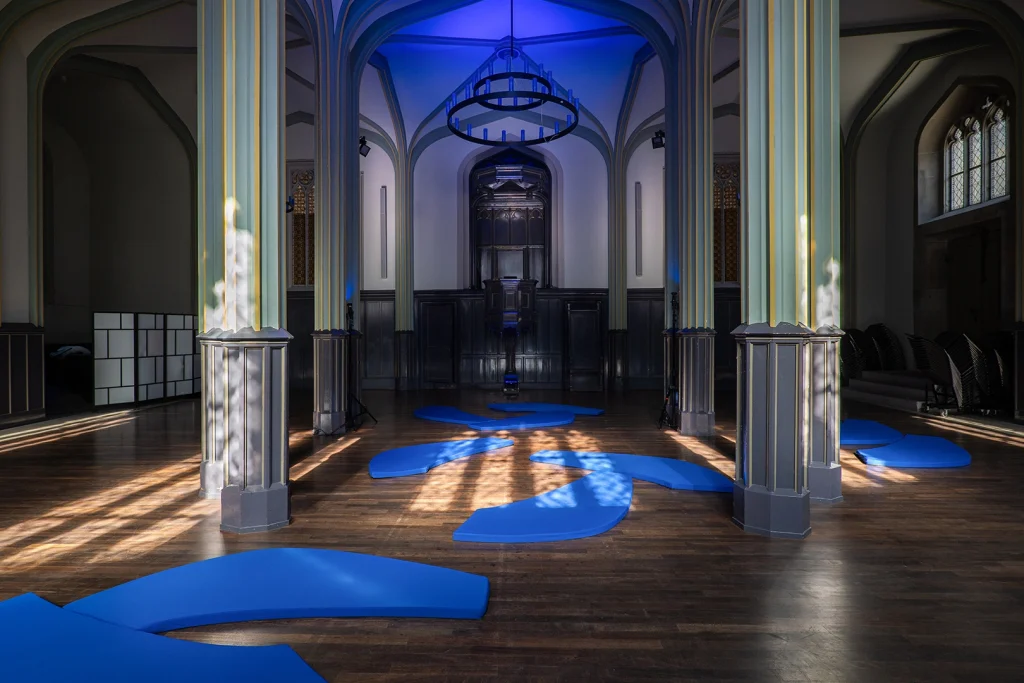
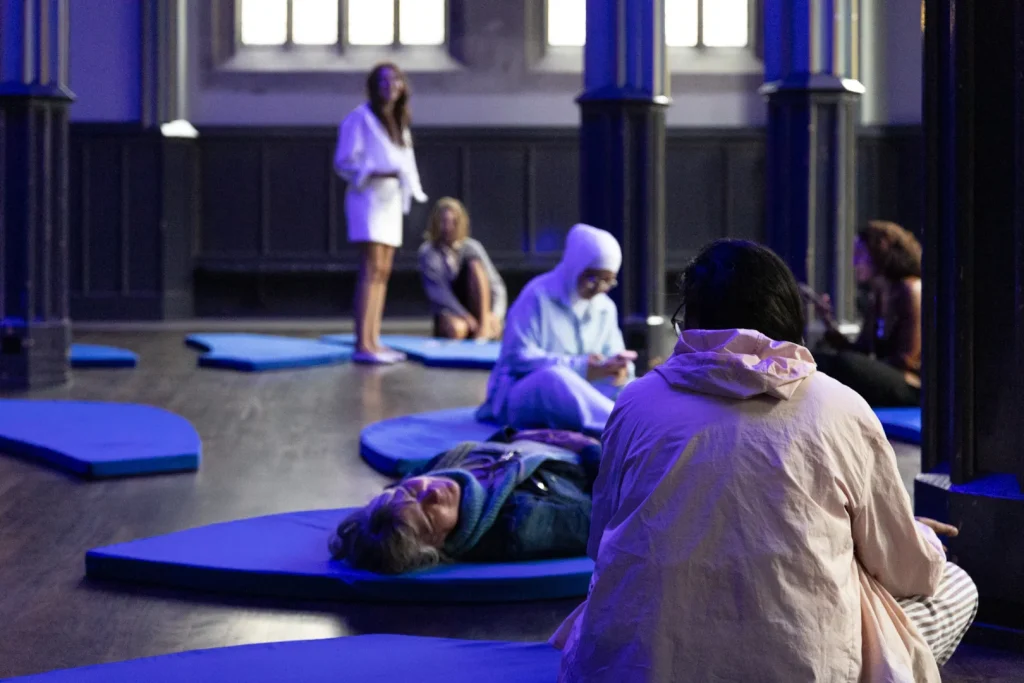
That was the case with the project, The Meeting Point, I did recently at Kulturhaus Helferei with curator Anastasiia Biletska. I had this setting of a historic chapel to work with, and my intention was to create a space of encounter. The mission statement of the institution is “to bring people together, regardless of their origin and their gender,” and I wanted my installation to reflect that openness.
We organized a series of events to activate the space. The installation encouraged visitors to stay, lie down, sit, and spend time there, and it worked even better than we hoped. People just passing by were coming in, staying for a while, and starting conversations. It was beautiful.
ID: Your use of color is also selective. It reminds me of the distinction you made between slowing down and slowness: the latter involves deliberate decision-making and intent. Maybe “control” isn’t the right word, but “intentional” is.
In your paintings, the canvas often feels raw—sometimes just a clear gesso in the background, with two pale colors, or stark contrasts like black and white. In the Helferei installation, you flooded the space with blue light, extending it into the cushions as well. Are there reasons behind your choice of colors or the minimal palette?
TK: I think in shapes, not in colors. For me, it feels natural to work in monochrome. At the same time, I see colors as a force of nature. They carry meaning and impact. If I don’t have a clear reason to use a color, I don’t use it. I usually begin with silhouettes and shapes, on the surface or within the space. Later, as the project develops, I intuitively choose colors if they add something.
For example, in the chapel at Helferei, the project was about going inward. The deep blue emerged as the natural choice to activate the space and draw people in. Many entered simply because they saw the blue light from the outside, and then found themselves immersed within it. For me, blue is associated with spirituality. But color is subjective; everyone brings their own associations. I can only set the intent and see how it unfolds. I usually use muted, opaque colors to create a sense of tranquility.
ID: So color has more to do with how you respond to a particular piece or installation, rather than any symbolic meaning, because those change anyway. That makes me think that, while your work is very intentional, perhaps there is quite a lot of room for chance. Or perhaps it’s a game of balancing intentionality and chance?
TK: For sure. I like to think about the concepts and read on the topic for upcoming projects. I make sketches and collages and plan each detail. If it’s an installation, I build models of the space to see how I might stage it. I go inside the space to experience the scale, hear the sound, and sense what I want to create there. It’s a long process of contemplation and preparation.
But at some point, I move into the production phase, and that’s the moment for experimenting and letting go. I’ve learned not to be attached to the outcome I imagined, but to follow the natural progression, to risk failure, and now and then to create something completely different from what was initially planned.
As you say, it’s a game of balance. In each work, I try to find the right visual equilibrium until it feels complete. Over time, I’ve developed a sense of where I can plan and where I need to let go.
Exhibiting the project adds another level of complexity. Things might not go as intended. People may perceive the work differently or interact with an installation in unexpected ways. And I welcome that.
ID: Can you tell me a little bit about the architectural references in your work?
TK: Architecture and architects such as Tadao Ando and Peter Zumthor inspire me greatly. The way they create spaces with the aim of shaping experience as an embodied encounter: what happens when you enter a space and feel it? That’s something I’m very interested in.
I find it fascinating how architects work methodically and with deliberation. Architecture is human‑made, civil, and structured, while nature is free and ungovernable. For me, architecture stands in contrast to nature, and yet the most beautiful moments happen when the two come together: geometric forms against organic ones, something fixed alongside something fluid.
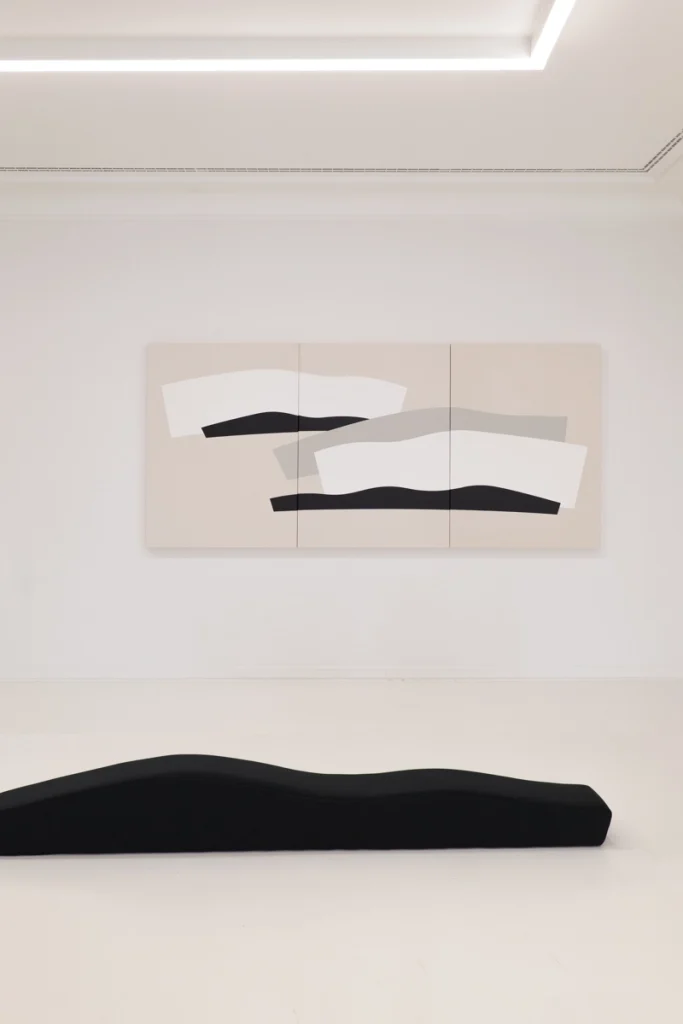
I encounter these contrasts every day, and they emerge in my work. But I don’t use direct references. I’m more interested in how this overlapping of natural accident and perfection of right angles can be employed within my practice. For example, a recent work, exhibited at Helmhaus, is a painting called Landscape: Illuminated. It represents a symbolic place where you can encounter yourself and recall the moment of clarity. I also extended it with an object positioned in front of the painting so that, when you step toward it or sit on it, you become part of the scenery.
I like to relate to my process as constructing something—building up. I value the intentionality of architecture, but I also allow for fluidity and chance, like in nature.
ID: So then, architecture is not so much a reference, but an approach?
TK: Well, yes. I like to relate to my process as constructing something—building up. I value the intentionality of architecture, but I also allow for fluidity and chance, like in nature. But nature isn’t entirely random; it has its own logic. We constantly encounter patterns and symmetries, though they’re slightly varied, never uniform. I carry this principle into my art: when I repeat shapes, they’re placed differently, never exactly the same, even if I try.
Architecture is calculated and rational, yet it also provides space for human expression. And of course, many architects themselves take inspiration from nature.
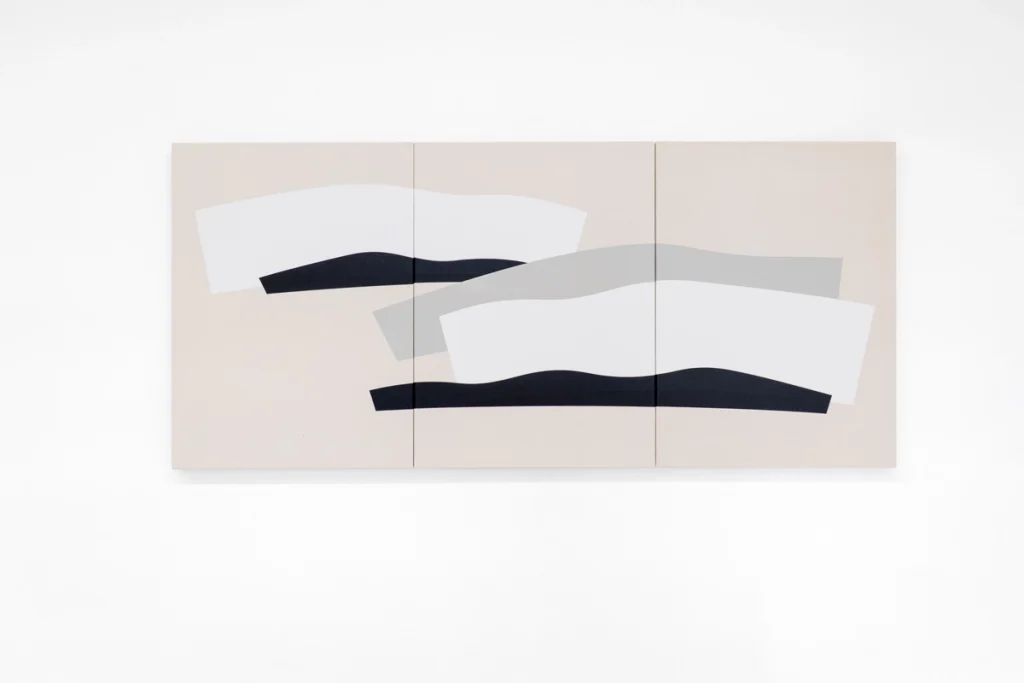
ID: The way your work invites people seems very straightforward. Your large organic forms are immediately noticeable; you see the whole form, all at once. They sit atop clear-gessoed backgrounds. The substrate is also immediately revealed. They are exactly what you see, and you see all of it immediately. But if you choose to spend more time, there’s more to discover. This reminds me of Rumi’s phrase, “come as you are,” as a sincere invitation. Your work carries that spirit of generosity: it presents itself openly at first glance, and then it’s up to the viewer to spend more time. There’s certainly more beneath the surface, but the simplicity isn’t deceptive. It’s layered, subtle, and generous.
TK: Thank you. Very observant of you. I believe art can have a spiritual function, addressing very deep needs. I relate to art much the same way that some people relate to places of worship: it can transmit certain states, and it can invite people into those experiences, create connections, offer solace, or provide company.
About the Artist:
Tetiana Kartasheva (b. 1989) is a Zurich-based artist working with abstraction and spatial experience. Her practice explores the emotional and psychological resonance of form, often addressing themes of presence, memory, and belonging. Through simplified forms and a restrained palette, her minimalistic paintings, graphic works, and installations create timeless, meditative environments that invite introspection.
To learn more about Tetiana Karthasheva and her work, please visit her website at: https://kartasheva.com/

ilknur Demirkoparan
ilknur Demirkoparan (b. Ankara Türkiye) is a Turkish-American artist whose research-based interdisciplinary practice spans painting, installation, sculpture, digital media, and creative programming to explore identity and memory through image-making, dissemination, and repetition. Demirkoparan is also the founding director of the MinEastry of Postcollapse Art and Culture. She lives and works in Zurich, Switzerland.