

Building Solidarity: Curating and Architecture in Zones of Conflict
Authors: Maya Bamberger and Gülistan Kenanoğlu
Curator Maya Bamberger hosts curator and architect Gülistan Kenanoğlu to discuss how architecture, as a spatial and social practice, can expand the field of curating in conflict zones.
Focusing on the exhibition Divine Violence / Jin, Jîyan, Azadî (ژن، ژیان، ئازادی), curated by Kenanoğlu at Apexart, September 13 – October 26, 2024, they explore the challenges of curatorial engagement with violence and discuss strategies to evade its reproduction, romanticization, or fetishization— building trust, friendship, and solidarity.
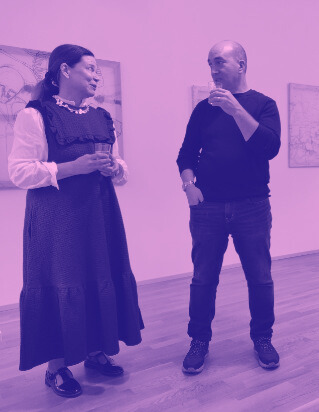
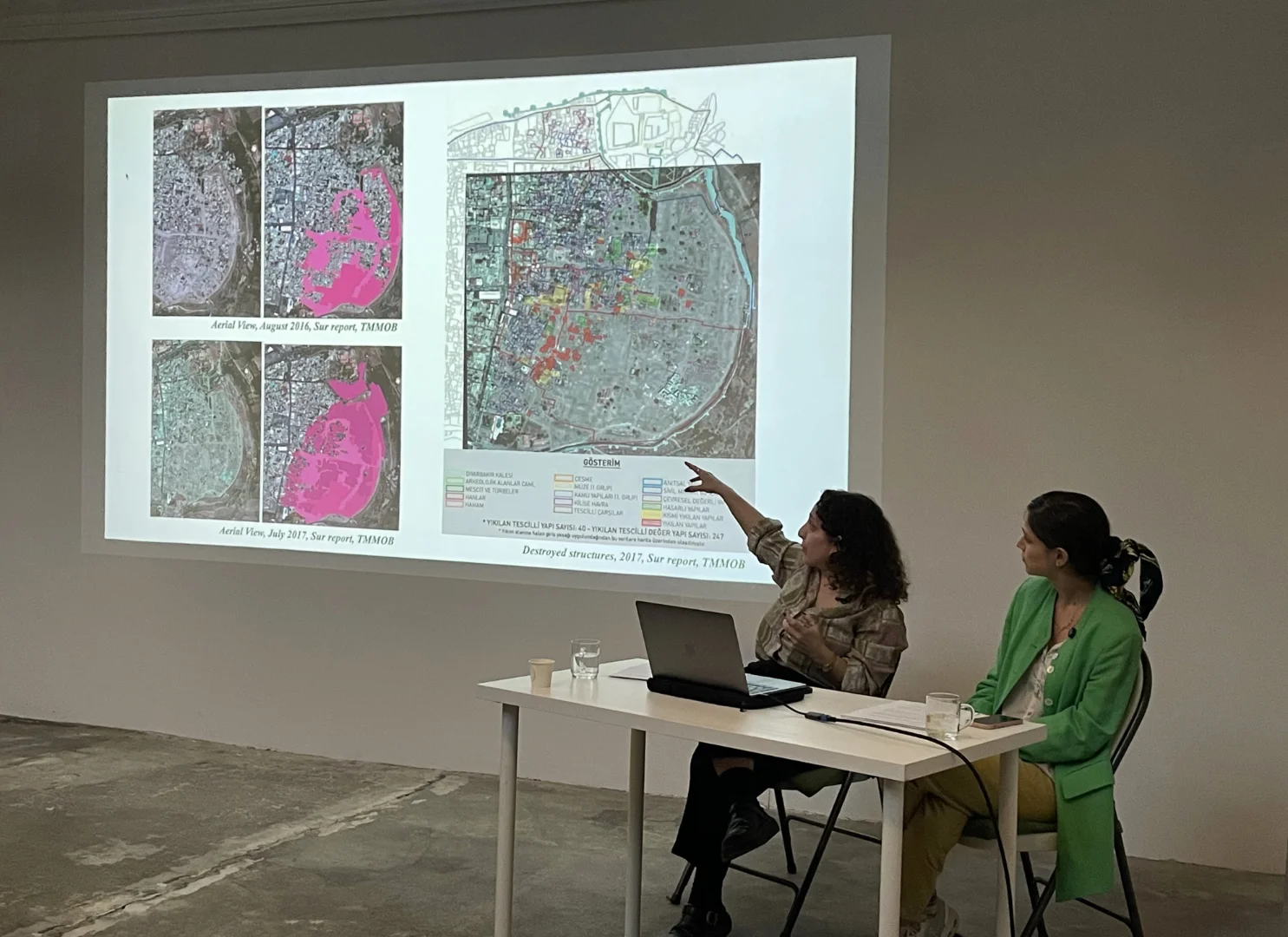
This conversation has emerged from a series of rehearsals and ongoing exchanges, and it continues to unfold beyond this publication. One of its iterations took place in front of an audience at Residency Unlimited in New York on April 1, 2025.
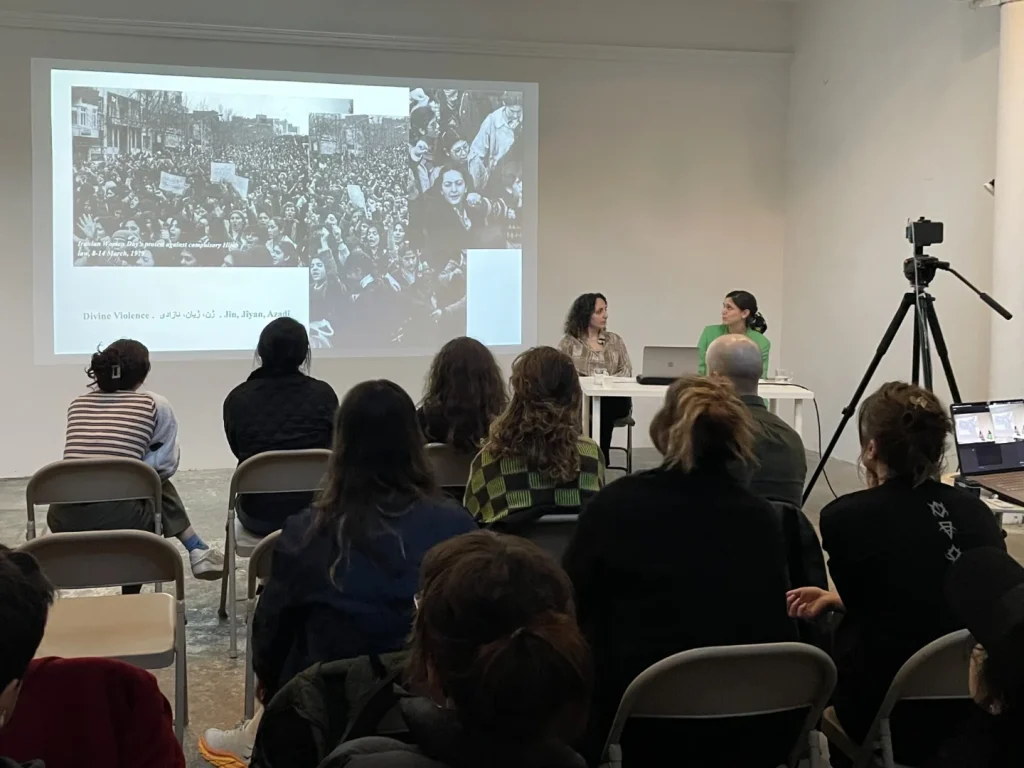
Maya Bamberger: We first met here, at Residency Unlimited, New York, in October 2024. As curators working in the Middle East, in regions marked by violence and conflict, we immediately recognized a shared language, including a shared interest in the curatorial as an expanding field—one that is shifting its role in response to global crises. Naturally, we started talking about the dilemmas and limits we face in our work. You suggested opening this conversation to the public. I’ll admit—I hesitated. Coming from Israel during these atrocious times, I keep asking myself how to be an actor in the field without reproducing the very structures of violence I wish to resist. As Saidiya Hartman asks, how might we “revisit the scene of subjection without replicating the grammar of violence?”1
How do I avoid being complicit in my country’s actions? How do I resist binary categories while navigating a polarized world? I’ve tried, and continuously failed. What I do know is that it’s time to listen and learn from other geographies and histories. That’s why I’m engaging with you in this conversation— to learn from your practice and to think together about what architecture might teach us about curating in the aftermath of destruction.
While preparing for this conversation, I realized I am addressing an imagined audience, not just a critical one, but an audience that already hates me. I found myself talking defensively.
But that’s not the conversation I want us to have.
So I want to say this—to both of us: What if we speak to an audience that already loves us, as we are all already in solidarity?
As I wonder if we’ll ever be able to heal from what is currently happening, I want to begin with the concept of healing. What do you mean when you speak about healing in the context of architecture and curating?
I keep asking myself how to be an actor in the field without reproducing the very structures of violence I wish to resist.
Gülistan Kenanoğlu: Thank you for this nice introduction. I’ll start by sharing a bit of my background. In the early 2010s, with the effect of the Arab Spring and the war in Syria, the east and southeast of Türkiye had gone through a massive urban warfare, countless curfews, human rights violations, and destruction. As a local to Diyarbakır, I experienced this process first-hand. After the conflict ended, a recovery process started in the region, and local art institutions organized a small workshop and invited art practitioners and researchers from Türkiye to discuss the current situation. In one spontaneous conversation with an artist friend, I asked: how do art making and artistic gatherings open ways for healing? Is it even possible to heal?
These destructions, as Martin Coward points out, are not only against the built environment, resulting in urbicide2, but they also destroy the communities’ spatial belonging, identity, and social fabric. After such a conflict, it is not so easy to recover and organize gatherings. Even random gatherings on the streets can be perceived as political gatherings in the post-conflict atmosphere of the region. So, activating the art scene in the region may ease the process of getting together and offer a safe zone to discuss, share, and heal.
MB: In my experience, there are artistic projects that emerged in Israel after October 7th with the intention of healing, but the healing is directed solely towards a specific part of society. In your context, when does art truly heal, and when does it only heal the deeply broken infrastructures, offering the illusion of change while leaving deeper injustices intact?
GK: Healing, by its very nature, has a structure that tends to those it promises to heal. Artistic and curatorial projects, produced immediately after a traumatic event, might serve a specific group, rendering larger structural injustices invisible. Here, the curatorial shifts its implications, positioning itself within a terrain of ethical and political responsibility. I see curating as a platform to listen to others’ stories and allow sharing and exchange, rather than solely acting as a transmitter of brutal narratives in atrocious times. This platform should not only document current history, but also renarrate and amplify marginalized and omitted voices. The inclusion of local actors directly affected by the conflict in the curatorial process determines whether art can truly play a transformative role. So it’s not just about pointing out the cracks, but also thinking about how to get through the cracks together—practicing collective repair, designing practices of mutual care and solidarity.
MB: It was eight years after the destruction that you were able to touch these things again in your curatorial work. Right now, as horrible things are currently happening, I feel the urgency to act, but I also feel paralyzed—by grief, by lack of perspective, and especially by identity politics defining who is allowed to speak and the us vs them paradigm dominating the field. What allowed you to look back and bring that moment into your curatorial work?
Healing, by its very nature, has a structure that tends to those it promises to heal. Artistic and curatorial projects, produced immediately after a traumatic event, might serve a specific group, rendering larger structural injustices invisible.
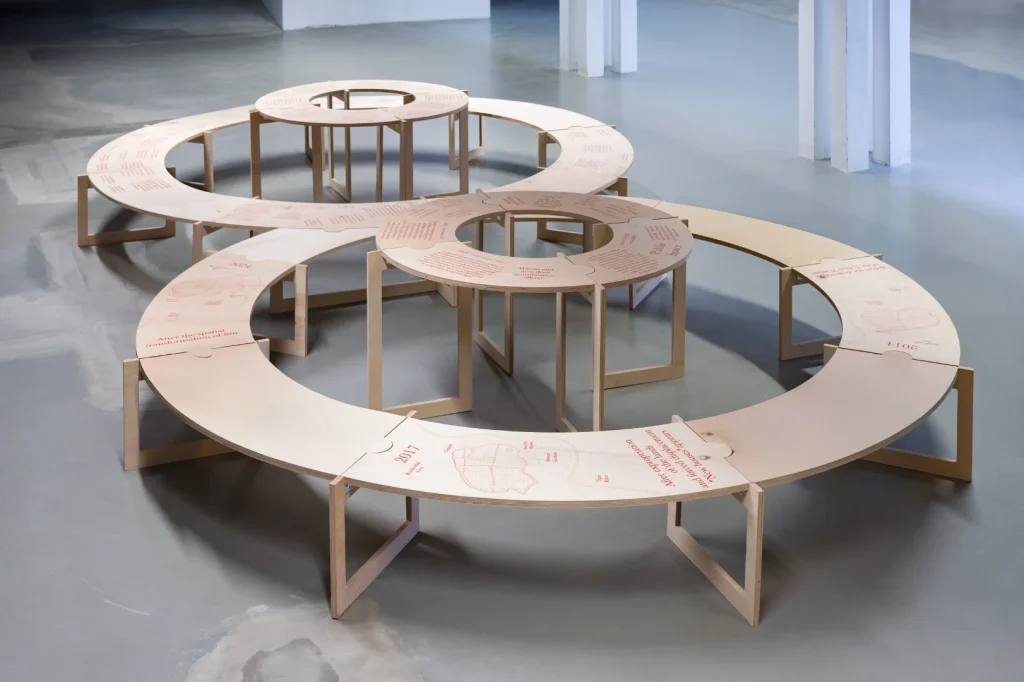
GK: As a curator and architect living in Diyarbakır, I wanted to understand the post-conflict situation of the region, but it was not so easy to react immediately. After eight to nine years, in 2023, I did an eight-month-long fellowship at BAK in Utrecht, Netherlands, and IKSV in Istanbul, Türkiye, to work on urban transformation of the Sur region and its socio-political and economic effects on the public in post-conflict Diyarbakır. Conducting this research away from Diyarbakır gave me the necessary critical distance to move beyond the emotional weight and internal hesitations that had delayed this inquiry, allowing me to transform these conversations and reflections into a concrete project, Expropriation and Displacement. I used maps, photographs, and testimonies from residents. Talking to locals—many of whom were friends or friends of friends—helped move the research from theory to lived experience.
One thing that stayed with me was something a friend said. I was criticizing the gentrification, privatization, and violence of it all. But he said, “At least now we are able to be present in public again without the fear of being victimized; it was not always safe to be on the street.” That statement completely shifted my perspective. It showed me the importance of staying in touch with the people who live through these transformations. When I approach a region, I do a site analysis to reveal tacit knowledge.3 However, the participation of local residents makes the research grounded in lived experiences.
MB: That brings me to your project in Iran. You were deeply connected to Diyarbakır and rooted in that context, but what drew you to work on something happening in a different geography? And what gave you a sense of permission, or perhaps responsibility, to engage with a context that isn’t your own?
GK: After working in Sur region of Diyarbakır, I wanted to explore and learn from different geographies facing different forms of oppression and violence. As a Middle Eastern country, conflicts in surrounding countries affect Türkiye. I know many Iranians who migrated or flew to Türkiye to seek a new life. We were talking about the situation in Iran, often informally. Over time, these conversations shaped another narrative in my research. I had the opportunity to work with Apexart in New York, and it became a chance to turn this research process into an exhibition.
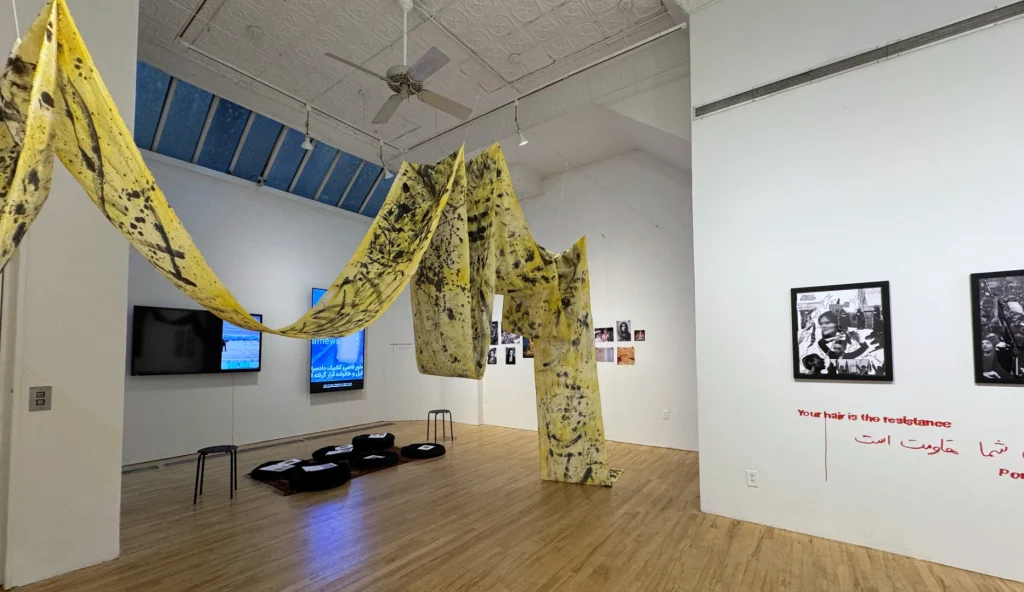
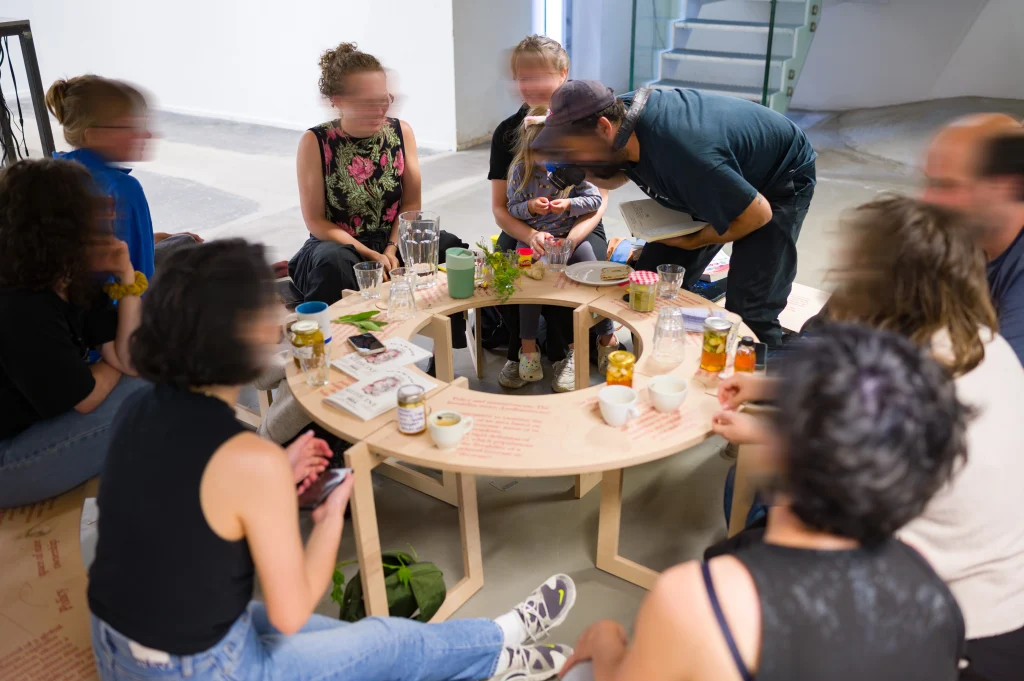
Divine Violence brings people together to share stories and produce knowledge collectively. By using architectural tools, analyses, field research, and community partners, I believe I detached the threat of fetishizing the women of Iran from telling their stories collectively.
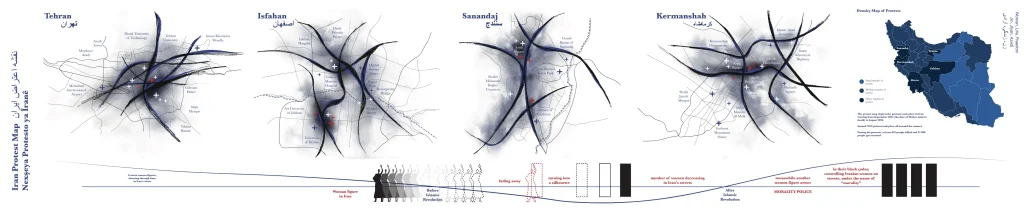
Divine Violence exhibition came to light as a result of extensive research, conceived around Jin, Jiyan, Azadî,4 situating the discussion within post-revolutionary Iran to today. Rather than telling the stories, it re-narrates Islamic feminist history. I worked with an artist/architect and a lawyer to examine the legitimization process of femicide in Iran through various fragments. Focusing on the aftermath of the evacuation of women from the streets, I tried to examine the spatial transformation of public spaces in Iran through patriarchal forms and Islamic regime.
We started with historical and archival research and dove into interviews, small talks, and spontaneous conversations to have a better understanding of the situation in Iran’s streets.
We then presented many photographs from the streets of Iran and anonymous graffiti drawn on the walls, which tell the stories of women in an uncensored way. With the lawyer, we did detailed research on how the country was prepared for the Islamic revolutions. To understand the scale of the uprisings against the patriarchy and the regime, I worked on a density map for protests in the country. Before conducting research in the streets, I created a narrated map of the city to show and contextualize significant public spaces where collective action takes place. For example, with the rising number of morality police in Iran, women are being faded away from the streets of Iran, turning into silhouettes. Day by day, public spaces are becoming more patriarchal as spaces where femicide becomes legitimized.
MB: There’s a risk in turning a person into an exhibition without asking them.
GK: Curating an exhibition on a politically challenging situation is an act of solidarity. In that sense, it is important to build a network of trust and friendship to be able to continue working on such a topic. I always ask myself: Where do I position myself in such research? Speaking of Divine Violence, Mahsa Amini was not the main subject, but with her unfortunate death, I found the courage to do something about the current situation, which I was already interested in and doing research on. Divine Violence brings people together to share stories and produce knowledge collectively. By using architectural tools, analyses, field research, and community partners, I believe I detached the threat of fetishizing the women of Iran from telling their stories collectively.
MB: How do you suggest we might apply this kind of site awareness to our daily lives?
GK: One useful practice is to slow down and pay attention to the ephemeralities of daily life. That’s what I do—notice the things that are easy to miss. Take a walk like a flâneur,5 observe closely. Often, the first thing that catches your eye is the thing you’re already searching for.
MB: I keep thinking about who is allowed to tell a story. Maybe the better question is not whose story, but why are you telling it? What is your motivation?
GK: We try to find a way to tell our story through the narratives of others. My main motivation is to create a platform that empowers audiences to share their own stories. Coming from Türkiye to New York, I noticed many people don’t really know what’s happening in other parts of the world. This kind of research allows us to connect across regions, to talk about violence and healing in many forms—just like you and I did.
MB: Yes, I feel that too. I still have more questions than answers. I don’t trust people who say they have the answers. So I value this space of holding questions together.
GK: That brings us back to the title: Building solidarity, friendship, and trust. Understanding one another comes before the action.
To conclude:
“Solidarity does not assume that our struggles are the same struggles, or that our pain is the same pain, or that our hope is for the same future. Solidarity involves commitment, and work, as well as the recognition that even if we do not have the same feelings, or the same lives, or the same bodies, we do live on common ground.”6 – Sara Ahmed
Thank you for creating this engaging space.
MB: And thank you for your honesty and bravery.
- Hartman, Saidiya. “Venus in Two Acts.” Small Axe: A Caribbean Journal of Criticism 12.2 (2008): 1-14. ↩︎
- Coward, Martin. Urbicide: The Politics of Urban Destruction. Routledge, 2008. ↩︎
- Polanyi, Michael. “The Tacit Dimension.” Knowledge in Organisations. Routledge, 2009. 135-146. ↩︎
- Jin, Jiyan, Azadi (eng: Woman, Life, Freedom) movement defines emancipatory actions taken by women in the Middle East. Jin Jiyan Azadî originates from the Kurdish feminist struggle for freedom and gender equality against colonial domination and patriarchal oppression. ↩︎
- Benjamin, Walter. The Arcades Project. Translated by Howard Eiland and Kevin McLaughlin. Harvard University Press, 1999. ↩︎
- Ahmed, Sara. The Cultural Politics of Emotion. Routledge, 2013. ↩︎
About the authors
Maya Bamberger is an independent curator and learner based in New Haven, CT. Maya holds a MAS in Curating from Zurich University of the Arts, yet her main teachers are the artists she collaborates with. She approaches curating as a social practice, developing ways of being with art that resist its disciplining into art history. She works closely with artists to form temporary research communities that imagine and embody otherwise. As curator of RawArt Gallery, she curated numerous exhibitions and initiated the Shuttle Project for emerging artists. Her independent projects include, among others, Understandable Misunderstanding and co-founding and editing the inaugural issue of Shoket, a magazine for curating. She has participated in residencies such as Triangle, Residency Unlimited, and the School of Commons.
Website: Maya Bamberger
Gülistan Kenanoğlu is an architect, founder of the SB Arch Lab initiative with a Bachelor of Architecture, and an independent curator with an MA in Design & Curatorial Studies. Kenanoğlu’s work explores the complex relation of deconstruction and construction practices in the architecture of post-conflict cities by zooming into oriental studies and postcolonial theory. Further, she adopts a collaborative and participatory curatorial practice – exploring exposition and fetishism – going hand in hand with her architecture practice. Her works have been awarded several grants and exhibited at different institutions including; Residency Unlimited, Apexart Gallery, BAK (basis voor actuele kunst), and Istanbul Foundation for Culture and Arts (İKSV).
Website: SBARCHLAB