

The Past Is Alien, and the Future Is Uncertain: A Conversation with Kadir Kayserilioğlu
Kadir Kayserilioğlu is an artist who wears his heart on his sleeve. His work is tender, personal, yet deeply universal.
In this conversation, I sat down with the Izmir-based Turkish video artist to discuss his work and its recurring themes of estrangement from time, place, and the worlds we inherit. How does the past become alien? What forms of life persist within systems of control, surveillance, and violence? And what kinds of hope remain available in such times?
Moving between abandoned industrial landscapes, digital infrastructures, and dreamscapes, Kayserilioğlu reflects on how personal histories and collective realities intersect, producing narratives that are at once melancholic, speculative, and eerily resistant.
Ilknur Demirkoparan: The Past Is an Alien Planet (2021) was my entry point into your work. It was almost an hour-long piece, so I made myself some coffee and sat down at the kitchen table to watch. Something about your storytelling felt so sincere that I began to feel like I was getting to know you through that work. I could also relate to that sense of a lost past. We’re both Turkish; we’re both from Izmir, and that past feels a little alien to me now too.
Kadir Kayserilioğlu: I’ve heard many commentaries about that piece, but this is the first time I’ve heard an emigrant’s perspective. We’re both from the same country. We share the same history. What I’ve seen in Türkiye, you’ve seen too, as a child or a teenager. I don’t know exactly when you left, but I was surprised to hear that you feel the same way. I had never really thought about the story from this perspective because I’m not an emigrant myself, but you mentioning this makes me realize there are many ways the film resonates with different audiences.
At its core, though, the film is about the past.
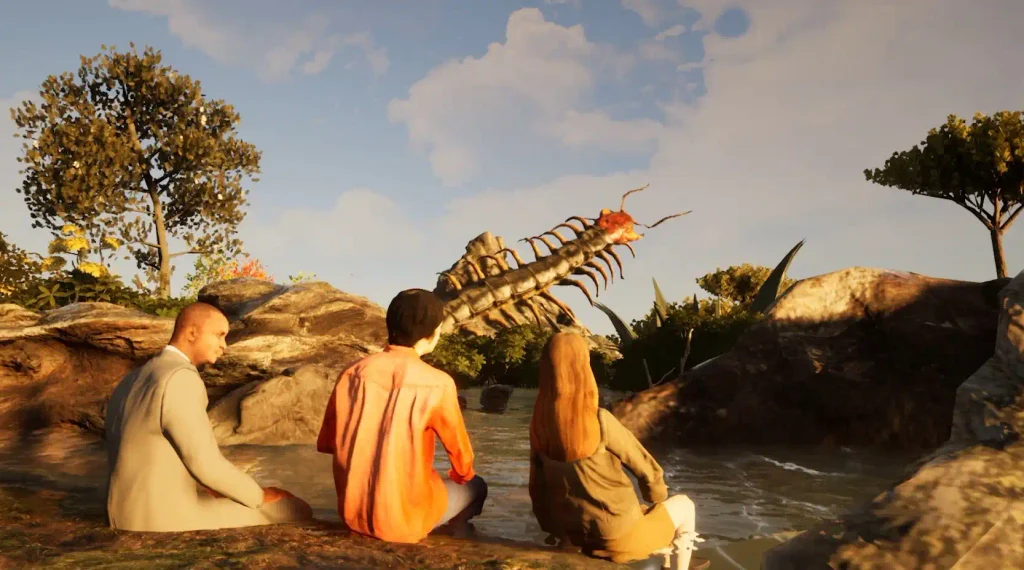
The title of the film, The Past Is an Alien Planet, comes from an article by Mark Fisher with the same title. Mark Fisher was a cultural critic who wrote about nostalgia, the past, capitalism, and capitalist culture. As far as I remember, that particular text was mostly about time travel in science fiction, but it was the title that resonated more with me. How does the past become alien? What causes this feeling? During the COVID pandemic, I thought about these questions constantly as I began designing the island that appears in the film.
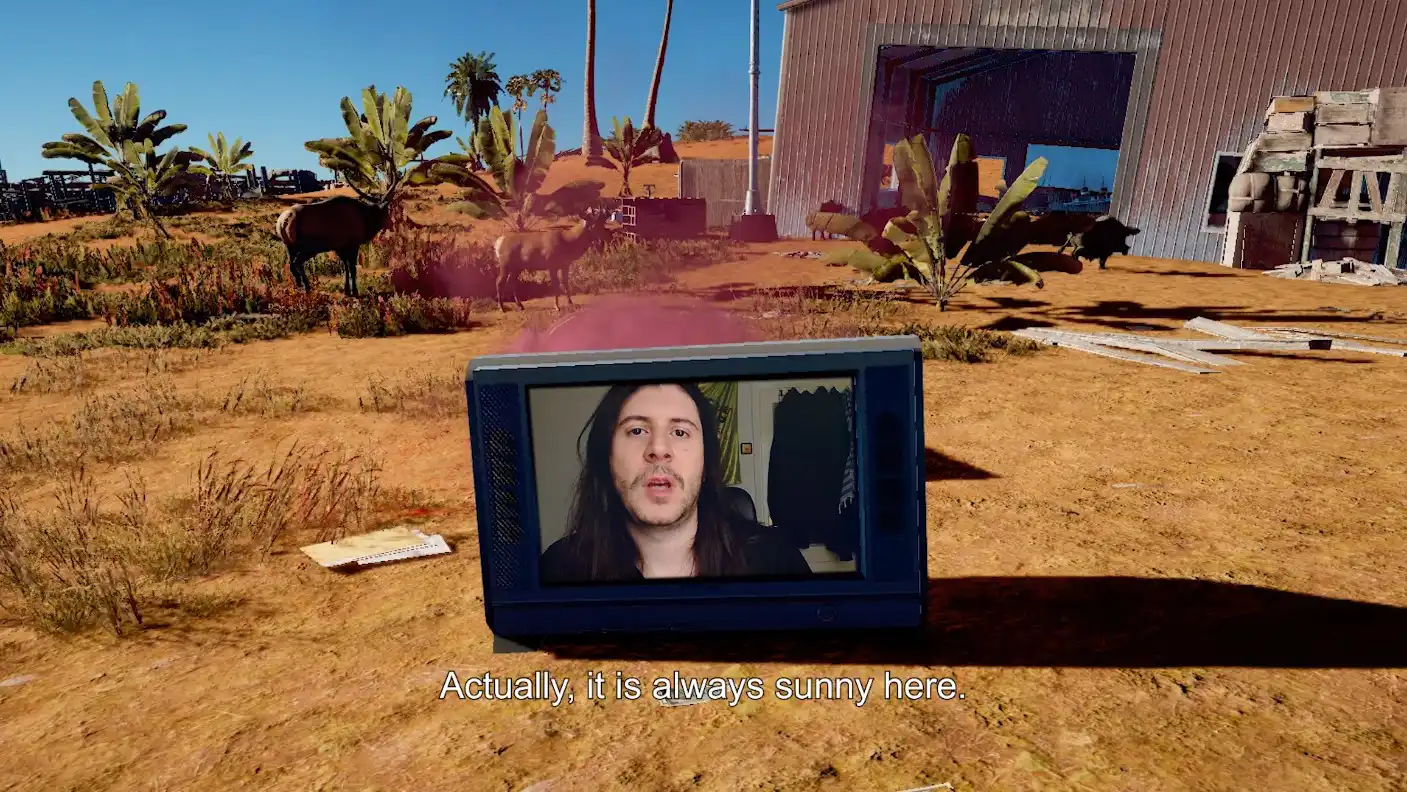
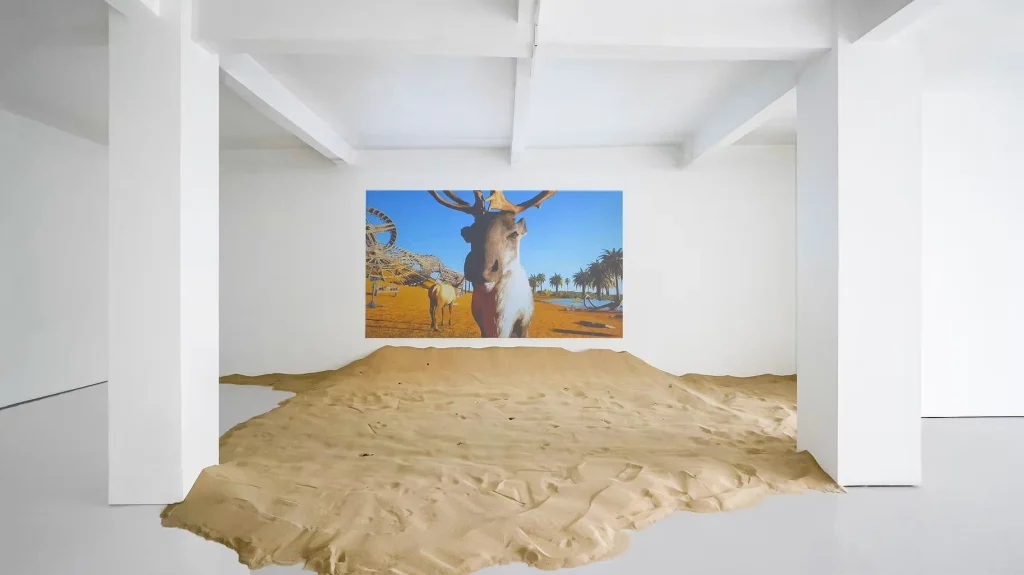
The island seems peaceful at first. The sun is always shining. The sea is clean. Animals wander freely. It feels calm and inviting. But at the same time, there’s something devastating about it. There are broken houses everywhere, and there are no people. Maybe they’ve abandoned the island. Maybe they’ve disappeared. Maybe they no longer exist. Maybe the world belongs only to animals now.
In that sense, it resembles the pandemic. Nobody is outside. Only animals remain.
It’s also a place where past, present, and future collide. You encounter objects from different eras existing side by side. There’s a mammoth skeleton and a crashed helicopter in the same landscape. Nothing quite makes sense chronologically.
Throughout the film, you see me appearing on television screens scattered around the junkyard. The island is full of broken objects, and the televisions are part of that landscape.
I started thinking of those screens as representations of the past. In a way, I’m already gone. You’re watching recordings of me. I’m not really speaking to you directly. I’m speaking to myself in the past, and you’re encountering that recording later.
I wanted those scenes to create a sense of nostalgia, but also something stranger than nostalgia. I wanted to create a voice that was coming from somewhere distant, carrying traces of life that’s no longer present. Everything in the film grows out of this strange relationship between memory and time.
I wanted to create a voice that was coming from somewhere distant, carrying traces of life that’s no longer present. Everything in the film grows out of this strange relationship between memory and time.
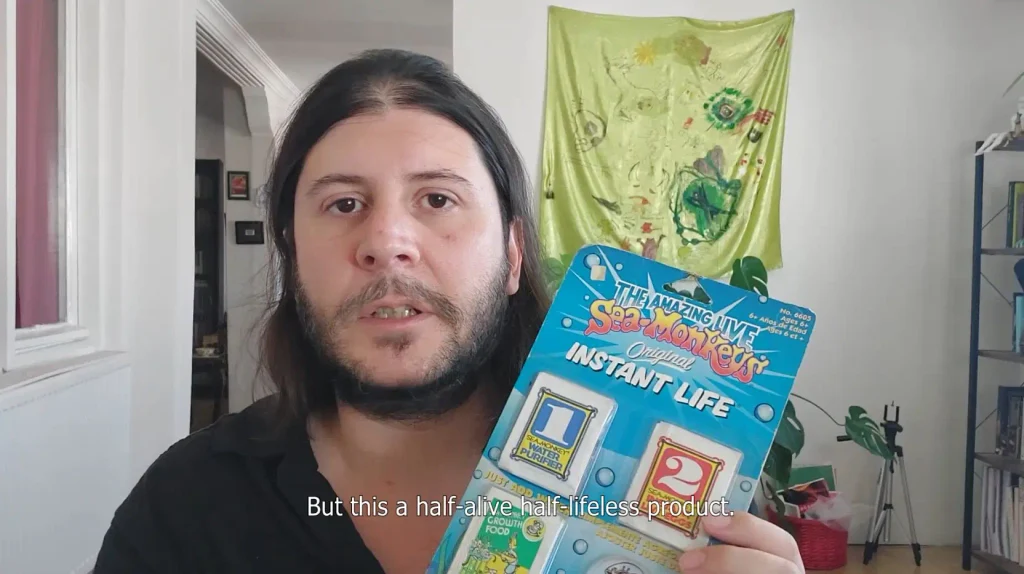
ID: In contrast, The Walls of Heaven (2024) explores the idea of world-building. In that piece, you, as the narrator, explain the etymology of the words “paradise” and “garden” while building a terrarium for Sea-Monkeys. As you continue to create this micro-habitat, the narrator’s thoughts wander between topics of weapons trade, surveillance technologies, and resistance. As I was watching, I kept asking myself: Am I the Sea-Monkey in someone’s terrarium?
KK: I was thinking about something like that. A world within a world, a system within a system. In each one of them, from the largest to the smallest, there are worlds inside worlds, like the satellites that orbit a planet. Nations are enclosed by borders; within nations are cities. And within those cities, we have smaller worlds of our own: we care for animals, build terrariums, and use digital software to simulate life.
This is what a “world within a world” means to me. Each of these worlds is guarded by what I call the walls of heaven. The phrase emerged as a way of describing places that appear safe and protected but are ultimately maintained through borders and systems of violence. Each one of these worlds is guarded by violence, by weapons, by structures of power.
According to Europe, Türkiye and other Middle Eastern countries are jungles. The implication is that to keep your garden, you must heavily guard it through techniques of violence. On a macro scale, this becomes dystopian: missiles fly above you, and those living within these borders are powerless. You cannot escape. You have nowhere else to go. You do not know what will happen in the future, or even a minute from now.
Our lives are monitored and guarded by forms of technological surveillance and violence. In a sense, these systems function like gods. That is what I was trying to address.
ID: Ah yes, I almost forgot! In the film, you include a clip from a speech by a European Union politician who describes Europe as a garden, and everything outside it as the jungle, warning that the jungle will eventually overgrow and invade the garden. We hear this kind of rhetoric all the time, yet I’m still in disbelief every time I hear it.
KK: Maybe the present is also alien, right?
ID: The present is alien. And maybe we are really estranged from our own present, isolated in our little terrariums.
KK: Yeah, that was the metaphor for me.
I started researching this work when Israel attacked Palestine. It was horrible. We were seeing the violence unfold on Instagram, on YouTube, across social media. It was horrible, but we couldn’t do anything to change or stop it. It felt completely desperate.
I used the garden as a metaphor to represent borders and control. At first, I wanted to create a film that was completely desperate, not just negative but hopeless, because that was my mood. But then I realized I didn’t need to do that. The world might be really bad, but I didn’t have to replicate that. I wanted to make something that carries some hope.
One day, while I was filming, I noticed a centipede in the terrarium. The centipede must have devoured everything, and when there was nothing left to consume, it left. The moss had rotted. Everything inside seemed dead. But one day, I found this tiny yellow bug. I remember thinking, oh, there’s still life happening in here. Maybe there were millions of other organisms there that I couldn’t see.
That felt like a way out of the dark narrative. You cannot stop life.
I wanted to focus on resilience at the end of the film.
According to Europe, Türkiye and other Middle Eastern countries are jungles. The implication is that to keep your garden, you must heavily guard it through techniques of violence. On a macro scale, this becomes dystopian: missiles fly above you, and those living within these borders are powerless. You cannot escape. You have nowhere else to go. You do not know what will happen in the future, or even a minute from now.
ID: At the end, you light a cigarette and ask, What’s the lesson learned from all of this? Watching the events unfold on our television screens, in a way, is like watching the world through the glass of our own terrariums. We look into other terrariums, other worlds, the ones being destroyed. We hate seeing what’s happening, yet we can’t do anything about it. We feel powerless. Without giving away the ending of your film, you ponder a totally unrelated act as your personal solace. At first, the ending comes across as a critique of the type of feel-good solutions, but the more I thought about my own bitter laughter at that conclusion, the more I realized that perhaps these unrelated and seemingly inconsequential acts of resistance are the very things that keep us from being completely alienated from our own humanity. Maybe that’s what keeps us hoping, and if hoping is the only thing left in our power, then hoping is what we must do.
This brings me to your other piece, 64 Years Before or After (2021), where you continue to explore themes of world-building, life, and layers of worlds within worlds. In this piece, the narrator has a dream where he sees three aquariums. One of them is dirty, and there’s hardly any life left in it. Another one is doing slightly better. There’s a moment when the narrator realizes that he’s in the dirtier of the two. And then there’s the third aquarium. The water is relatively clear, but the creatures living there are trying to leave. They’re watching the other two being destroyed, and even though they don’t necessarily need to leave, they think it’s inevitable that the same thing will happen to them, so they believe that leaving is the only plausible option for them.
KK: That piece is a collaborative project I made together with my artist friend, Ali Kanal.
When we started working on it, we were speculating about different things, including dreams. The dream in the piece isn’t actually one of our dreams. The text is an adaptation of a passage from Radio Free Albemuth, a Philip K. Dick novel.
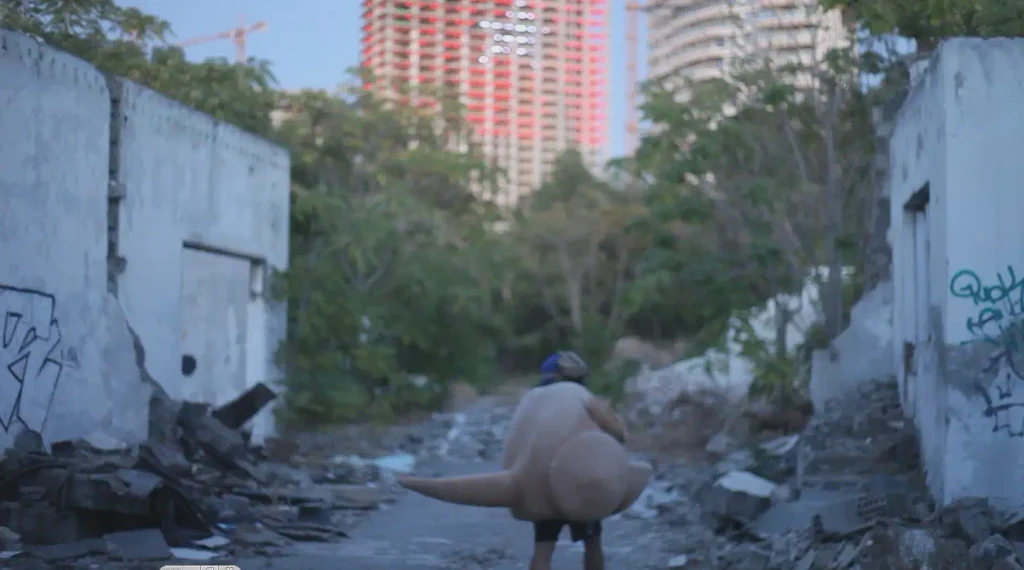
We wanted to use that text, but we weren’t sure how. We knew we wanted to make a video, but we didn’t know where to begin. Around that time, we were spending a lot of time in an abandoned Sümerbank complex in Türkiye.
Sümerbank was one of the early nation-building projects of the newly formed Turkish Republic, and one of the earliest examples of a state-sponsored industrialization project, aimed at rapidly rebuilding and sustaining a functioning private enterprise. But now it’s gone. Sümerbank no longer exists. Only the residential buildings remain, and those are abandoned as well.
The residential blocks are in decay, and the vegetation has completely taken over. It feels post-apocalyptic. At the same time, it’s incredibly quiet and peaceful. And because it’s so empty, it’s also a little frightening.
One of my friends found a strange costume there. You know the Nesquik kangaroo mascot? It was that costume. He cleaned it up and kept it, and eventually we decided to use it for the film.
We started imagining the character in different ways. Maybe he’s a dinosaur, because he has a tail. Maybe he’s a cosmonaut. Maybe he’s some strange interdimensional traveler. We wanted there to be a science-fiction atmosphere in the video.
The text I narrate in the video, as the character wanders around the abandoned site, can be understood as his inner thoughts. Maybe he’s thinking about the future. Maybe he’s reflecting on a world where everything seems exhausted, and life has almost disappeared, like the first aquarium in the dream.
We wanted to create a sense of confusion. Where are we right now? What timeline are we in? Is it about the past or the future? We left time ambiguous on purpose.
These are times of uncertainty in Türkiye. We don’t really know what’s going to happen. In a way, things have looked the same for twenty years, but at the same time, they keep getting worse, little by little, every day. And yet nothing ever fully collapses. Things appear routine on the surface.
When you can’t see what’s ahead of you, the past becomes blurry too. The uncertainty doesn’t just affect the future. It changes the way you understand the past as well.
That creates constant confusion, constant anxiety about the future. And I think when the future becomes so unpredictable, the past starts to become alien as well. More and more alien every day.
These are times of uncertainty in Türkiye. We don’t really know what’s going to happen. In a way, things have looked the same for twenty years, but at the same time, they keep getting worse, little by little, every day. And yet nothing ever fully collapses. Things appear routine on the surface.
ID: You just finished a new film, Ghosts in Google Street View (2026). Can you give us a little teaser?
KK: Of course. Technically, I would describe it as an experimental research project that combines desktop aesthetics, machinima, and footage I shot in real life.
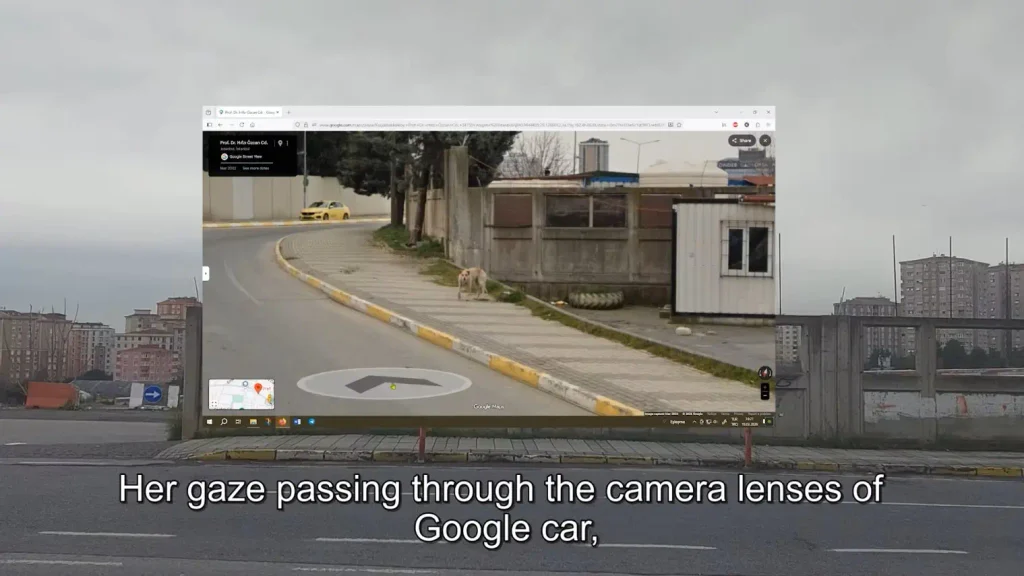
One day, I was using Google Street View, and I randomly came across a picture of a stray dog. It was an ordinary dog on an ordinary street, and there was nothing particularly special about the situation. But the dog’s look really affected me. This dog was looking directly into the camera placed on the roof of the Google car. And somehow, I felt that there was an indescribable amount of emotion in that look, at least for a human viewer. The first thing that came to my mind was Roland Barthes’ theory of punctum in his book Camera Lucida.
So, the film is basically about me trying to track the photograph’s exact coordinates to find the dog in real life. While searching, the film starts moving into different subjects: becoming-animal, colonialism, Google’s surveillance regime, and so on. I have always liked jumping from one subject to another, and I did the same thing here, but the dog remains at the center of everything.
There is also a very specific context here. Over the last two years, there has been a very aggressive social campaign, with quite violent language, around the decision to remove stray dogs from the streets in Türkiye. Today, it has become increasingly difficult to see any stray dogs. In a way, the film also carries some of the last traces of an older relationship between humans and animals in urban life. I really love animals, so making this work was actually quite emotional for me.
About the artist:
Kadir Kayserilioğlu is a Turkish video artist and experimental filmmaker whose practice spans machinima, documentaries, video diaries, and visual essays. His work explores themes of micro-history, speculative materialism, eschatology, and forms of collectivity. To learn more about Kadir Kayserilioğlu and his work, please visit his website at: https://www.kadirkayserilioglu.com/

ilknur Demirkoparan
ilknur Demirkoparan (b. Ankara Türkiye) is a Turkish-American artist whose research-based interdisciplinary practice spans painting, installation, sculpture, digital media, and creative programming to explore identity and memory through image-making, dissemination, and repetition. Demirkoparan is also the founding director of the MinEastry of Postcollapse Art and Culture. She lives and works in Zurich, Switzerland.