

Is There Any Room For Utopia After Utopia? The Utopian Impulse In Contemporary Art Projects In Romania
by Daria Nedelcu
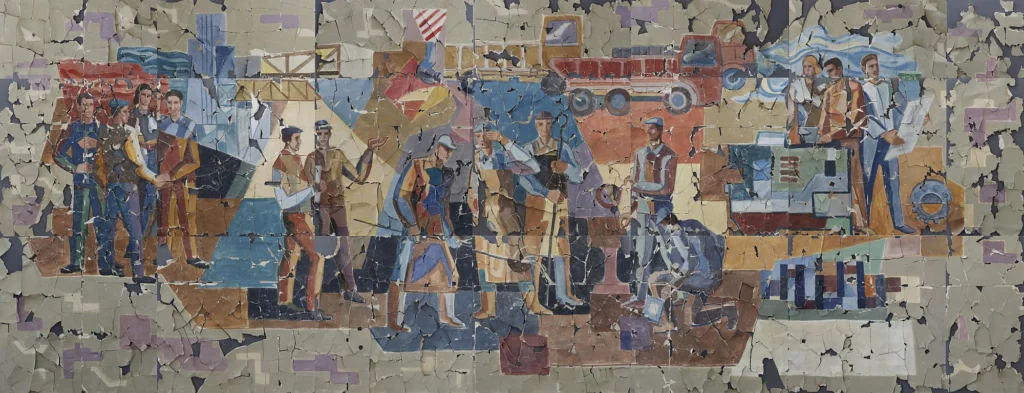
A large fresco depicts four groups of men, some engaged in labour while others observe and discuss the work in progress. Its narrative sequence is disrupted by ambiguous traces that traverse the surface of the image: deep fissures, subtle dislocations, and irregular fragments that compose a factory landscape of workers, industrial equipment and tools, held together by a field of differently coloured geometric shapes. Together, these elements foreground a dense glimpse of the past, one that emerges through the cracks of recent history.
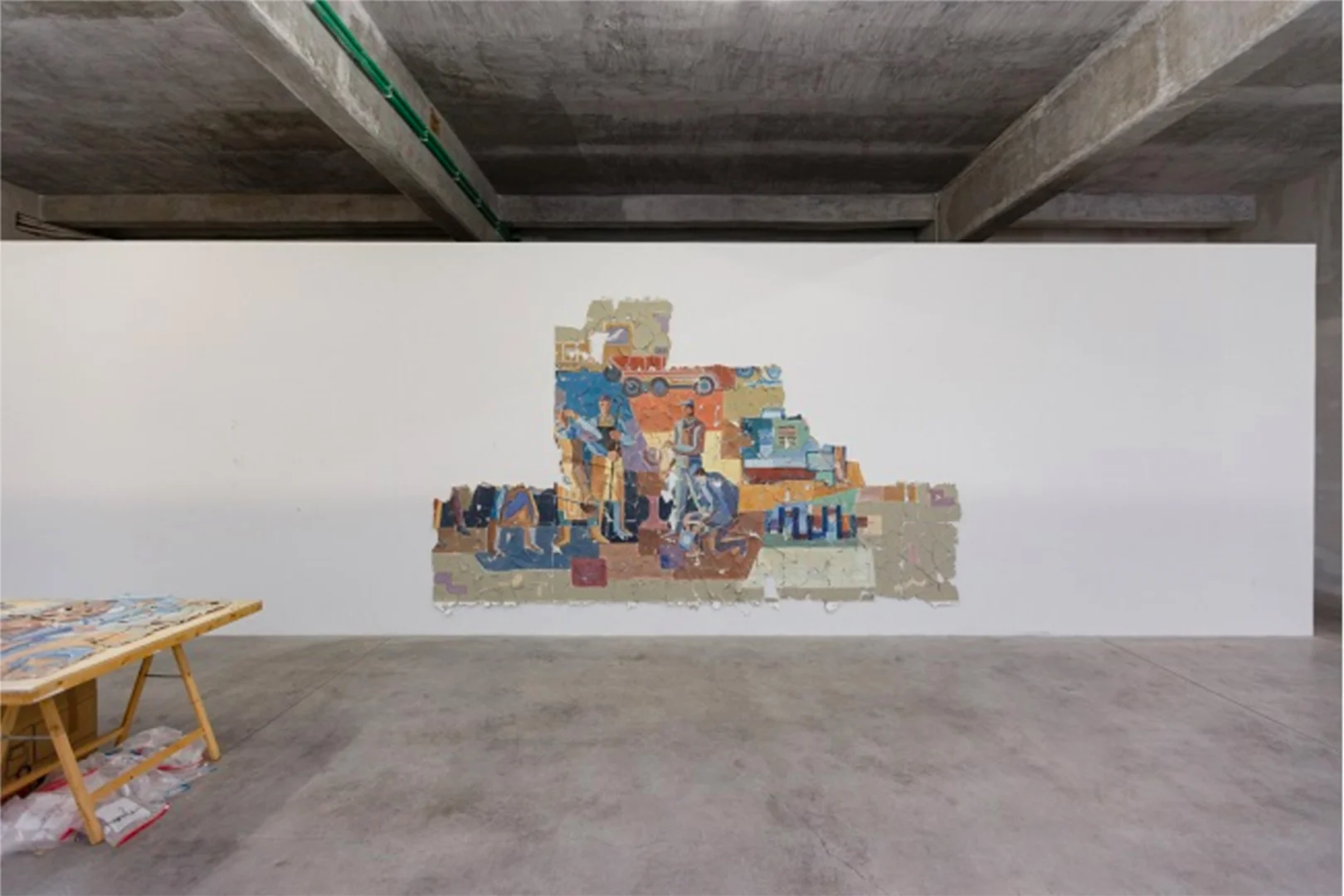
This image represents the last part of a collaborative work started by the Cluj-based Romanian contemporary artists Şerban Savu and Cristi Rusu in 2016, which takes as its starting point the socialist mosaic from the former Red Flag Factory in the city of Brașov, Romania, as a remnant of the communist project.1 The first part of the work, titled Reenactment. A Fresco for the Future, consisted of the replication by Şerban Savu of the mosaic from the Red Flag Factory in the artistic context of Plan B Gallery in Berlin, using the mural painting technique. In the subsequent two interventions, Cristi Rusu dismantled, and then Șerban Savu reconstructed the fresco, transforming it into a cycle of preservation, destruction, and reassembly.
Header image: installation view of the same work.
Savu and Rusu’s collaborative work remains relevant because it represents a return to material fragments of the Romanian communist utopian project, bringing to the fore a broader local spectrum of attitudes toward the recent past, and especially, the concept of utopia. The three parts of the project contribute to a wider description of the physical interaction with the fragments of Romania’s socialist past:2 their appropriation, transformation, destruction, or preservation.3
In this essay, I will focus on seven contemporary artists who were living in Romania at the time the artworks were created, and who further develop the aspects introduced by Rusu and Savu: Silvia Amancei and Bogdan Armanu (1991), Irina Botea (1970), Mona Vătămanu (1968) and Florin Tudor (1974), Vlad Nancă (1979) and Kristin Wenzel (1983).
Despite generational, biographical, and experiential differences regarding the socialist regime—including Wenzel’s East German upbringing—there is a common tendency in their artworks, realized between 2012 and 2020. Employing time-based media, such as video and installation, they revisit and reframe material and immaterial fragments of past modernist utopias, including ruined architectural objects, urban plans, public artworks, or utopian texts. The means of expression seem to respond to the type of engagement showcased in the artworks, which can be read as a form of activation of former modernist utopian projects. Moreover, these artistic means lead to a deeper kind of crack than the one hovering in Savu and Rusu’s collaborative artwork–a rupture within the linear, everyday temporal realm, as well as within dominant neoliberal sociopolitical and economic principles, values, and visions.
What differentiates their artistic projects from the work of Șerban Savu and Cristi Rusu is not only the broader spectrum of modernist utopian projects they revisit, but also the attitude reflected in their return to the past, which I refer to as the “utopian impulse,” after the theorist Richard Noble.4 For Noble, the utopian impulse is a tool for free and “wishful thinking,” which he describes as a tension between a social and political critique and a radical future conveyed by that critique.5 Although Noble focuses almost entirely on Western artists and authors while putting aside the development of the relationship between the utopian impulse and the sociopolitical context that generated such an attitude, his contributions to the utopian impulse remain key.
What differentiates their artistic projects from the work of Șerban Savu and Cristi Rusu is not only the broader spectrum of modernist utopian projects they revisit, but also the attitude reflected in their return to the past, which I refer to as the “utopian impulse,” after the theorist Richard Noble.
Expanding the contextual frame, the notion of utopian impulse is charged with additional uses and semantic layers as it manifests in the artworks I survey here. The utopian impulse is a tool for examining how artists living in Romania at the time engage with the remnants of past utopias and their positions towards the concepts of utopia and communist utopia.
Conceptually, I will integrate principles from the off-modern theory developed by the theorist and artist Svetlana Boym: “prospective nostalgia” and the “archaeology of pentimenti,”6 and David Damrosch’s use of the concept in multiple terms that elude traditional categories: a concept, a manifesto, a research project, and a work of art at once.7 The off-modern operates beyond the debate between modernism and postmodernism, with Boym considering the off-modern closer to the critical and experimental character of modernism than to the irony, subversion, and post-historical nature of postmodernism.8
For Boym, prospective nostalgia is both an emotion and a cognitive act, wherein returns to the past are undertaken to extract what is needed in the present for the purpose of actualizing a future.9 In the contemporary art projects of artists living at that time in Romania, the utopian impulse is combined with prospective nostalgia. The relationship between time and the utopian impulse is reshaped by the prospectively nostalgic gaze, which continuously mediates between past, present, and future.
The interest in the material remnants of the past, as well as the affect that directs the gaze toward the past to identify what is presently missing or may be useful in constructing the future, converges with the “archaeology of pentimenti.” Boym sees this playful “discipline” as a conceptual instrument of the off-modern and its specific mode of thinking.10 The objects of study of the archaeology of pentimenti are “unexplored contexts,” “the specific politics of places,” “uncomfortable histories,” and “alternative histories.11” The category of uncomfortable and alternative histories also includes revisited utopian projects found in the works of the artists I study. Within the off-modern context, which is concerned with uncovering pentimenti and keeping them alive, the pentimento acquires, as Boym explains, the status of a map of multiple possibilities rather than an index of originality.12
In the selected projects, the artists engage in various acts such as going through, unearthing, or gazing toward what is left from multiple pasts and opening them within a disenchanted capitalist present toward the possibility of different, non-capitalist futures. It is the particularity of this “retrograze,” directed at failed modernist utopian projects, in which the act of looking overlaps with an act of imagining, that is important to address within the local historical episode of post-communism and within one of its defining phenomena, the “anti-communist establishment.” Such a brief overview of the sociopolitical context and its pervasive anti-communist discourse also justifies the importance of the artworks in rehabilitating and actualizing the multifaceted notion of utopia.
It is the particularity of this “retrograze,” directed at failed modernist utopian projects, in which the act of looking overlaps with an act of imagining, that is important to address within the local historical episode of post-communism and within one of its defining phenomena, the “anti-communist establishment.”
A Very Short Introduction to a Long-Standing and Conflicting Relationship: Post-Communist Anti-Communism and Utopia:
After the December 1989 Revolution, Romania entered a new historical epoch entitled post-communism, commonly described as a process of transition from the real socialist regime established in the aftermath of the Second World War (1947) to a liberal democracy and market economy. The post-communist period, as the name suggests, maintained well-defined positions toward the recent socialist past. During the first two post-communist decades, the sentiment of anti-communism was dominant among protagonists in civil society, mainstream culture, and the public political sphere.
Of its extensive history and institutional spectrum, I focus on an episode from 2006 that resulted in the publication of the Final Report for two reasons. On the one hand, the initiative to condemn the communist past and, consequently, to reinforce the anti-communist discourse locally came from political institutions, the government, and the presidency, all of which promoted a neoliberal and neoconservative agenda. One year after the presidential elections won by the Justice and Truth Alliance in 2004, the Institute for the Investigation of Communist Crimes was established, and later, in 2006, the Presidential Commission for the Analysis of the Communist Dictatorship in Romania. Based on the results of research conducted by anti-communist intellectuals, led by political scientist Vladimir Tismăneanu as head of the Presidential Commission, a document entitled the Final Report was produced, and the President of Romania formally condemned the communist regime in Romania as criminal in Parliament in 2006.
On the other hand, this episode, evocative of the relationship with the recent socialist past, is interesting also in terms of the local reception and understanding of the notion of utopia and of communist utopia in local historiography. As a consequence, this moment in local history raises the question of how the anti-communist discourse impacted the reception and use of the concept of utopia, of communist utopia and its remnants in contemporary artworks in post-socialist times. According to the accounts of the theorist Ovidiu Țichindeleanu, the 2006 episode marks a moment when the anti-communist discourse was directed not only at the communist past, but also at the failures of Marxist theory and the inadequacy of leftist thought. In this prosecutorial stance, a conflation of terms took place. Țichindeleanu notes that the report “condemned in broad strokes ‘the communist ideology,’ ‘Marxist conception,’ and ‘Marxist-Leninist dogmas,’ for having ‘the pendant of terror.”13 Leftist positions were deemed elements out of place in the post-socialist present.
The 2006 anti-communist discourse reveals a connection with the prevalent understanding of utopia—as a literary genre, social theory, and political practice—as prefiguring or being conducive to violence and authoritarianism. In Adrian Dohotaru’s overview of local writings on utopia from the second half of the twentieth century to the beginning of the twenty-first century, the recurring interpretation of utopias concerns their function as a radical transformation of society, more often than not employing violent revolution as a means and resulting in an authoritarian state.14 Another related observation is the repeated equivalence between utopia and the real communist regime as a Stalinist political project in local historiography, with a focus on its repressive aspects.15 This conflation of terms, or projection of the repressive side of an episode of the history of the real socialist regime onto a variety of understandings and forms of utopia, has led to a predominantly negative reading of the concept of utopia. As Dohotaru explains, such a discourse underpins certain positions towards the status quo. It negates alternatives and critical positions toward neoliberal conditions, diminishes the social longing for what is missing “for egalitarian and libertarian conditions as well as for social harmony”—leading to a prevailing acceptance of current social conditions.16
Another related observation is the repeated equivalence between utopia and the real communist regime as a Stalinist political project in local historiography, with a focus on its repressive aspects. This conflation of terms, or projection of the repressive side of an episode of the history of the real socialist regime onto a variety of understandings and forms of utopia, has led to a predominantly negative reading of the concept of utopia.
In the end, the Final Report sparked further debate on the part of leftist theorists to assess, more cohesively, not only the recent socialist past but also the post-communist present, and to reactivate and actualize a leftist theoretical tradition while still positioning communism as a critique of post-socialist capitalism.17 And yet, the question remains—how did contemporary artists relate to the actual socio-political conditions, and what kind of use did they make of modernist utopias or utopian remnants?
It is now a matter of learning hope…
Although they belong to different generations—Irina Botea is a representative figure of the 2000s art scene, based and working in Bucharest, while Silvia Amancei and Bogdan Armanu emerged as a duo in 2012 in Iași18—a preoccupation with architectural and urban utopian projects intersects in some of their works. Employing video as a means of exploring the material fragments of a former utopian community or the communist utopia (with its architectural projects serving leisure and health purposes for a vast majority of people19) and, lastly, of the modernist utopian vision of architecture (aiming to contribute to the improvement of living conditions20), the artists imbue the spaces occupied by ruins or relics of the past with an affective and ideational potential to be used in forging alternatives. The critique of the present and of the recent post-communist past, with its associated utopianism—the capitalist utopia—in which the rule of private interest and the accumulation of capital led to chaotic acts of privatization and the loss of common resources for public use, is accompanied by the insinuation of desire and hope for alternatives.
The desire to transform present conditions emerges from Irina Botea Bucan’s video work It’s Now a Matter of Learning Hope (2013–2014), through the mediation of a protagonist, a narrative strategy employed in some utopian texts. In this way, the work returns to modernist utopian projects and texts to bring alternative initiatives to memory. Here, the utopian impulse takes the form of a subtle negation of the present, animating the relationship between what is and what could be. Textual sequences from Thomas More’s Utopia, Constant’s Our Desire Builds the Revolution, Ernst Bloch’s The Principle of Hope, and Vilém Flusser’s A New Imagination, concerning the dynamics of here-elsewhere, reality-imagination, desire-hope, are repeated by the fellow artist Ileana Faur in the process of memorization by heart.
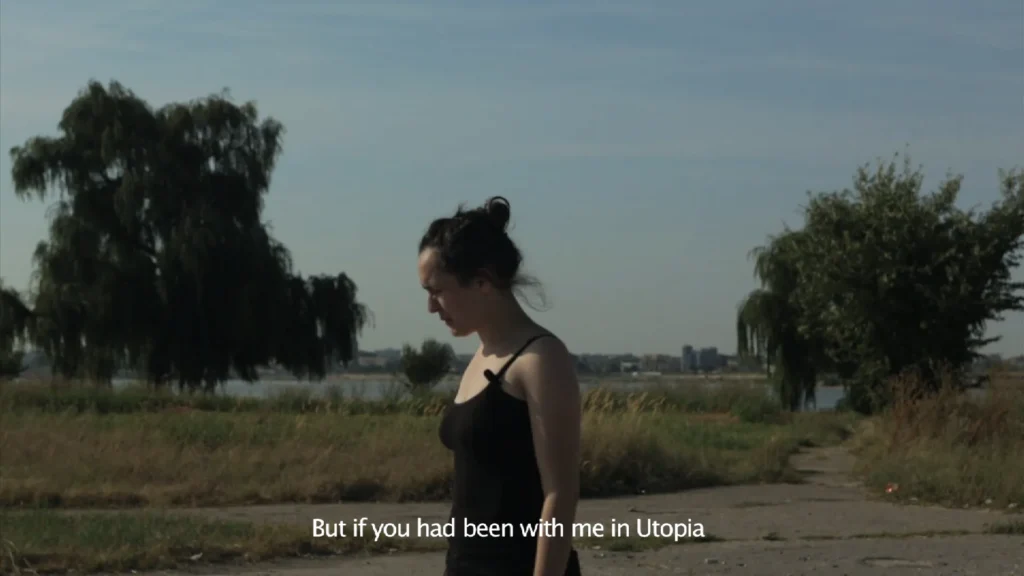
The memorization process unfolds against the backdrop of Lake Mori, a communist project intended to regulate the flow of the Dâmbovița River and to create a recreational area.21 Although construction ceased a year after it began, in 1986,22 Irina Botea argues that the spontaneous reconfiguration of the space by its users as a leisure area aligns with the utopian conceptual ambiance constructed by the texts.23 Remnants of the ambitious project to build a Bucharest–Danube canal and a recreational area have, in some places, been reclaimed by nature.
The memorization exercise in which Ileana Faur participates can be interpreted as a process of detachment from the dominant principles, norms, and values of a given society under a specific political regime. The textual fragments introduce elements of the utopian impulse: desire, imagination, hope, critique of the present, and the affirmation of the possibility of an alternative that contributes to the improvement of collective life. Radical sequences from Constant’s manifesto construct a critique of bourgeois society and culture, with its passive, static norms, values, and practices.24 These are counterposed by desire, in its role as a vehicle for expressing deficiencies and participating in societal transformation.25 Desire, as an affective instrument directing beyond an unsatisfactory present, is combined in this collage of ideas with hope. The amplification of individual and collective human potential is closely linked to engagement in shaping the future.26
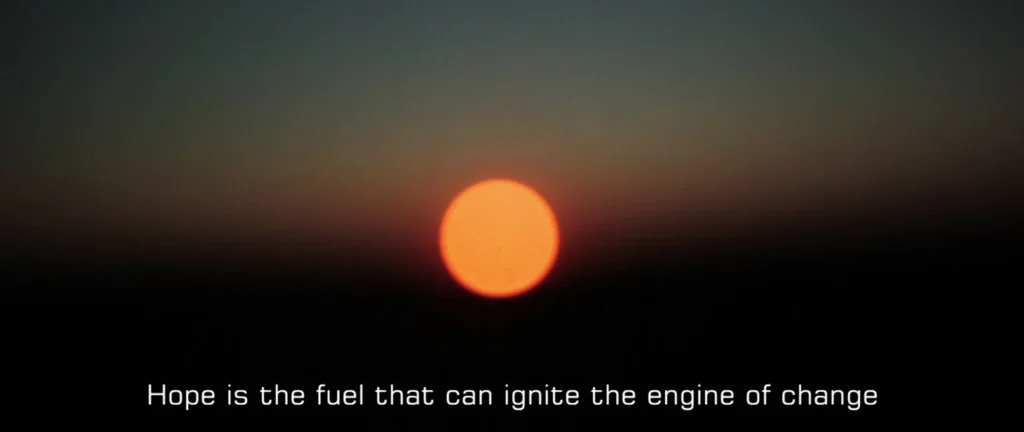
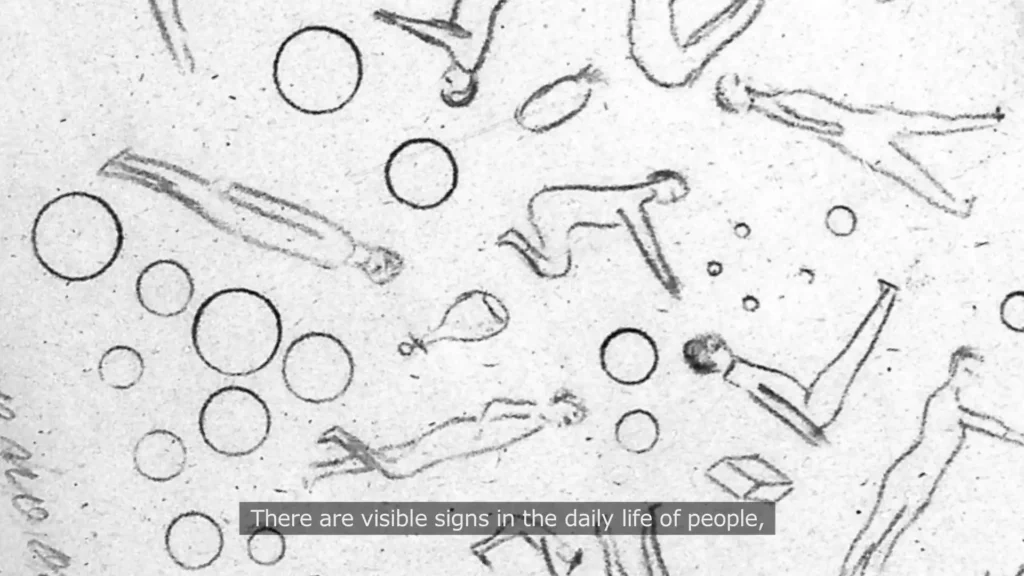
The staging of past promises and past futures is also undertaken by Silvia Amancei and Bogdan Armanu, with the aim of directing the gaze beyond the capitalist condition. Articulating, participating in, and managing the future, without intervening in the unpredictability that defines it, facilitates the reactivation of a methodology of hope. Taking the form of a video essay, Amancei and Armanu’s Talking about the Future (2017) is structured into four chapters addressing the precarious neoliberal present, the possibility of a better future, and the past as a holder of hope for a desire that ultimately reveals itself as socialist. The visual material is a dazzling assemblage of expressionist drawings of exhausted figures, excerpts of texts recited by a narrator, and both moving and still shots of a socialist domestic interior or of a symbiosis between architecture and the natural landscape.
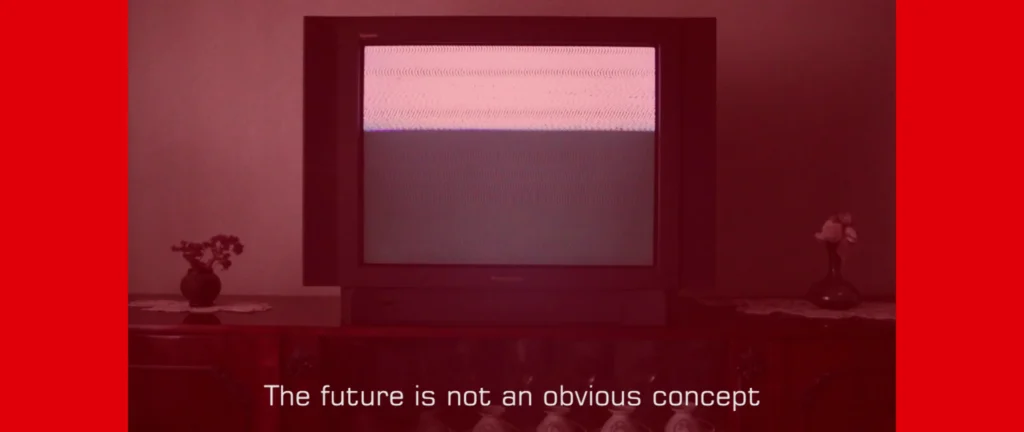
The first two chapters work with the visual by turning it into abstract content or by animating it through a stroboscopic effect, introducing dramatic elements into an act of negating present conditions and moving beyond them, plunging into a recent past where different ways of being and living are conceived. A collage of images of modernist architectural buildings, including the iconic Bauhaus school in Dessau, intersects with flashes of nature to conjure a convivial scenario in which humans are no longer intruders. This vision is further grounded by an additional drawing in which small, humble houses are scattered across space and integrated into the landscape. The utopian scenario, however, is undermined by the pessimistic recognition that such ideas could not spread beyond the borders of theory and text.
Narrating a more individualized story of a young couple, the third chapter illuminates the unsatisfactory, precarious economic and psychological conditions that confine the future to anxiety and uncertainty. The horizontal movement of the camera, registering blurred urban landscapes impossible to locate, pauses on a long shot of a still-life situated in a former socialist domestic space, then zooms again into a connection error, navigating the rich space of the glitch. The rendering of fragile natural and human corporeal realities in expressionist drawings or video footage is counterposed by found photography from the past: gatherings of people, associated individuals, and representations of an unsettling collective body. The narration traces the origin of the story, read in the ideological terms shaping everyday capitalist life, and denounces the role of politics and its failure in the face of private interests.
A sunset captured during a road trip opens the final chapter, the part of the video essay which uncovers hope as a reminiscence of the past and frames socialist desire as a tool for transforming an ending into an imminent new beginning. The “map of multiple possibilities”27 of the past is expanded by the two artists through the introduction of a future past, the socialist past.
Toward the Future via the Past
Looking back to look forward is a shift in attitude when it comes to working with what was left behind from the attempt to implement the communist utopian project in the former Eastern Bloc and with the individual and collective memories. In recent years, this attitude has arisen in the works of both contemporary artists Mona Vătămanu and Florin Tudor and Vlad Nancă. The artists have worked for the last two decades from various angles with what was left behind from the attempt to implement the communist project in the former Eastern Bloc and with the individual and collective memories attached to it. Debuting against the backdrop of post-communist Romania in the late 90s/beginning of the 2000s in Bucharest, the artists document the changes the city undergoes, as well as the conflicting presence of materiality representing the former regime. Their endeavours to capture and make visible the present and to confront the viewer with relics of the recent past spread beyond Bucharest, to other post-socialist cities, signaling the need for understanding the present on a local-regional scale.
The act of looking is taken further in the video works by acts of walking through, researching, and collecting visual material from the recent past and architectural projects with a representative and civic function. The artists perform the “pentimenti archeology” and work with “inconvenient, what if histories” to keep them alive, to explore their remnants, containing a future past brimming with possibilities. The working process entangles an interest in the ruins and a “prospective nostalgic”28 gaze searching for “something else that has happened once,”29 inspecting “the itinerary of difference.”
The video work “Gagarin’s Tree” (2016) represents a turning point in how the past is engaged. While the video depicts the ruined interior and exterior of a former center of youth activity during the socialist time, in Chisinau, Republic of Moldova, Ovidiu Tichindeleanu, cultural theorist, narrates the complicated provenance of the decaying physical remnants of the historical epoch they belong to. The return to the recent past, mediated by the ruins of an architectural object belonging to socialist and capitalist utopia alike, is an action with double stakes. On the one hand, it is a review of a historical era defined by utopian optimism that tried to establish itself, as a period of divergence from the unique thread of Western modernity.”30 On the other hand, the remembrance brings into discussion a historical episode marginalized in the acts of reflection on the recent past— namely, post-communism and its effects on the present.
The return to the recent past, mediated by the ruins of an architectural object belonging to socialist and capitalist utopia alike, is an action with double stakes. On the one hand, it is a review of a historical era defined by utopian optimism that tried to establish itself, as a period of divergence from the unique thread of Western modernity.” On the other hand, the remembrance brings into discussion a historical episode marginalized in the acts of reflection on the recent past— namely, post-communism and its effects on the present.
The orientation towards the past has a nostalgic prospective gaze that pursues a “future past potential.”31 Țichindeleanu wonders what remained alive of the communist utopian project that tried to detach itself from the Western modernist political and ideological order, although it incorporated some aspects such as industrialization or expansion in space. The past of the future seems to be placed in the process of conversion from the “space of experience” to the “horizon of expectations”32 by exploring some aspects of the communist utopia that may still be alive or reactivated, instilling a sense of hope for the future.
A second architectural object—The House of Nations—is explored by the camera while Tichindeleanu introduces the history of disobedience and solidarity between the so-called Third World and Second World—Eastern Europe and the Global South, which, in the 1970s, planted the seeds for a divergence from the Western order that should be rediscovered and activated from the perspective of a regional internationalism. The structure, the texture, the rhythms of the brutalist facade, and the entanglement of vegetal and concrete elements are given an entire foreground in the end, building a long-lasting tangible interaction with a future past that calls not for its reinstatement, but for alternative habits of thinking and a stimulation of imagination.
The itinerary to the future via the past is also speculated in Vlad Nancă’s video work “The City and the City and the Freedom Artist” (2019). Fragments of spontaneous everyday life are staged. The moving image intersects with the still image. The past meets the present. Sequences from the novel The City and the City by the British writer China Mieville create a narrative ambiance for the visual material. The novel presents the investigation of a detective hired to investigate a crime in a wealthy city. But the rich city shares the same physical space as the poor one. The inhabitants of the two cities take possession of the same place while practicing their gaze to ignore the presence of the others.
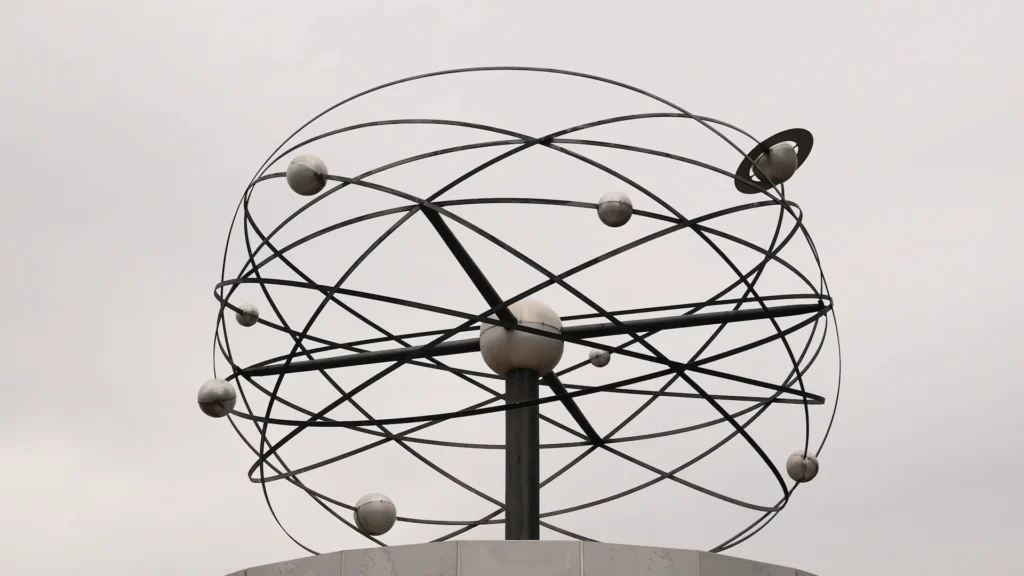
The universal clock in Alexanderplatz, along with other architectural and decorative objects, artifacts of socialist and capitalist culture alike, visually supports this metaphor of Berlin as a dual city. Two cities occupy the same space: the socialist and capitalist Berlin. Two temporal dimensions intertwine in this (re)visit that Vlad undertakes: “the space of experience” and “the horizon of expectations.” The space of experience is associated with the assimilation of the past into the present.
In Vlad’s case, the act of returning to the material aspects of the socialist project actualizes the idea that “something else had once happened.”33 At the same time, the possibility of alternative futures brings, in the present, a horizon of expectations. Therefore, remembering a utopian modernist project that meant to deviate from capitalism can function as a process of expressing desires and a criticism directed at current conditions, in order to imagine alternatives.
Building Humble Micro Utopias
Kristine Wenzel leaps forward and builds a humble alternative, a micro-space for a temporary collective within the premises of the Suprainfinit Gallery in Bucharest, Romania in her exhibition “The Near and the Elsewhere” (2020). Wenzel was born in the mid-80s in Gotha, Eastern Germany, and grew up witnessing the transformation after the collapse of the Berlin Wall. In her works, the forms of conviviality encompass acts of recollection, reimagination, and preservation. She revisits modernist utopias that aimed at transforming living conditions through material remains, while she builds temporary molds for alternative ways of being. Her microutopias are space and time-based and could be seen as symbolizing a transformed totality. At the same time, they evoke her previous practice, which entailed an abundance of architectural mock-ups for various kinds of urban microarchitecture: kiosks, pavilions and cabins.
Taking inspiration from the childhood swimming pool in the GDR where she used to take swimming lessons as a child, Kristine gives the micro-space of the gallery in Bucharest the form of a pool meant to provide free social events. While the swimming pool is dedicated to people and their activation of it, having in the middle a fountain, symbolizing the value of communality, the walls become a display area for architectural elements inhabiting the edges of our visual and memory field. Replicas of architectural ornaments are created by the artist, based on her collection of discarded decorations amassed in recent years during her walks in the city of Bucharest after the storm. Through the presence of the fragment and the ruin various seeds of the past are being conjured, some overlooked because of their failure, some neglected because of negligence, both waiting to be reconverted and reactivated.
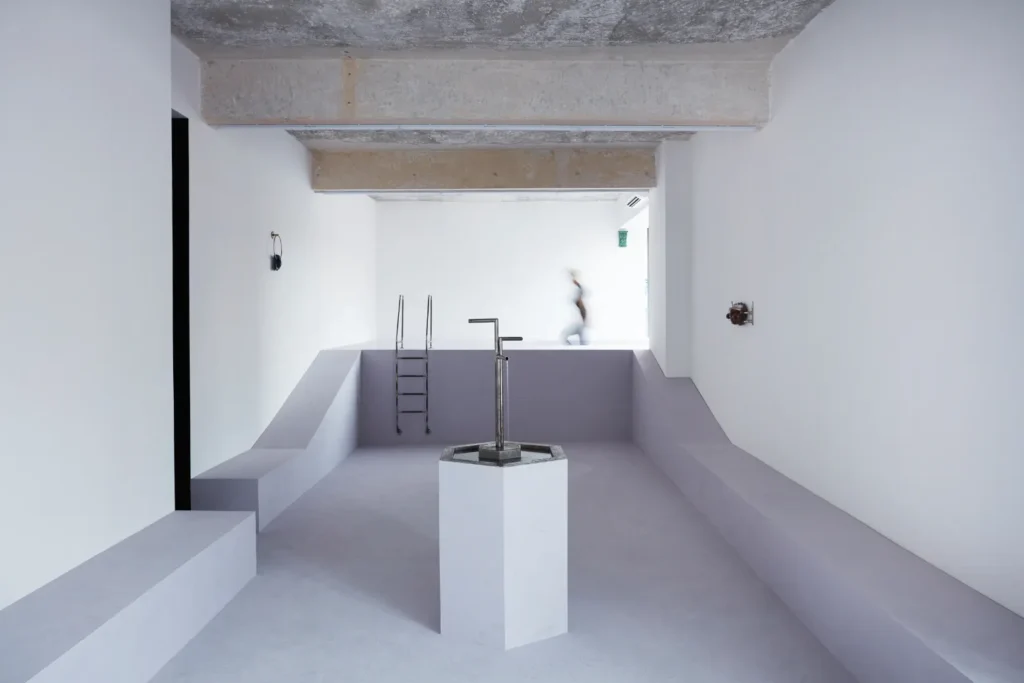
Employing the medium of installation, Kristin Wenzel gives form to a prominent aspect of the communist utopia, namely the collectivity, by shifting the function of a gallery from a white cube into a meeting space. Wenzel references the function, the energy, and the atmosphere of an East German public swimming pool by linking it to the structure built in the gallery space. The act of revisiting a past utopian project and the act of creating a new micro-utopia overlap. In this enterprise, the evocation of the space of individual memory triggers acts of collective remembrance. The relational situation that Wenzel builds is constituted as a response to the postsocialist-capitalist society. The built micro-space works according to different principles, constituting itself as a critique and as a relativization of the dominant characteristics of competition, individualism, and alienation, but also a gradual disappearance from the public space of the objects that used to trigger convivial moments in the neighborhood: small gardens, benches, and grills, just to name a few.
From the vantage point of a capitalist present deeply marked by cracking, unsatisfactory conditions, the act of revisiting material aspects of past utopian projects in contemporary artworks is inscribed in an area of interest for different ways of living, based on alternative principles that are embedded in architecture, as existential scenography for daily life, or in radical texts. These returns to a ”future anterior” mediated by material remnants or by the conceptual and affective force of radical ideas reflect a particular utopian impulse. The opening of the horizon of “what is” (in front of us) toward the “not-yet-become,” toward what is lacking and what is desired,34 takes place, in the case of the works under discussion, through what Boris Buden calls “a detour into the past.”
In expanding the historical context and conceptual depth of what Noble had persuasively termed the utopian impulse, the artists I have discussed here each create what I view as an optimistic ambience, centered on layers of macro-histories and micro-histories that emerge through the cracks of Romania’s recent history. In doing so, they constitute potential alternatives. We can say that desire and hope are actualized through remembrance and stimulated toward another way of relating to the future—one that is indeed more hopeful.
Note on the text:
A significant part of this essay is adapted from Daria Nedelcu’s eponymous bachelor’s thesis, written and submitted in 2022 at the Faculty of Art History, University of Fine Arts, Bucharest.
About the author:
Daria Nedelcu (b. 1993) is a curator and art historian interested in the multifaceted approaches to the concept of utopia in contemporary art practices and exhibitions. Her curatorial practice entangles utopian thinking with backward-looking, touching upon alternative and overlooked histories. She believes that taking elements from the past that are missing today can help stimulate micro-changes in the contexts in which we work, while also keeping alternative histories alive. Nedelcu is currently a Ph.D. candidate at die Angewandte, Vienna, and an associate Ph.D. candidate at ZHdK Zurich, writing a dissertation on the relationship between utopia and contemporary art in post-socialist Romania.
Footnotes:
- “Răzvan Anton & Miklósi Dénes, Cristian Rusu & Șerban Savu, Mihai Șovăială | Uzina de fapte și alte povestiri (nemărturisite).” www.fabricadepensule. Accessed 10 July 2022. ↩︎
- Oksana Sarsikova, Peter Apor, Past for the Eyes, Central European UP, Budapesta, 2013, pp. ix, x. ↩︎
- The ideological change from the socialist regime to neoliberal democracy in Romania after the December 1989 Revolution was accompanied by acts of transformation in the public space, encompassing several types of physical interventions upon the materiality of the former regime: removal, covering, transformation, resignification and abandonment. In some cases, the regime’s symbolic and historical material signs such as statues and monuments were removed from the public space, some of them destroyed or pushed outside the city, while in other cases, they were merely covered or assigned a different meaning. ↩︎
- Richard Noble (ed), Utopias, Cambridge: The MIT Press, 2009. ↩︎
- Noble p. 14. ↩︎
- Svetlana Boym, The Off-Modern, London: Bloomsbury,2017. ↩︎
- Boym, p. xii. ↩︎
- Boym, p. 4. ↩︎
- Boym, p. 39. ↩︎
- Boym, p. 29. ↩︎
- ibid ↩︎
- ibid ↩︎
- ibid ↩︎
- Adrian Dohotaru, Socialistii. O mostenire, Cartier, Chisinau, 2019, pp. 371-379. ↩︎
- Dohotaru, p. 380. ↩︎
- ibid. ↩︎
- Tichindeleanu, pp. 27, 30. ↩︎
- Iași is one of the art centres in Romania where socially engaged art has prevailed since the 90s. ↩︎
- Claude Karnoouh, “De la particular la general. Sau cum și-a confirmat România comunistă integrarea în capitalismul mondial prin vastul proiect social și apoi turistic de urbanizare a litoralului de la Marea Neagră” în Șerban, Alina, Dimou, Kalliopi, Istudor, Sorin (Eds), Vederi încântătoare: Urbanism și arhitectură în turismul românesc de la Marea Neagră în anii ’60-’70, Bucharest: Asociația Pepluspatru, 2015, p. 147. ↩︎
- László Moholy-Nagy, “The New Bauhaus and Space Relationship,” American Architect and Architecture 151, 1937, p. 28. Cited in Peter Anker, From Bauhaus to Ecohaus: A History of Ecological Design, p. 17. ↩︎
- Steliu Lambru, “Lacul Morii”, Radio România Internațional.ro, accessed 03 August 2022. ↩︎
- The works were stopped due to the verdict given by specialists that a Bucharest-Danube canal to be built on the Argeș and Dâmbovița rivers is not possible. ↩︎
- Susan Snodgrass, ”Irina Botea: It is now a matter of learning hope, at threewalls, Chicago”, artmargins.com, Accessed 03 August 2022. ↩︎
- Constant, ”It Is Our Desire That Makes Revolution”, https://stichtingconstant.nl/ (Cobra, Nr. 4, 1949). ↩︎
- ibid. ↩︎
- Enst Bloch, The Principle of Hope, Cambridge: The MIT Press, 1995, p. 3. ↩︎
- Boym, p. 29. ↩︎
- ibid. ↩︎
- Owen Hatherley, ”The Institute of Mundane Socialist Memory”, in Vlad Nancă In the Natural Landscape the Human Is an Intruder, Bucharest: Dispozitiv Books, 2020, pp. 38-39. ↩︎
- Ovidiu Țichindeleanu, Gagarin′s Tree, 8′ 04′′, Mona Vătămanu and Florin Tudor vimeo, 2016. ↩︎
- Boym, p. 29. ↩︎
- Reinhart Koselleck, Futures Past: On the Semantics of Historical Time (Studies in Contemporary German Social Thought), Cambridge: The MIT Press, 1990, p. 259. ↩︎
- Owen Hatherley, “The Institute of Mundane Socialist Memory,” pp. 38-39. ↩︎
- Ernst Bloch, The Utopian Function of Art and Literature, Cambridge: The MIT Press, 1987, pp. 3-5. ↩︎