

Erdsicht-Global Change: A Vantage Point Not So Remote From Politics
by Lola Lorant
Observing the globe from space has become commonplace since the first Earth-observing satellite, Landsat 1, was launched by NASA and the USGS in 1972. By that time, the public had become familiar with the images of our planet returned by Apollo missions 8 and 17. Seeing this blue ball against the blackness raised environmental awareness to the necessity of preserving our only spaceship in a vast universe. Two decades later, satellites recorded alarming information regarding the state of this finite, overexploited planet. The exhibition, Erdsicht-Global Change (Earthview: Global Change), translated those complex data and results for a wide audience at the Kunst- und Ausstellungshalle der Bundesrepublik in Bonn in 1992.1 Curated by scientific journalists Annagreta and Eric Dyring, the project relied on the latest science and satellite technologies to conjure clear images of the situation.2 It depicted an endangered world going through population growth, ozone depletion, nuclear threat, and climate change – in step with the ecological concerns at that time.3 The general tone was one of unmistakable apprehension.
Erdsicht-Global Change took over from the latest objective knowledge claimed by science to warn against environmental threats increasing at a catastrophic rate. In the foreword of the book that accompanied the exhibition, Pontus Hulten called for caution when it comes to “topical” issues regarding the expected “objectivity and universality” of “cold” and “independent” science.4 To back his warning, he mentioned the influence of fashion and quoted the infamous Lysenko, who misled the scientific world, pointing out that “he had communism breathing down his neck…”5 Did this comment imply that science would have been devoid of any suspicion after the fall of the Soviet Union? Despite its objectivity, the discipline could hardly be neutral, and Pontus claimed modesty. Rather, the critical question underlying his remark is why a scientific outlook on the predicted global ecological collapse had become “topical” for an exhibition organized after the fall of the Soviet Union. Contextualizing this scientific and cultural initiative may reveal connivance with the Western political model that triumphed at the end of the Cold War.
Erdischt-Global Change first opened at the newly inaugurated Kunst- und Ausstellungshalle der Bundesrepublik in Bonn—the capital of FRG from 1949 to 1990—whose foundation stone was laid on October 17th, 1989, a few weeks before the fall of the Berlin Wall. Climate change was already on the German political agenda. An impassioned debate was ignited by the 1986 publication of “Warning of an Impending Climate Catastrophe,” by the Deutsche Physikalische Gesellschaft in the Frankfurter Rundschau. It spurred media coverage and entailed political action relying on science as a consensual tool.6 On the international stage, the exhibition followed key moments including the first warnings reported by the Intergovernmental Panel on Climate Change (IPCC), published in August 1990, and the UN Conference on Environment and Development in 1992. The event, popularly dubbed the Rio Earth Summit, exemplified a burgeoning global environmental consciousness.7
The exhibition project itself was connected to such transnational initiatives. It was organized under the aegis of the International Space Year, celebrated by space agencies of over thirty countries. The year 1992 was chosen to mark the 500th anniversary of the discovery of America by Christopher Columbus, and the 35th anniversary of the International Geophysical Year (IGY). A series of events, 160 in total, supported by the UN, took place within this framework, including Erdsicht-Global Change. Among them, a conference held in Munich echoed the exhibition’s topic. It gathered scientists eager to share space data collections on a long-term basis, willing to “find solutions to global environmental and climatic problems, and to better manage the resources of our planet.”8 These objectives, relying on the strong faith in science and its application, were facilitated by the new world order, according to what attendants of the conference were told during the welcome address: “Until recently, researchers were only able to collaborate with their colleagues in the United States, Japan and other “western” countries. After the momentous geopolitical changes of recent years, we have tremendous new opportunities for cooperation with scientists and engineers in the countries of Central and Eastern Europe and the constituent republics of the Commonwealth of Independent States. This is an opportunity we must not ignore.”9 This tendency toward transnational scientific cooperation, fostered by the new geopolitical order, was featured in Erdsicht.10
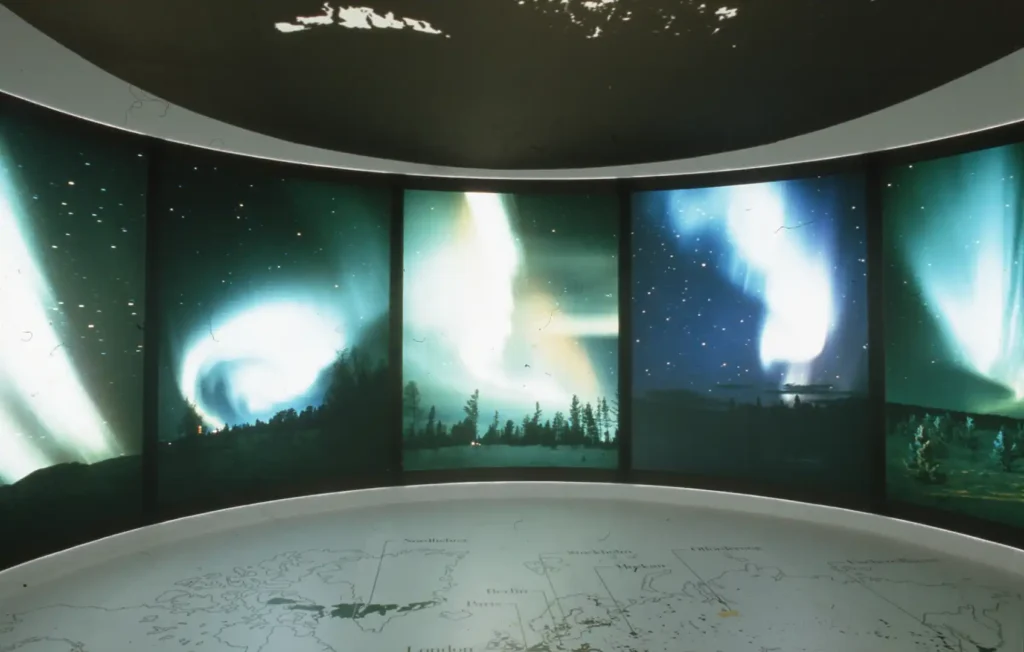
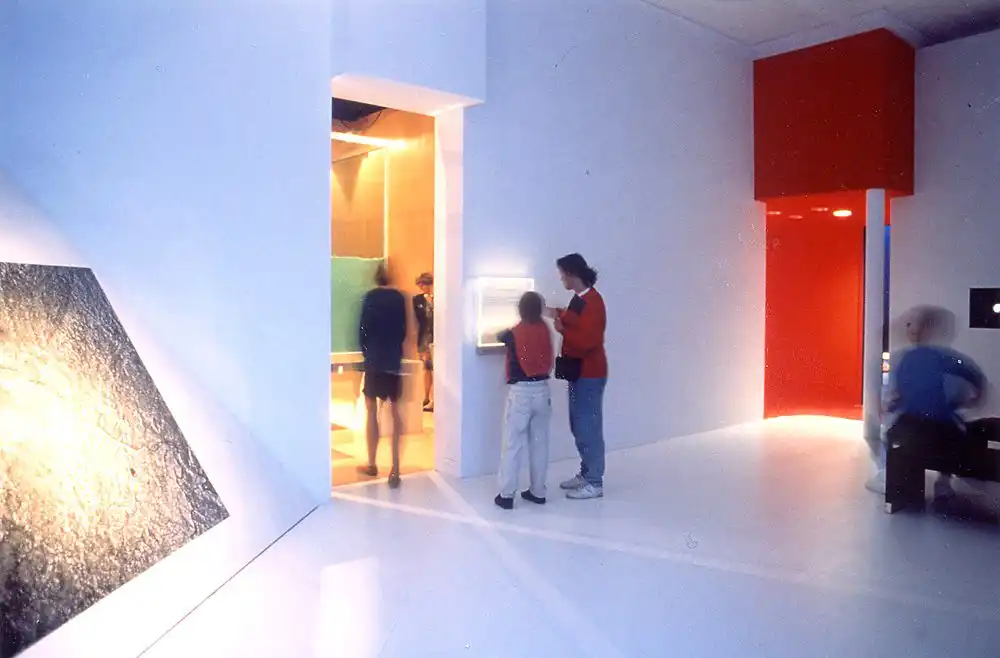
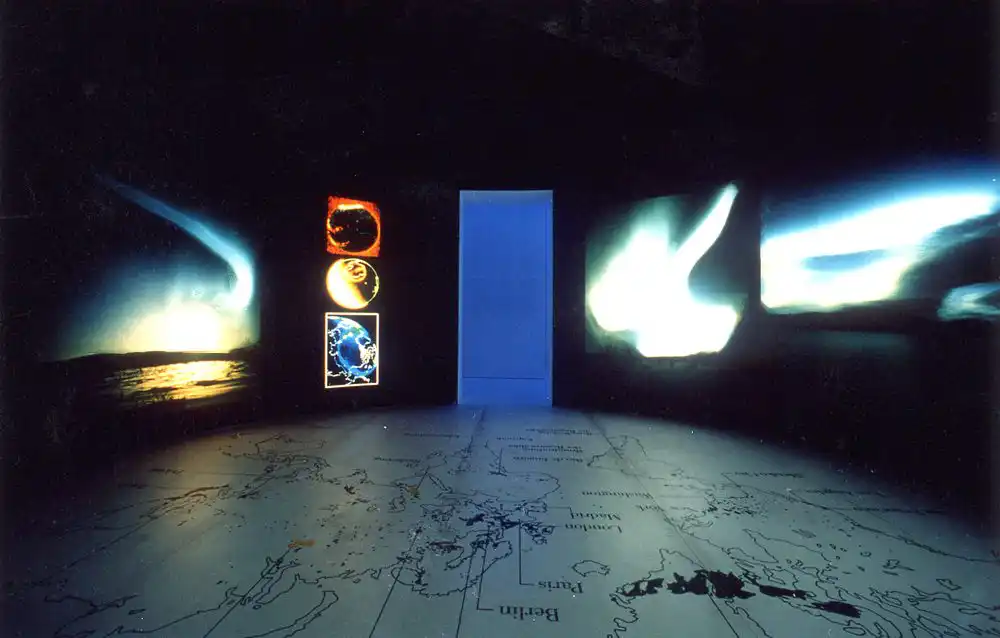
Erdischt-Global Change was a hybrid exhibition displaying scientific results from various research centres through didactic images and models. Likewise, Annagreta and Eric Dyring’s book accompanying the exhibition was not a catalogue per se, but a richly illustrated scientific reading. For instance, images gathered under the title “What Satellites Uncover” compared regions of the world separated by at least ten years. Thus, it became obvious to visitors that the use of fossil water for artificial irrigation could not be limitless or that Lake Chad was vanishing. In another room, a model dynamically showed ozone depletion in the stratosphere using green lights. Those are just a few examples of the fifteen exhibits.11 The interactive installation Global Change, showing 2D and 3D animated video, was a centerpiece among them. Specifically produced for the exhibition, it featured hundreds of satellite images fused through computer techniques. Clouds were removed and colors added for clarity. Visitors could select a particular story on natural changes among the 12 regions of the Earth: Antarctic Sea Ice, Vegetation Change, Pinatubo Eruption, Plankton (Coccolith) Bloom, or anthropogenic changes such as the Gulf War, Ozone Depletion, Aral Sea Shrinkage, Deforestation, Urbanization, Sea Level Rise, Europe at Night, and Deforestation. The theme of armament was developed through a world map localizing nuclear weapons and wall texts giving facts about the arms industry, conflicts, and refugees. Artists were also entrusted to participate in this scientific outreach.
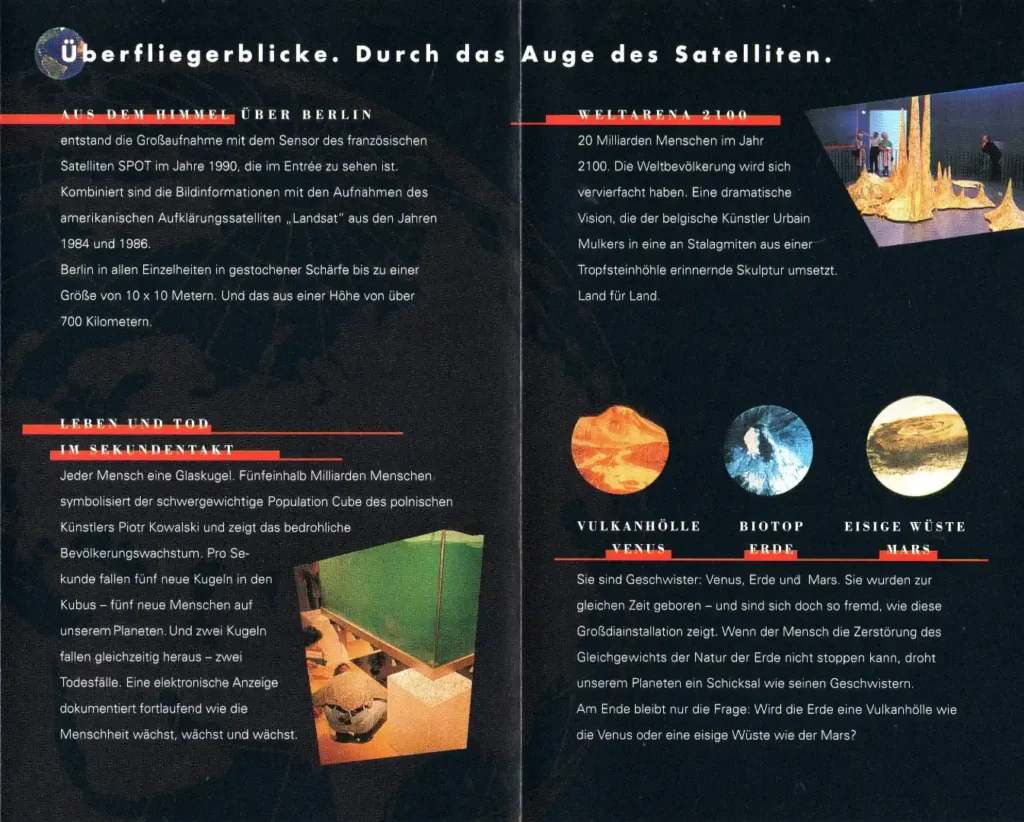
The five participating artists responded to the project by using new technologies, scientific images, data, or principles. The terrestrial sphere was the preferred iconographic element. Franz Xaver inserted a tiny video of computed data from the European Meteosat satellite through the spy-hole of a door. The installationOrbit (1989) situated the planet Earth outside, like a stranger looking at it from the safety of their house. But the locked front door, leaning to the left, conveyed an unfamiliar feeling as if terrestrial gravity no longer applied. Tom Shannon, known for playing with magnetic forces in his sculpture, presented Virgin Planet (1987), featuring a 10-centimeter floating globe above a cube. According to Shannon, our conscience, determined by the proportions of the Sun and the Earth, was undergoing “a transcendental phase, where our collective mind, aided by telescopes, microscopes and intelligent computers, beg[an] to connect with the larger context we ha[d] always ignored.”12 A larger installation displayed a selection of globes from Ingo Günther’s ongoing project World Processor, begun in 1988. Perched on 110-centimeter-high sticks, 33 planets were scattered in a round room, each highlighting specific information relating to population, economy, environment, and human rights.
Human demography was a major topic in the artistic propositions. Urbain Mulkers’s installation, World Arena 2100 (1992), foreshadowed 20 billion people on earth in 2100. The estimation was modelled in height using styrofoam and wood for each country mapped on the floor. Piotr Kowalski tackled the same idea with Population Cube (1992), a project he had been working on since 1975. The artist who studied at the Massachusetts Institute of Technology between 1947 and 1952 thought of new technologies as “a new tool allowing [people] to see the entire world.”13 Thus, in a 2m20 x 2m20 transparent cube on four granite pedestals, filled with half a million glass marbles, he materialized the world population. Using laser-adjusted counting devices, the sculpture tracked the population in real time: marbles dropped from above for every five births and fell through the bottom for every two deaths. A wall graphic, based on the prognoses by the United Nations Population Fund and the International Institute for Applied Systems Analysis, corroborated those demographic forecasts. It depicted global population growth from the last 10,000 years to the year 2090. Additionally, a video produced by the association Zero Population Growth and the Southern Illinois University in Carbondale, USA, showed the rise of the global population from the year 1 A.D. to the estimated figures in 2000.
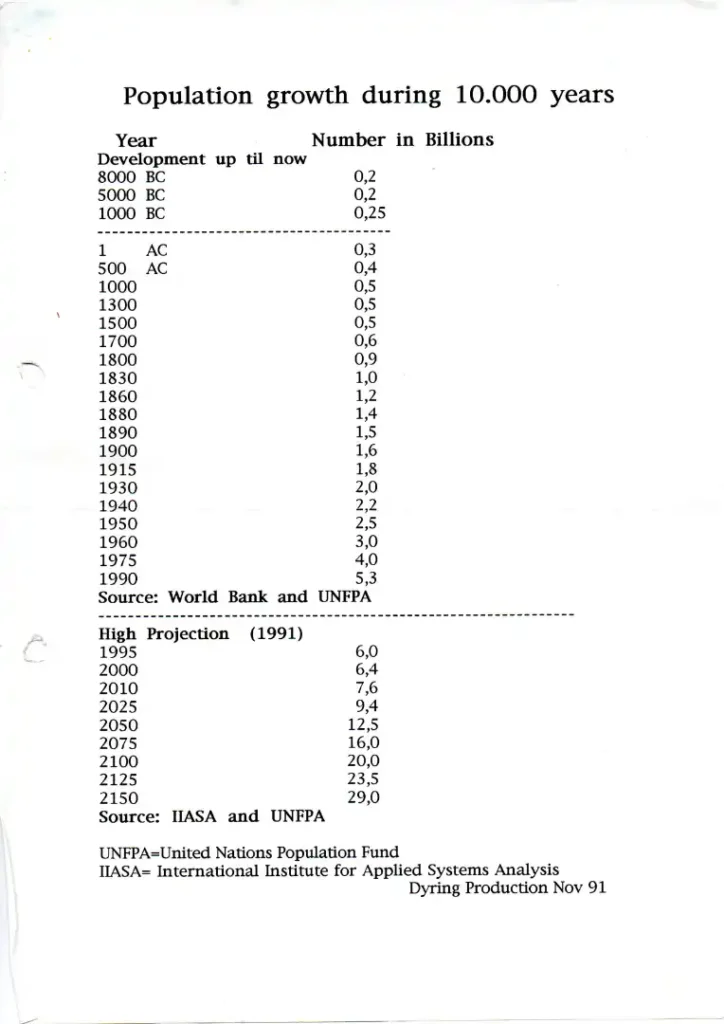
The demographic boom was a common worry that has lately been outshone by global warming and the ongoing 6th mass extinction. But an exponential number of people on Earth was considered a major risk to limited natural resources and was widespread in environmental thought.14 It was expressed in the best-selling book, The Limits to Growth, published in 1972, also known as the Meadows Report. Commissioned by the Club of Rome, it argued for limiting population expansion and resource consumption to avoid the collapse of human societies. The now-famous essay, “Tragedy of the Commons” by Garrett Hardin, published in Science in 1968, also stressed the question of overpopulation and called for imposing a reduced number of children for the sake of resource management. Likewise, Paul R. Ehrlich, alarmed against the consequences of population growth, including famine, in The Population Bomb.15 In 1994, the topic was still a major concern, generally approached in terms of the total number of people on Earth without historical, economic, or sociological distinctions.
The association of art, science, and technology was in tune with the times and eager to experiment with the ubiquitous world of new technologies and telecommunications. The topic was consecrated at the 42nd Venice Biennale in 1986, dedicated to “Art and Science.” Regarding satellite images more specifically, some featuring the Earth through the observation satellite SPOT interfered at the art exhibition “Many Worlds/Monde Multiple” curated by Don Foresta at the Grande Halle de la Villette in Paris in 1988. Images of the full globe were often associated with images of a transnational networked sphere. Such visual representations provided by new technologies could have optimistically been considered an opportunity to create a universal language where artists played a key role. Discussions during the international workshop “Babel – The Myth of Human Understanding in Art, Science and Technology” held at the Academy of Media Arts in Cologne in 1992, suggest this belief. According to the session minutes of “Satellites, Networks, Intelligent Machines: The Arts in Search of Universal Understanding”:
“The endeavor to overcome the gap between art and technology had been continued since the seventies in the discussion on new communication technologies. Satellites, networks and intelligent machines have turned out to be today’s vehicles of the human wish for universal understanding.
Potentials of the new technologies with regard to communication lie in the growing importance of images and visual information. The information scientist and director of IMAGINA, Philippe Quéau, INA, Paris, explained that Western rationalism was far from being a universal code of understanding. In Asia, for example, multilayered modes of expression prevailed over linear ones. The present emphasis on images, which is also due to electronic image processing, could lead to a mutual relation between concept and image thus giving opportunities for a more universal dialogue.” 16
But Piotr Kowalski qualified that utopian idea by reminding us that new technologies did not result from subjective visual languages seeking a universal language. To him, while artists were free to use technological tools as they wished, the latter were originally crafted for the military-industrial complex. Therefore, “they were all linked, in one way or another, to a will, avowed or unavowed, of domination on the world.”17 Artists who participated in the Erdischt exhibition used objective, complex computerized data, as well as advanced technological devices, to make impactful, self-evident, and informed overviews of the situation of the Earth. In this respect, they imposed an authoritative, ascending vision that was difficult to challenge.
The array of globes in the exhibition, subordinated to our gaze, was closely linked to the representations of power, imperialism, as well as to globalized technological, communication, and financial dynamics. They owed a lot to the research on the biosphere encouraged by the military strategies of the two superpowers of the Cold War.18 The space race between the USSR and the USA propelled technical innovation, including launching satellites into space that expanded the human experience and vision of the biosphere. Nevertheless, the exhibits in Erdsicht stood out insofar as they crossed technology with environmental prospects to display ecological facts, which were quite rare in the mainstream visual culture inherited from world conflicts and corporate globalization.19
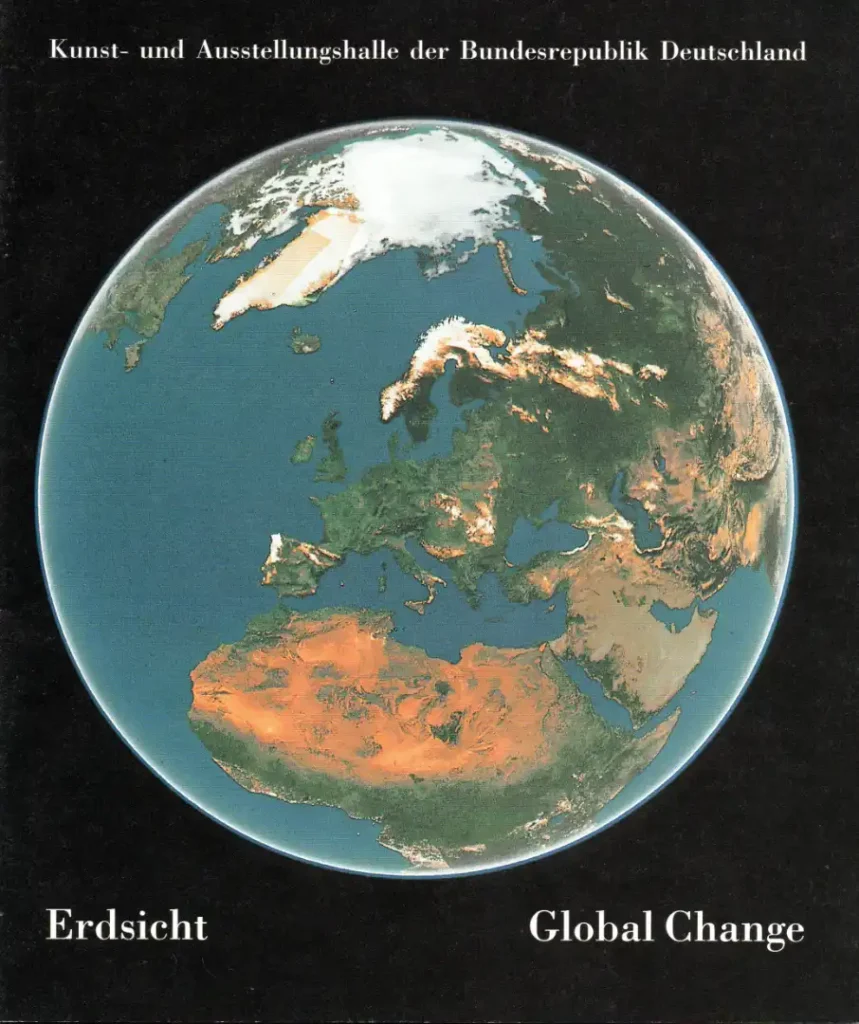
Within the context of space conquest, the two iconic photographs captured by NASA – the Earth rising from the first orbit of the moon or the full Earth seen during the last Apollo flight – respectively in 1968 and 1972, dramatically changed our views on Earth. On the one hand, discourses around the wide circulation of these photographs emphasized universal brotherhood and supported the idea of a harmonious spherical form, dear to the views of the Earth in Western mapping histories. In doing so, they did not fully depart from an imperialist tone. After all, whole-earth pictures were offered to humanity thanks to the American space conquest, and such feats were the implicit products of an economic and political model.20 On the other hand, those images fostered ecology, rooted in the idea of an endangered and fragile harmony to preserve. They were also widely used by environmental movements and institutions. In this way, the Earth became an icon for environmentalists. Taken in pictures further away by the spacecraft Voyager I at the beginning of the 1990s, it was seen for the first time as a “pale blue dot,” a speck of dust, a pixel in a vast universe that would be our only world for a long time to come.21
Appearing to dissolve national borders, Erdischt-Global Change put forward a borderless world without national collisions. It shattered the visual grammar of “imagined political communities” legitimized by maps and described by Benedict Anderson.22 The Earth, seen from above and in full, appeared as a single undifferentiated space. Talking about the “pale blue dot,” Carl Sagan stated: “From this vantage point, our obsession with nationalism is nowhere in evidence.”23 Politics seems piddling and disappears under the clouds, the oceans, the green or yellow soils, and the white poles. Thus, the exhibition could signal a faint shift toward transnational science after the strong polarization of the world. When it traveled to Berlin for the first Conference of the Parties in 1995,24 it opened with a satellite map of Berlin and Potsdam without a single trace of the former Berlin Wall. In Berlin, the exhibition perfectly matched the United Nations’ vision of a global approach to environmental protection. But this stance was not new, as ecological issues influenced the East-West political cooperation in overlapping ideological divides. They were an opportunity for the policy of détente and contributed to normalized international relations in highly publicized conferences.25 After the fall of the Soviet Union, ecology remained a matter of federative collapse.
In 1994, Erdischt-Global Change traveled to Stockholm, a highly symbolic city since it held the United Nations conference for environmental awareness in 1972. The boycott of the international event by nearly all the Eastern countries and the Soviet Union after a dispute over the exclusion of the GDR belonged to a past polarized world. Yet, Erdsicht’s stop in Stockholm offered snippets of interpretation regarding the geopolitical situation following the fall of the Soviet Union. Coinciding with the International Association of Art Critics (AICA) congress in Sweden, art critics were invited to visit the exhibition, though they apparently barely talked about it.26 Only one of the participants, Apinan Poshyananda, a curator from Thailand, mentioned it when reflecting on a workshop on the topic, “The Threat against the Body.” He reported that “several members in the group were impressed by the exhibition […], where science, ecology, earth and body seem to be separated and yet undeniably are interrelated entities. Bubbly mud, ozone’s depletion, explosion, tormented body, seem to reflect signs of threats through lack of equilibrium.”27 His comment reflects the anxiety-provoking discourses of the congress. A post-collapse world struck by numerous crises was portrayed during this international meeting on the theme Strategies for Survival – Now! Links between Criticism, Art and Politics. In fact, the art critic Christian Chambert declared in the opening speech:
“Now that people have finally torn down the Wall, the world is very different. However, there are no fewer problems. Many wars and ethnic conflicts are going on, apparently with no end in sight. What happens after Harrisburg and Chernobyl? New nuclear tests are taking place in China and are being planned by France. Economic, political and ecological chaos is threatening all the time. Overpopulation, homelessness, crop failure, poverty and fatal diseases such as AIDS are increasing dangers. The ecological problems reach across national borders and in the end afflict our own body. We discuss strategies for survival, for the continued life of our globe.”28
Chernobyl had demonstrated that nature was part of society, impossible to escape, even more so when it went off the rails.29 In the wake of the recent nuclear catastrophes, art critics’ comments shifted the focus back to the ecological question of the individual, in its more intimate form: the body. Erdsicht-Global Change, as well as ecology in general, was likely to be connected to situated and subjective points of view. Down-to-earth experiences and political disorientation crossed its global vantage point. In the end, this back-and-forth fulfilled Annagreta Dyring’s wish: “Distance is important, it gives you an overview. We need it to see clearly, as a complement to what we experience directly.”30 Thus, global environmental phenomena can be explored through different scales and histories in all their complexities.
Erdsicht contributed to a new political and environmental imagination increasingly relying on modeled and digitized data. Remote images and representations of Earth shaped the visual language of our contemporary ecological sensibilities, offering new points of view that would affect the way we apprehend the environmental crisis, consequently informing political actions.31 It displayed macro perspectives that tended to smooth out plural environmental representations, as well as to depoliticize and dehistoricize some situations.32 In doing so, the exhibition was instrumental in bringing to a wide audience a scientific and visual culture informed by satellite images that would set the stage for the Anthropocene paradigm. The concept quickly went beyond the purely hard sciences to address global environmental crises across the social sciences. However, its vantage point that allowed us to grasp the magnitude of environmental changes has been rightly criticized for its tendency to flatten out unequal responsibilities among human societies with regard to environmental damage.
In the meantime, the exhibition Erdsicht-Global Change was conceived in a specific context where remote images of the Earth paradoxically carried out an implicit idea of the forthcoming world order after the defeat of communism. The so-called end of history, or rather the belief of a universal impulse towards liberal democracy announced by Francis Fukuyama—appealing for some Western liberal dominance at the turn of the 1990s—could have coalesced with satellite images remote from political struggles.33 However, the exhibition diverged from that confidence in the future by taking the ecological collapse entailed by human activities seriously. While Francis Fukuyama argued that environmental problems were not “so serious as to inevitably lead to the collapse of society,”34 Erdischt-Global Change alerted to a possible unhappy end for humankind. It assessed a pivotal moment where it was not so much the so-called “end of history” that was at stake, but rather “the end of nature” and its far-reaching consequences for human history envisioned at that time by the environmentalist William McKibben.35 In that sense, Erdischt-Global Change shed light on climate change that would become the cornerstone of environmental debates and actions in the decades to come. As such, the exhibition was among the few catalytic events at the beginning of the 1990s to announce a critical chapter in environmental history, in which ecology plays the leading role in our future.

About the author:
Lola Lorant holds a Ph.D. in Contemporary Art History and teaches at Université Rennes 2. Her research centers on the U.S. art scene from the mid‑20th century onward. Building on a dissertation examining transatlantic artistic exchanges by Nouveau Réalisme artists during the Cold War, her current work investigates how artistic production and its accompanying discourse intersect with cultural stereotypes, international politics, and environmental thought. Her recent publications appear in the Journal of Global Pop Culture and Théia.
Connect with Lola Lorant on Instagram, Academia
Footnotes:
- The exhibition ran from June, 19th 1992 to February, 14th 1993. Four other exhibitions were simultaneously presented at the Kunst- und Ausstellungshalle der Bundesrepublik: Territorium Artis, Pantheon der Photographie im 20. Jahrhundert, Niki de Saint Phalle and Gustav Peichl, Architekt der Bundeskunsthalle. ↩︎
- It was organized in partnership with the DLR (Deutsche Forschungsanstalt für Luft- und Raumfahrt), the UCL (University College London), the DARA (Deutsche Agentur für Raumfahrtangelegenheiten) and the ESA (European Space Agency). ↩︎
- Mostafa K. Tolba, ed. The World Environment, 1972-1992: Two Decades of Challenge (London: Chapman & Hall, 1992); B.L. Turner II, William C. Clark, Robert W. Kates, John F. Richards, Jessica T. Mathews, William B. Meyer, eds. The Earth as Transformed by Human Action: Global and Regional Changes in the Biosphere over the Past 300 years (Cambridge, Cambridge University Press, 1990). ↩︎
- Pontus Hulten, “Vorwort,” in Erdsicht-Global Change, eds. Annagreta and Eric Dyring (Bonn: Kunst- und Ausstellungshalle der Bundesrepublik Deutschland; Stuttgart, Verlag Gerd Hatje, 1992), 13. ↩︎
- Ibidem. ↩︎
- On the widespread idea of “climate catastrophe” in Germany in the second part of the 1980s, read Matthias Dörries, “Anticipating the Climate Catastrophe,” in Catastrophes: A History and Theory of an Operative Concept, eds, Nitzan Lebociv and Andreas Killen, (Berlin, Boston; De Gruyter Oldenbourg, 2014), 181-196; Silke Beck, “Localizing Global Change in Germany,” in Earthly Politics. Local and Global in Environmental Governance, eds, Sheila Jasanoff and Marybeth Long Martello (Cambridge, MA, London: The MIT Press, 2004), 173-194.
↩︎ - The 178 participating nations discussed environmental problems and economic developments, resulting in signing agreements on climate change and biological diversity. Ken Conca and Geoffrey D. Dabelko, eds, Green Planet Blues: Environmental Politics from Stock holm to Kyoto, Boulder, West view Press, 2010. ↩︎
- Welcome address by P. Fasella, Director-General for Science, Research and Development, Commission of the European Communities in European “International Space Year” Conference – Central Symposium – Vol 1 – Remote Sensing for Global Change, Climate Change and Atmosphere & Ocean Forecasting (Noordwijk: ESA Publications Division, 1992), XXVII. ↩︎
- Ibidem. ↩︎
- Clark A. Miller and Paul N. Edwards, Changing the Atmosphere: Expert Knowledge and Environmental Governance (Cambridge, MA and London: MIT Press, 2001); Ken Conca, Michael Alberty and Geoffrey D. Dabelko, eds. Green Planet Blues: Environmental Politics from Stockholm to Rio (Boulder, Oxford: Westview Press, 1995); Sheila Jasanoff and Marybeth Long Martello, eds. Earthly Politics. Local and Global in Environmental Governance. ↩︎
- For an account of the exhibition, read Andreas Denk, “Erdsicht/Globaland Change,” Kunstforum 120 “Kunst und Humor I” (1992): 334-335. ↩︎
- Thomas Shannon interviewed by Jérôme Sans, “Thomas Shannon: Une vision globale”, Art Press, no 181 (June 1993): 42. ↩︎
- Piotr Kowalski interviewed by Patrick Talbot, “ Les artistes devant les N.T.,” Art Press, special issue “Nouvelles technologies, un art sans modèle:, No. 12 (Summer 1991): 16. ↩︎
- Hervé Le Bras, Vie et mort de la population mondiale (Paris: Le Pommier, 2012). ↩︎
- Paul R. Ehrlich, The Population Bomb: Population Control or Race to Oblivion (New York: Ballantine Books, 1968). ↩︎
- The workshop was directed by the artist Fabrizio Plessi. “Babel – The Myth of Human Understanding in Art, Science and Technology,” International Seminar and Experimental Artistic Workshop on Arts and Media, Academy of Media Arts Cologne, Federal Republic of Germany, 5-10 October, final report. 1992, p. 5/6, FR ACA DFORE THE RES 010, Archives de la critiques d’art-Collection INHA, Rennes. ↩︎
- Piotr Kowalski, “Les artistes devant les N.T.,” 16. ↩︎
- J. R. McNeill and Corinna R. Unger, eds. Environmental Histories of the Cold War (Cambridge: Cambridge University Press; Washington: German Historical Institute, 2010). ↩︎
- Telling in this regard is the selection among Ingo Günther’s World processor globes for the Cebit 94’ in Hannover. Overall, topics a priori more consensual or arousing fewer concerns regarding the state of the planet were preferred. Apart from “Refugee populations”, “Refugee currents” and the “Chernobyl cloud”, the globes selected for the fair addressed geographic, demographic and economic questions. ↩︎
- Denis Cosgrove, Apollo’s Eye: A Cartographic Genealogy of the Earth in the Western Imagination (Baltimore, London: The Johns Hopkins University Press, 2001). ↩︎
- Carl Sagan, Pale Blue Dot: A Vision of the Human Future in Space [1994] (New York: Ballantine Books Edition, 1997). ↩︎
- Benedict Anderson, Imagined Communities [1983], London, New York, Verso, 1991. ↩︎
- Carl Sagan, Pale Blue Dot: A Vision of the Human Future in Space, 17. ↩︎
- The exhibition was held at the Botanischer Garden between March 30th and April 28th 1995. ↩︎
- On the environmental diplomacy between FRG and GDR during the détente, read Kai Hünemörder, “Environmental Crisis and Soft Politics: Détente and the Global Environment, 1968-1975”, in Environmental Histories of the Cold War, eds. J. R. McNeill and Corinna R. Unger, 257-276. ↩︎
- The congress took place in Stockholm, Malmo and Lund from September 22nd to October 1st. ↩︎
- Apinan Poshyananda, “The Threat Against the Body,” in Strategies for Survival – Now! A Global Perspective on Ethnicity, Body and Breakdown of Artistic Systems, ed. Christian Chambert (Lund: The Swedish Art Critics Association Press, 1995), 326. ↩︎
- Christian Chambert, “Strategies for Survival – Now!” in Strategies for Survival – Now! A Global Perspective on Ethnicity, Body and Breakdown of Artistic Systems, ed. Christian Chambert, proceedings of the 28th AICA Congress in Sweden (Paris: AICA, 1994): 11. ↩︎
- Ulrich Beck, La société du risque [Risikogesellschaft, 1986] (Paris: Flammarion, 2008); Bruno Latour, Nous n’avons jamais été modernes : Essai d’anthropologie symétrique (Paris: La Découverte, 1991). ↩︎
- Annagreta Dyring, “Die Forscher haben die Verpflichtung, zu berichten,” in Erdsicht: Global Change, eds. Annagreta and Eric Dyring, 17. ↩︎
- Jenny Goldstein and Eric Nost (eds), The Nature of Data: Infrastructures, Environments, Politics (Lincoln: University of Nebraska Press, 2022). ↩︎
- For an historical perspective on the Anthropocene, read Christophe Bonneuil and Jean-Baptiste Fressoz, L’événement Anthropocène : La Terre, l’histoire et nous [2013] (Paris: Éditions du Seuil, 2016). ↩︎
- Francis Fukuyama, La fin de l’histoire et le dernier homme [The End of History and the Last Man, 1992] (Paris: Flammarion, 2018). ↩︎
- Ibidem: 27 ↩︎
- William McKibben, The End of Nature [1989] (New York: Penguin Random House Publishing, 2006). ↩︎