

Industrial Evolution
by Zoe Grace Marquedant
i.
To be abandoned is to be without humans. Without foot traffic, interest, investment. To be sunbleached, cracking, spilling rust into the surroundings. Falling back to earth like a meteorite, only fantastically slowly. Sinking then, leaving a carcass of ceiling tiles, bricks, the covers for electrical outlets.
The inequality of material defences against time is evident. Ceramics stand more impervious to the earth compared to metal, which sheds itself when exposed to the elements. The air, the water, the weight of trespassers break, fissure structures that had withstood any initial dismemberment. The removal of furniture, remembrances, copper. Valuables. The carrying off by scavengers.
Glass panels and panes are an entrance waiting to happen. They are the start of something, the unlit fuse in the fist of the youth. When the last of the former occupants closed their windows, locked their doors, the weaknesses of each portal begat the path into the future of this enclosure. Chains threaded through handles, boards nailed into frames are deterrents, but not permanent fixtures. Nails can travel in a second, lesser-known direction. Fences bare footholds, sagging like eyelids under a well-placed foot.
What is left to do is perhaps not merely a coupling of breaking then entering, but an act of witness. To see the last of the dance halls. The power plants, hotels, embassies. Lying in wait under a layer of grime. Identical in their unimportance. Made kindred by dereliction. The unmistakable features of casinos and cinemas scraped away by gravity. By hands and toes, climbing to a vantage.
What is left to do is perhaps not merely a coupling of breaking then entering, but an act of witness. To see the last of the dance halls. The power plants, hotels, embassies. Lying in wait under a layer of grime. Identical in their unimportance. Made kindred by dereliction. The unmistakable features of casinos and cinemas scraped away by gravity. By hands and toes, climbing to a vantage.
To look out upon this cityscape, this wilderness of wires. To watch trams and pedestrians. The anthill, the orchestra, the everything that went on living beyond the boundaries of this lot. The obliviousness of the surroundings. Unaware of the neighbors, the past, the histories. Or else ignoring the obviousness. Having grown a sort of blindspot. An inability to see, or rather an ability to look past, to look through the unremovable.
Frozen as these spaces are in a state between built and building. Neither developed nor developing. But claimed, in a way. Entangled by purpose. By private ownership. By lack of funding. By historical status. By absent residents. By forgotten ambition. By something, some use which prevents the present from intervening. Having fallen into the stop bath of withdrawn significance. Stuck in former function. Weighted in place.
Until the prying eyes and crowbars of outsiders find time or reason. To repel, to crawl, to open the sealed vaults of institutes, centers, stations, and airfields long since grounded. Loosing their curiosities, their imaginations, their fears amidst the darkness, the network of hallways. To cautiously wander into sprawling emptiness in search of the monstrous. Looking for bravery, for souvenirs, for entertainment. For proof that one could. For the blank canvas of an empty wall. For ghosts or evidence of the living.
The misplaced archaeology of riffling through the debris of ticket booths, swimming pools. How this becomes unlikely documentation. The last of the bandstands, drying racks, vats, and bottle caps. Stepping through what once was. An industrial park, a house, a roller coaster. So discordant with the present. But present all the same. Having once existed on the fringes, now abuts busy streets, schools, the emerging, up-and-coming neighborhoods.
The ancient office blocks sit vacant among bustling apartments. The rotting wedged in with the living. Interesting, perhaps only to the amateur climber. The photographer, the artist, the daredevil. Who gives their attention in exchange for the unknown? That which grows there and nowhere else. The endemic dangers. The native populations of songbirds and speculations. The myth and rumors. The unlikelihood of predicting exactly what will happen. The adventure in this randomness.
The insistence that there is something striking in the juxtaposition. Of an ice skating rink populated by pigeons. Of soft evening light falling through molding curtains. Of a headquarters, banks of security monitors still pulsing with electricity but watched by no one. The floors stacked upon floors. Their uniformity. Impenetrably similar. Covered in evidence of time passing. Styles shifting. Best-by-dates and expirations. Pictures. Mirrors.
Remarkable? Signage directing, warning no one. The interiors, colors, combinations of metals of former eras. Cemented sentiments disappearing beneath graffiti tags. Letters carved into the dust. Statements made ominous by their lack of context. The catchphrases, calling cards, nicknames. The unofficial guestbook of these places. The currency of anonymity within them.
Evidence of people amidst yawning absences. Footprints picked across puddles of broken glass. Having slipped past the sightlines, the questions of passersby. With a neutral expression, an innocuous rucksack. Having skirted the dogs in the front gardens, the eyes at open windows, the alarms of onlookers with vested interest. Concern and cellphones.
Having avoided observation. Carrying flashlights, ropes, bolt cutters. The ranks of passive invaders. Urban explorers, squatters, uncategorizable others. Teengers. Breaking in. Breaking things. Scrouging thrills with everyday objects. Their unauthorized demolition. The razing of the ruins, boot heel by boot heel. Enraged and emotional, shattering forgotten spaces. The need deep in the body to uproot anything light enough, to dangle off the ledge, to untether ice.
Where else? But the where that has been deemed not fit for proper public consumption. Ruled uninhabitable because of building materials. Because of the collapse. Exposed wiring. Asbestos. Lead. Unknown chemicals. Known maladies. Hazards, liabilities. Tinged by allegations of significance. Protections. The tied hands of governments.
Where else? But the where that has been deemed not fit for proper public consumption. Ruled uninhabitable because of building materials. Because of the collapse. Exposed wiring. Asbestos. Lead. Unknown chemicals. Known maladies. Hazards, liabilities. Tinged by allegations of significance. Protections. The tied hands of governments.
Protected status shields some buildings from being formally torn down. But perhaps this is just long-winded opportunism, waiting for sagging staircases and corroded outlets to culminate in a mix of unsalvageable and unsafe conditions which will greenlight demolition, investment, and invite the vague spectre of redevelopment.
Until insurance or arson or greater reason, the socket sits unoccupied. I less, without a sense of self. The building continues to dry out. Or else, collect rain and strays. Patroned only by site managers, police officers with torches, casting around for unwanted visitors. Lone relics. Sentries, immune to progress. Overlooking the advancement, the fiber optics, the wireless march into the airwaves. An unintentional observation tower.
From which the world is sprawling. Is going and going and going. Spilling out. A canopy of buildings. A weaving of emergent needs. Highways, bike lanes, co-ops. Residential blocks. Interspersed by plum trees. Washing machines, complex shelving units. The curbside ecosystem birthing innovation, a necessity. To carry outside, to carry away, to tetris onto the train, the cargo bike. End tables, office chairs, IKEA lamps, boxes of books. “Free to a good home.” Reuse. What is left is truly the remnants. Stoved-in cabinets. Shoes without laces. Couches even the skaters and burnouts won’t drag into the forest.
How relatively simple this moving, refurbishing, rejuvenating is! The ride to the dump is comparatively bloodless. Measured against the impossibility of reforming an Olympic village. The stubbornness in the structure of a stadium. These are not dual-purpose breeds. Their silhouettes, their water lines, their coding cannot be easily overwritten.
Perhaps one outcome is gathering. There is something indelible about the ways in which people will be among people. On a patch of grass, an embankment, a set of steps, an outbuilding. Crowd into spaces. Cluster. Picnic, come together. To bicycle, to grill, to windsurf. They’ll corner off dog parks, organize community gardens, innovate low-impact grazing. There will be hawks again. Cyclists with magnets on strings, picking up dozens of bottle caps, stray nails, metal obstacles.
Reclamation becomes, in a way, about philosophy. Whether the existing “nature” of a space can be superseded by its next iteration. By the ability not to forget, but to build again. A giant chess game crafted from street cones and buckets. Palates cut and shaped into tables. Lights. Courts. Sandpits. So long as the memory is held somewhere. Archived not just in the minds. A nod to the previous. Accessible to both historians and kids. Something to say, this existed.
Reclamation becomes, in a way, about philosophy. Whether the existing “nature” of a space can be superseded by its next iteration. By the ability not to forget, but to build again. A giant chess game crafted from street cones and buckets. Palates cut and shaped into tables. Lights. Courts. Sandpits. So long as the memory is held somewhere. Archived not just in the minds. A nod to the previous. Accessible to both historians and kids. Something to say, this existed.
In some instances, this becomes a question of superstition. A test of energies. Can a hospital, a prison, a place of worship become anything else without invoking the past? Can we drink or dance or live in the remains of another republic? We must, sometimes. In places where there is only so much space. We must build from within while keeping perhaps the coffee cup on the facade, the slogan painted across the parking structure.
ii.
That which cannot be repaved, repopulated in this way, may be ceded back to nature. Having already been partially reclaimed. Trees sprouting through floorboards. Bats and swallows sleeping in the belfries. While humans debated the viability of the space, these critters have found their footing amongst the others seeking shelter.
Oddly, there is poetry in their ecology. The symbolism of flowers growing where there were once guards. The peregrine falcons perched atop relative skyscrapers, perhaps raising chicks in the window of some c-suite corner office. Oblivious to the throngs of tourists in the platz below. The world growing regardless of rent rates or politics. Amidst our own indecision or inaction, something began to nest. Not waiting for city ordinance or permission, but lacing twigs and laying eggs. Indifferent.
But also symbiotic. The unintentional partnership of an animal making its den so close to our own dwellings. There is an annoyance in something nosing through the bins, but even the raccoon feels like an advent. Something else living off döner and chips. Surviving the demands of the urban environment.
There is a certain hope in the bees bobbing amongst the blooms of an abandoned lot. Bolstered by beekeepers, boxes, but also wild populations are wiggling their way off critically endangered lists. Hundreds of species. To think there are hundreds of species. Just of bees. Just in these patches of grass. How could such a sparse habitat support anything other than wishes? The dried dandelions, their wind-born lottery.
And yet, the mere millimeters of the spiny mason bee, which could be dismissed as a fleck in the breeze, tumbles towards open flowers. The teeny life rests, spends the winter in a snail shell. How tempting the symbolism. The tiny city apartment, the cold months spent huddled indoors. Their presence is not only possible because of a plethora of invertebrates, but also due to planting programs. Foundations ensuring these species have the necessary ingredients with which to build their intertwined little lives.
In this way, the window box and the allotment feel like greater contributions than expected. So long as gardeners remember that these species are dependent on certain pollens, not just any blooming thing. Remember to plant not indiscriminately, but with the four-spotted narrow bee in mind. Without this attention, our efforts are not more than the passive comforts of a concrete-covered planet. “Save the bees” will become a eulogy and a warning, not a triumph. For these bees, these advances may seem like small steps, but insects are cornerstones for greater accomplishments.
The larger inhabitants, the boar, are more obvious. They radiate from the residential forests, leaving their fringe existence to occasionally rampage down more populous districts. It all seems incongruous with the brutalism and cement and buildings. Their sweet, striped piglets emerge in the spring. To root through flowerbeds and get too close to dogs, joggers, cyclists. Nosing through the soccer pitch. Coexisting with varying results. Some offer water dishes, rear the sick or injured. Others carry sticks.
Without the presence of any real predators, apart from hunters, generations of Schwein will continue to surface out of the city’s green spaces. The proximity to deeper forests, lakes, and perhaps truer wild provides a passageway for larger populations. Drawn to earth thick with worms. Strange that they’ve learned that they can find them in our graveyard. They’re intelligent enough to connect school bells with snack wrappers. To use even street crossings.
Nightingales, which migrate to distant Africa, also return to the city. To sing their love songs, to inspire the poets. Unbothered by the din of city living. Vaulting their voices above the racket of traffic, portable speakers, wedding processions. Somehow finding each other in hundreds of thousands of trees. A sign of the coming spring, one of nature’s timekeepers, arrives promptly.
There are these animals which will, tidal-like, stream between the buildings. Who reenter. While there are also whole near-invisible populations that go unnoticed until they impede development. Sand lizards and hibernating smooth snakes halted the construction of a manufacturing plant, albeit in land that was once forest at the city’s limits. Still, their protest, their sluggish sit-in, feels potent. As the urban space encroaches, the first inhabitants make themselves known.
There must be a harmonious existence between the newcomers and the established populations. Fields left for the skylarks. Awareness of herons and eagles. Consciousness of waste and resource consumption. The oasis that has grown here along the Spree must be respected. A concerted effort without losing steam in the romanticisation of the urban jungle, the pocket prairie. While there is resistance in the hundreds of kestrels. They are buoyed by nesting boxes, conservation programs. The victories must not be momentary.
The great population of foxes is a success for the city, but not the surrounding forest. What is impressive about one should not overshadow the work required for the other. There must be space too for this sudden prosperity of rusty cubs. Born after the frost lifts, batches of October foxes will strike out each year in search of new territory, untimid and hungry. Omnivorous, they repurpose cat food for their needs. Again, a city slicker emerges, shows its true nature. Banished from their parent’s dens, they too are youths looking to make their living.
Despite our neglect, nature is undeterred by the urbanity of its surroundings. Goshawks hunt among park occupants. Feasting on the innumerable pigeons. Sparrow hawks snatching, unfortunately, unidentifiable tufts of rodent or fist-sized house sparrows off of snow-covered meadows. Common buzzards eat leavings.
The plethora, the positives, the booming population feel largely like comparisons to the city itself. A cement slab, a relative zero from which there can only be more. The count does not begin- and cannot begin- in the long since felled forest. The city has been growing, growing back for decades. Longer in some cases. The bats in the citadel seem not to have noticed the centuries passing. Performing their own brand of nightlife in the summer sky. The cityscape has been habitable, viable for longer than we have been paying attention.
The areas within which have been fenced and decreed as eco-friendly could perhaps always be more fruitful. The reclaimed so-called wastelands are still largely fragmented. If the aim for the abandoned railyard, the airstrip, the theme park is an ecological paradise, there is care to be taken. While overgrown lots have become safe haven for pollinator populations, there must be equivalent high-rises and luxury apartments for nature to inhabit.
This adaptive form of nature is perhaps indicative of its role in the future. Urban environments have emerged as something other. There are attempts to plant more heat-resistant grasses. Heritage breeds are employed instead of mowers, weedwackers, an army of handheld engines reduces emissions. This is more future-forward thinking than simply letting the ground go to seed. If the success of the urban jungle is to suggest a world capable of crawling out from under the weight of climate change and a warmer planet, these are perhaps the first steps.
This is more future-forward thinking than simply letting the ground go to seed. If the success of the urban jungle is to suggest a world capable of crawling out from under the weight of climate change and a warmer planet, these are perhaps the first steps.
The image of sheep grazing in overgrown stadiums is emblematic too of the mixture of domesticated and wild nature possible in cities. More than low-impact maintenance and cheap gardening. Their incorporation gives a place to a landrace animal also displaced by modernity. Now those old staples may also find some occupation in the fragmenting green of the future.
Perhaps this combination of nature is, as it’s been, reflective of its surroundings. Bees busy making nectar in graveyards from metropolises of their own. Densely living amongst their neighbors like any other city dweller. Finding a path between what is feasible. Making what is possible vibrant.
While our parks may not yet bear the full weight of the plant’s biodiversity, there has formed this new nature. They are perhaps not true forests, but spaces of mitigation. A chance to offset the larger crisis. A unique realm, a refugee from the dearth of farmland and monoculture crops. Novel ecosystems in neighborhoods, abandoned roofs where spontaneous vegetation has taken root. In a sense, this nature is the new industry, breaking ground.
About the author
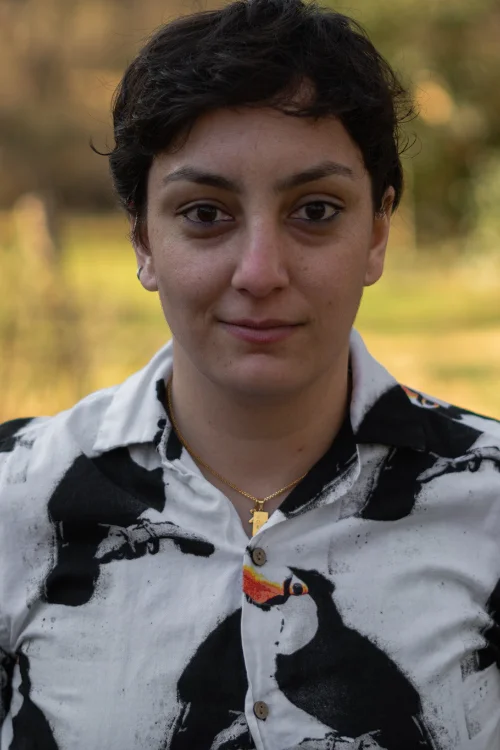
Zoe Grace Marquedant is a queer, Asian-American writer. She earned her B.A. from Sarah Lawrence College and her M.F.A. from Columbia University. Her work has been featured in Butter Magazine, In the Mood, 13tracks, and elsewhere. She is also a columnist for Talk Vomit.
Author’s website: https://zoegrace.uber.space