


Cricket’s Philanthropy
by Simon Mohsin
Dolbear’s law states that counting the number of cricket chirps per 15 seconds and adding 40 to the count will give the air temperature in Fahrenheit.
TF=40+N15
Exhausted and wanting to escape the heat of the scorching sun, the fledgling sparrows huddled together in the small gaps between the electric boxes on top of the long electric pole. As the city people increasingly cut down the trees, many birds are forced to build homes in unsafe places. The fledglings with sad eyes watched as their parents wandered around in the heat looking for food. At the end of the day, the little ones waited eagerly to talk to their parents, but their parents were already too tired. They returned home, fed the little ones, ate whatever was left over, and immediately fell asleep, dreading the next morning’s cycle.
The two fledglings, Titin and Tutun, don’t complain. Instead, they go to see their grandfather, who built a nest in the eaves on the roof of the house right beside the electric pole. The two siblings often went to their grandfather to hear his stories. That night, too, they went to see their grandfather after their parents fell asleep. They are no longer afraid of the dark. The lack of trees in Dhaka has put nocturnal beasts and hunters at a disadvantage, too. Owls and bats lack the necessary hiding places, making them rare.
As soon as they went to their grandfather, he said, “What story do you want to hear today, my dears?”
Titin responded sadly, “Grandpa, why is the weather so hot? Is there any way to figure out the weather for tomorrow? If I knew what the weather would be like, I would not let my parents out in this scorching heat.” Titin rambled as a hint of vulnerability flashed in his eyes. Their grandfather understood too well what was going on in their mind. But his response was mysterious, leaving Titin and Tutun to wonder what he meant.
“There is my dear, there is,” he said, “but the nature-destroying humans are ruining the natural habitat and stopping it from working.”
Tutun, curious as ever, asked, “What way are you talking about?” But his grandfather remained lost in thought. The children could sense that there was more to the story than he was letting on. What secrets lie hidden behind those words? The grandfather settled into his favorite armchair, his eyes twinkling with delight as he began to tell his eager grandchildren of a time when the world was lush and green. Everything seemed to stand still inside the small crevice in the eave, while outside, the city of Dhaka bustled with life, as horns and sounds of various kinds echoed.
The old sparrow spoke of the days before the buildings and concrete took over Dhaka city, when open windows welcomed not only people but also birds—sparrows, crows, doves, and even parrots—who flitted from balcony to balcony.

The old sparrow spoke of the days before the buildings and concrete took over Dhaka city, when open windows welcomed not only people but also birds—sparrows, crows, doves, and even parrots—who flitted from balcony to balcony. Squirrels scampered up and down trees, while owls or Bhutum Pecha darted about at night.
“And among them roamed another friend of ours: a cricket, who was as much a part of the city as its people,” said the grandfather with glowing eyes.
Tutun asked, “Is it a bug, Grandpa?”
But the old sparrow just smiled, “You don’t know what a cricket is? Then let me tell you.”
Their grandfather spoke with a twinkle in his eyes as he told the tale of the cricket who could fly faster than any other. The crows and owls could not catch him, for he was too quick.
“The cricket leader was my dear friend. One day, he decided to embark on a journey to visit all his followers across the country. Although he had never met them, the cricket leader had direct contact with them through messengers who carried his instructions far and wide,” started the grandfather.
“I told him not to go on this long and hectic journey, so did many of his advisers and messengers who were here in Dhaka. But crickets are headstrong creatures. Once they decide to do something, there is no changing their minds,” the old sparrow chuckled, saying these words.
“And so, the cricket set out on his journey, with some of his closest followers, flying fast over hills and valleys until he reached Sylhet—the coldest place in the country, and it was winter. I should tell you that although crickets could fly very fast, they could not continue for so long. So, he had to stop frequently on his way to Sylhet to rest. That’s why it took the leader a long time to travel around the country,” said the grandfather with a smile.
Titin could not be patient, and his curiosity forced him to ask the question, “Grandpa, did the leader tell you the tales of his journey after he returned?”
The grandfather, a little annoyed, urged him to have patience and listen carefully. He continued his tale, describing how the cricket leader had traveled to Sylhet to find his followers living well in the tea gardens. But despite their comfortable surroundings, the cold had made it hard for them to fly outside in winter, and the humidity of summer was equally challenging. When the chief went up further north of Sylhet, he discovered that the area had the highest rainfall in the country, making it impossible for crickets to fly outside during rain season. They were forced to hide in trees for most of the year, making them easy prey for crows and other birds. When his followers pleaded with him to find a solution, the cricket leader promised to consider their plight.
Tutun was about to ask another question, but his grandfather continued with his tale, not allowing the flow of the story to break.
He continued to tell them how the cricket leader then traveled to Chittagong, only to find it plagued by heavy rains and sudden floods. The trees were often damaged by landslides caused by heavy rains, leaving the crickets with no safe place to nest. The crickets could no longer know when it was safe to go out of their nests in the trees or when it was better to shelter in. Even if they could leave safely, there was no guarantee that their nests would survive. It was a life of uncertainty and danger that left them desperate for a solution. When they turned to their leader for help, he promised to do what he could and continued with his journey to other places in the country.
The leader’s journey took him to Rajshahi, where he was met with a landscape of dry rivers and swirling dust. The heat was unbearable, and even the birds struggled to fly in the harsh conditions. His followers told him of their difficulties living in Rajshahi, and the leader listened patiently. But amidst the bleak situation, there was a glimmer of hope— the people of Rajshahi were working tirelessly to find a way to solve their problems. Perhaps they would find a solution that could help not only themselves but all the animals that called this place home. Although this effort of the humans gave the cricket leader some hope, he was still upset that the crickets were suffering. He wanted to return to Dhaka, but his companions in the journey asked him to visit one more place. The leader agreed to their requests, and they arrived in Khulna. Here, too, they met with similar harsh conditions.
Khulna was plagued by intense heat and salty river water that damaged the plants and crops. The number of trees in the Sundarbans was decreasing, and the insects were struggling to survive in the harsh climate. The leader could no longer bear the suffering he saw around him and decided to return home to Dhaka.
The grandfather let out a weary sigh, “The cricket leader couldn’t help but think about how much Dhaka had changed during his absence. The people, driven by a desire for modernity, had cut down almost all the trees.” The old sparrow remembered that there was once a campaign run by the humans that for every tree cut down, five more must be planted in its place, but that campaign never became a reality. The once tree-lined roads of Dhaka now stretch barren and wide. Tall buildings and air conditioners have replaced the natural breeze and shade. They cool their homes with machines while making the outside world warmer.
The once tree-lined roads of Dhaka now stretch barren and wide. Tall buildings and air conditioners have replaced the natural breeze and shade. They cool their homes with machines while making the outside world warmer.
Fewer trees meant that there were fewer birds in the skies as well. In the past, wherever one looked, the comforting presence of flying birds was there. But today, trees have become scarce, and the cheerful sounds of birds and crows are all but lost. It was no different for the leader, for even the tree he called home fell victim to the constant changes. “Fate had a bitter irony,” the old sparrow continued, “as on the very day the cricket leader arrived in Dhaka, the tree that had been his home all his life was chopped down by humans to make more space for their buildings and roads.”
“On that heartbreaking day, a band of spirited children and passionate youth raised their voices in protest of the continuous tree cutting, but their pleas fell on deaf ears. The cricket leader, seeing his cherished home reduced to piles of wood and branches, wept in profound grief. Yet, despite his sorrow, he felt heartfelt gratitude for those brave children who had fought to save his beloved home. Their courageous efforts failed that day, but the leader hoped that they would continue in their noble quest. He strongly believed that someday, their collective efforts would stop the tide of destruction of nature.”
Tutun, brimming with enthusiasm and curiosity, inquired whether the cricket leader had indeed found a solution. Titin wondered whether the climate, environment, and nature could be saved.
The wise old sparrow, his eyes carrying the weight of time, responded, “Saving nature is only up to the humans. Our hopes are dependent on their actions.”
“Yet,” he continued, “seeing the scars that nature had endured, the cricket leader took a solemn vow that day, and his followers did the same. That day, the crickets, in solidarity with the wounded environment, stopped using their wings for flying as the bad weather didn’t allow them to fly, making their wings useless. Instead, they began making a constant chirping sound by rubbing their wings together.”
“Why, Grandpa?” Tutun and Titin inquired, their young faces full of curiosity.
Their grandfather, with a tender smile, responded, “When the chirping of these insects grows louder, everyone knows that day will be scorching hot. It’s a signal, allowing folks to prepare before going outside for the day. When the sound is gentle, it signifies cooler weather. It’s not just animals who benefit; people, too, can predict the temperature outside just by listening to the cricket’s chirp. I believe this is a gesture of the cricket leader’s gratitude to those young people who on that day tried hard to save his home.”
“When the chirping of these insects grows louder, everyone knows that day will be scorching hot.
“Wow, the cricket leader must be quite clever,” remarked Tutun, admiration glowing in his eyes.
However, Titin couldn’t help but wonder, “But how do these sounds solve the crickets’problems?”
The old sparrow admiringly replied, “Since the crickets do not fly anymore, they are able to stay safe inside their trees from harsh weather. At the same time, they’ve mastered their art of making the chirping sound to the point that the chorus comes from elsewhere, not their actual location.”
Tutun exclaimed, “Like a ventriloquist, Grandpa?”
“Yes, much like a ventriloquist. They use their art to hide their true location, making sure that predators remain clueless, and this ensures the crickets’ safety.” The grandfather explained with a nod and continued, “The leader did not forget us either.” With admiration for his friend, the cricket leader, he said, “When the crickets’ chirping sound becomes shrill and sharp, we, and all the crickets, know that danger lurks nearby, and we become alert and careful. Can you imagine the benefits that the cricket leader’s ingenious way has given us and so many others?” the old sparrow exclaimed with awe.
Tutun marveled, “That’s truly remarkable! I would love to meet our cricket friends.”
The grandfather gently cautioned, “In the urban forest of towering buildings in Dhaka, they have become few and far between. But as you both grow a bit older, we will travel to the villages, where nature is still comparatively untouched and safer than the cities. There, among the beautiful wilderness, our friends still call out to this day.”
Simon Mohsin is a multidisciplinary professional working at the intersection of political science, international affairs, and literary fiction. His diverse range includes children’s literature, experimental flash and microfiction in both Bangla and English, political analysis, and translation, with works that have appeared in Middle East Monitor, Libretto, and Views Bangladesh, among others. He is the author of the 2025 Bangla socio-political novel, Kantajir Kaktalio Kando (The Coincidental Incident in Kantaji), published by Swore O Books.
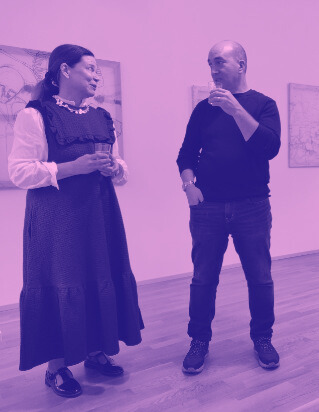
Tahia Tabani is an artist based in Bangladesh. Identifying as an “outsider and intuitive” artist, she focuses on socio-political themes, nature, and the lived experiences of her community. Her work spans oil on canvas, calligraphy, and traditional rural crafts, using these diverse media to document the emotional and social realities of her surroundings.