

Three Poems — The Dream/Curse: Art Notes From The Brain Cell
by Igor V. Satanovsky
These three pieces come from The Dream/Curse: Art Notes From the Brain Cell, a manuscript in progress. A pair of empty subway billboards, a painted face refusing legibility, a concrete museum built without blueprints are examined not for what they mean but for what they do to the observer standing in front of them. The writing treats artworks, buildings, and urban surfaces as devices that register what consciousness does when it collides with matter, shifting between lyric, analytical, and forensic registers as the subject demands.
TWIN VACANCY
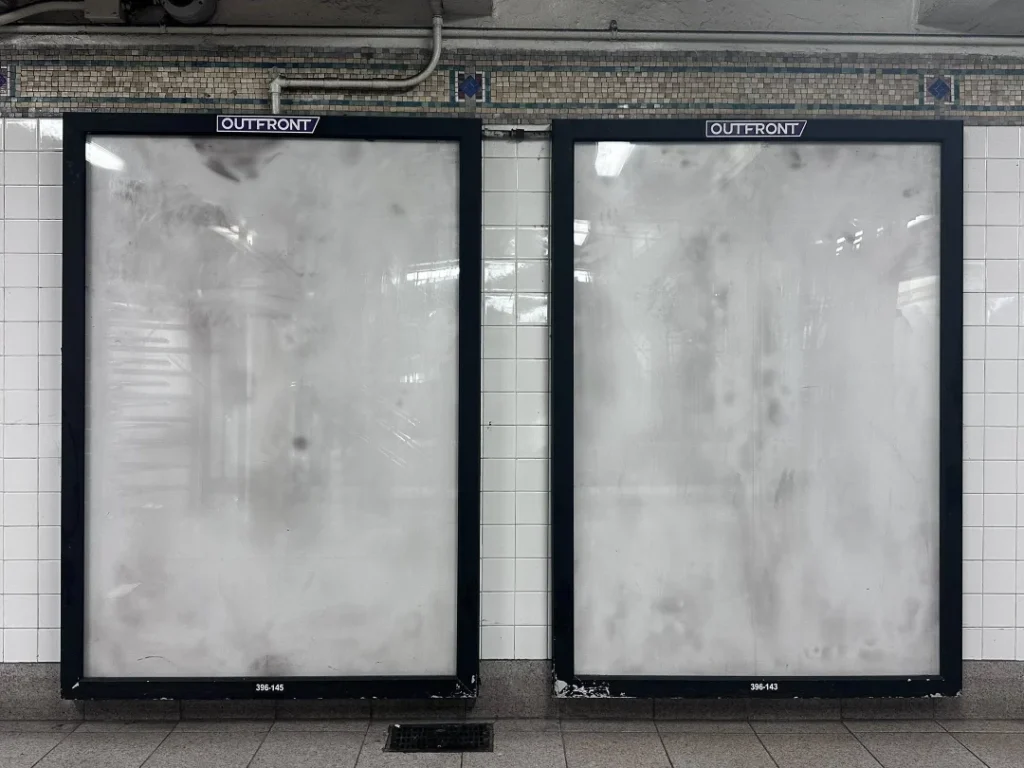
Two empty billboards face the turnstiles in a subway station—commercial real estate briefly unclaimed, already slipping the leash of its owners. Their glass is filmed with glue ghosts and subway dust. From one angle, the panels look blank; lean a little and a jacket, the ceiling fluorescents, a passing red sleeve drift across the half-mirror skin. Image forms only where residue meets reflection, and each small shift redraws the field. Beneath it all lies a quiet mulch of past campaigns and cleanings—time pressed into a pale, breathing haze.
A few steps farther and new geometries appear: a ceiling tube aligns with a diagonal smear, then fades; the turnstile lattice glides over both frames before falling away. The diptych recalls Rauschenberg’s early White Paintings—canvases that register whatever passes before them—yet here the surface is soot and glass, refreshed at commuter tempo. Observation sparks interference, composition dissolves, and nothing holds for more than a moment.
Because nothing is printed, absence turns asset. Paid space mutates into an open commons, curated by entropy rather than design. The loudest mark is the one withheld, proof that a tuned void can out-speak the billboard and, in doing so, pry a crack in the museum–ad continuum.
Observation sparks interference, composition dissolves, and nothing holds for more than a moment.
© Igor V. Satanovsky, 2025.
RECURSION, PAINTED
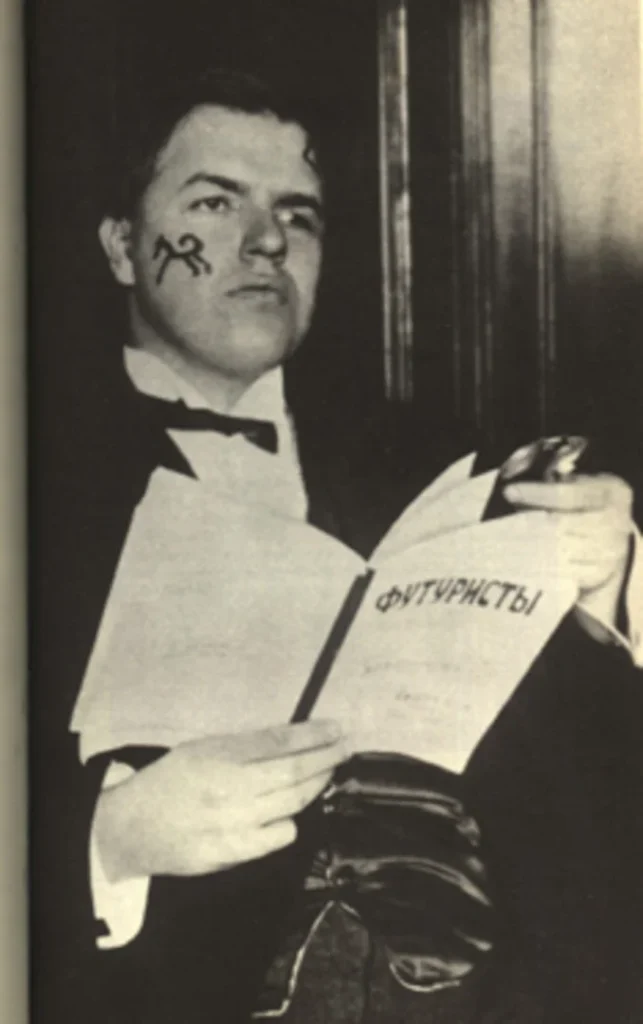
Burliuk’s original act—painting his face
to dissolve the boundary
between artist and art object—
loops forward a century and executes itself
again inside new conditions:
the surveilled, data-extracted self.
Every repetition now contains its ancestor.
The gesture no longer just saysI am art;
it says I re-enter the refusal of legibility
under intensified observation.
Each act folds back through time,
rewriting the earlier one—
a feedback ritual where each iteration
recalls and updates its own resistance.
In a regime that wants identity
to collapse into one verifiable profile,
the paint maintains superposition. The face lives
in simultaneous, contradictory states—
self/mask, individual/collective, authentic/artificial,
target/ghost. Cameras read camouflage
and declaration at once; the face both appears
and disappears—visible invisibility.
The gesture is a field-event—
aesthetic and political charge on the same coordinates:
time recursive, ontology in superposition,
semantics in interference;
noise thrown back into the observing system.
Burliuk’s paint: prototype of anti-recognition—
a living recursion, a superposition of selfhood—
resistance written on the face.
(For a contemporary extension of Burlyuk’s anti-recognition logic, see Adam Harvey’s CV Dazzle project.
In a regime that wants identity
to collapse into one verifiable profile,
the paint maintains superposition.
IMPROVISATIONAL ARCHITECTURE: MERCER MUSEUM AS SELF-DETONATING ARCHIVE
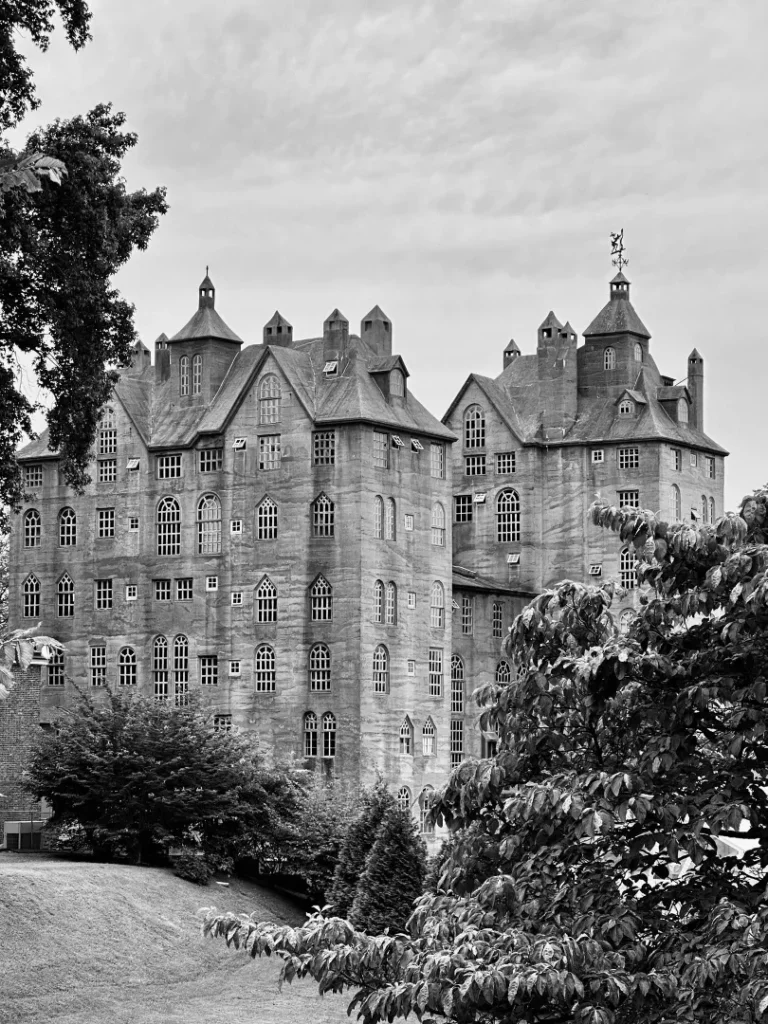
An eccentric outlier, the Mercer Museum rises in Doylestown, Pennsylvania like a poured-concrete gothic hallucination. Between 1913 and 1916 archaeologist-ceramist Henry Chapman Mercer built it without blueprints—sketched on the fly, then cast in cement. His earlier home-castle Fonthill rehearsed the tactic; the museum radicalizes it, turning architecture into real-time experiment.
Order meets you first. Fifty-five chambers array forty thousand pre-industrial tools—coopers, chandlers, smiths—each trade quarantined, every implement fixed to its function. Taxonomy rings the walls like a spell. Then the atrium detonates it.
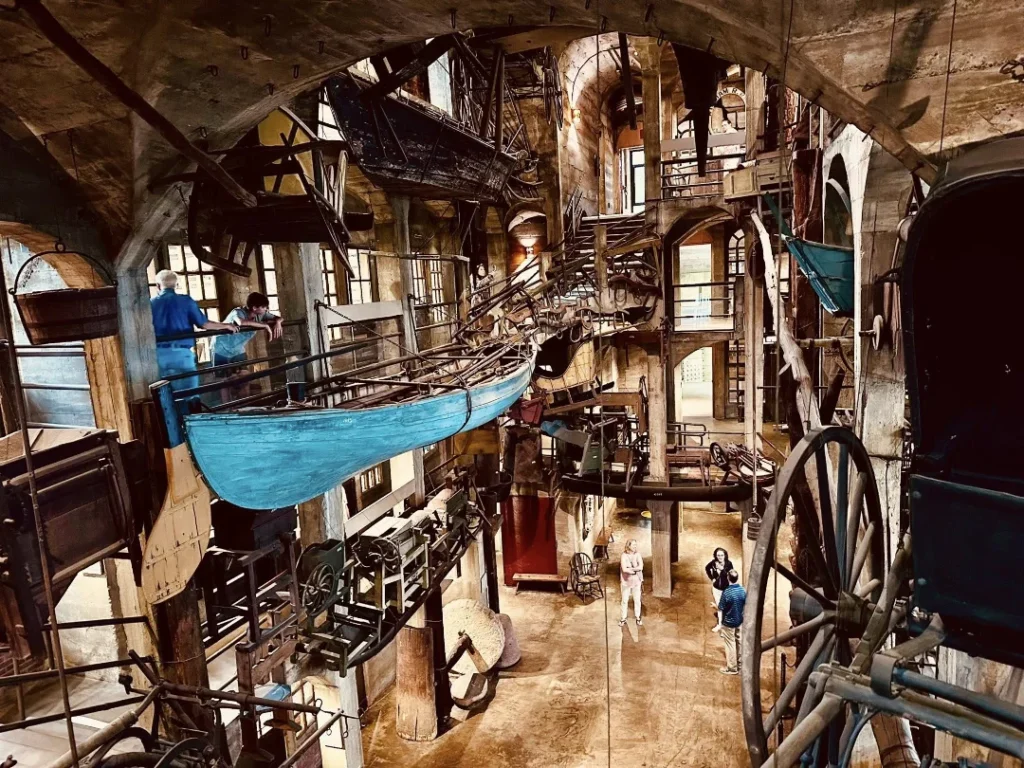
Through the six-story void wagons, a whaling boat, plows, and pulleys hang on steel cables, weightless yet menacing. The perimeter names and classifies; the center tears naming open. One step from alcove to void and you drop into controlled free-fall.
Concrete skins still carry the grain of their wooden molds, but in the atrium those lines kink into stress fractures; columns strain under the airborne cargo. The blue hull hangs right-side up, yet reads as a descent arrested mid-second. The building doesn’t depict collapse—it enacts it. Here the modernist impulse surfaces: Mercer preserves a fading world by sabotaging the very frame of preservation. Archive and anti-archive coexist, locked in structural contradiction. No slow entropy—an explosion frozen stiff. A museum built to remember, caught in the act of tearing its own memory apart.
Archive and anti-archive coexist, locked in structural contradiction. No slow entropy—an explosion frozen stiff. A museum built to remember, caught in the act of tearing its own memory apart.
Igor V. Satanovsky is a poet, curator, and artist raised in Soviet Ukraine who arrived in New York as a refugee in 1989. Author of ten poetry collections and recipient of the 2021 David Burliuk Prize (Otmetina) for experimental poetry, his work appears in Greening the Earth: A Global Anthology of Poetry (Penguin Random House India / Vintage Books, 2023). Since 2010 he has collaborated with the Boris Lurie Art Foundation on exhibitions at the NS-Documentation Centre in Cologne, the Berlin Jewish Museum, and the State Russian Museum in St. Petersburg. He co-hosts the Quantum Age Poetry Series at the Stavros Niarchos Foundation Library in New York City.
Image credit: Marta Jamiolkowska