

Prowizorium: The Endurance of Szczecin
Katarzyna Zimnoch and Paweł Kleszczewski
Intro
Last spring, Konik Studio’s artist-curator duo, Katarzyna (Kasia) Zimnoch and Paweł Kleszczewski, in association with the National Museum in Szczecin, opened Prowizorium, a massive three-part public exhibition marking the 80th anniversary of the city’s liberation. On view through September 28, the exhibition provides viewers with extended opportunities to joyfully commemorate and critically reflect on the complex and multi-layered histories of this lesser-known Polish city.
At its core, the exhibition centralizes the semantic depth of its name–Prowizorium–as a literal provisionality around how to speak of national identity, territory, and collective belonging when the very terms are in flux. By foregrounding temporariness over finality, Prowizorium acknowledges that the provisional, the incomplete, or the “not-yet” implied in its name, also offers opportunities to unsettle the overly deterministic historical narratives often used to define identity. It presents Szczecin as a creative cultural hub—a place where displaced persons, repatriates from the borderlands, and indigenous communities commingle and cocreate. In this sense, Szczecin becomes a city that contains in its unique singularity multiple and often contradictory situations.
As the culminating and most expansive of three interconnected projects, Prowizorium brings together contemporary art alongside archival elements such as the border post installation from The Border and archival catalogues, letters, and notes displayed on the Town Hall façade. We are therefore pleased to present to you this essay on Prowizorium, written by their organizers: Kasia Zimnoch and Paweł Kleszczewski. We hope that their take on their beloved city inspires critical and creative inquiry of our own home-cities, wherever they may be, where somber reflection is inseparable from joyful imagination.
Vuslat D. Katsanis
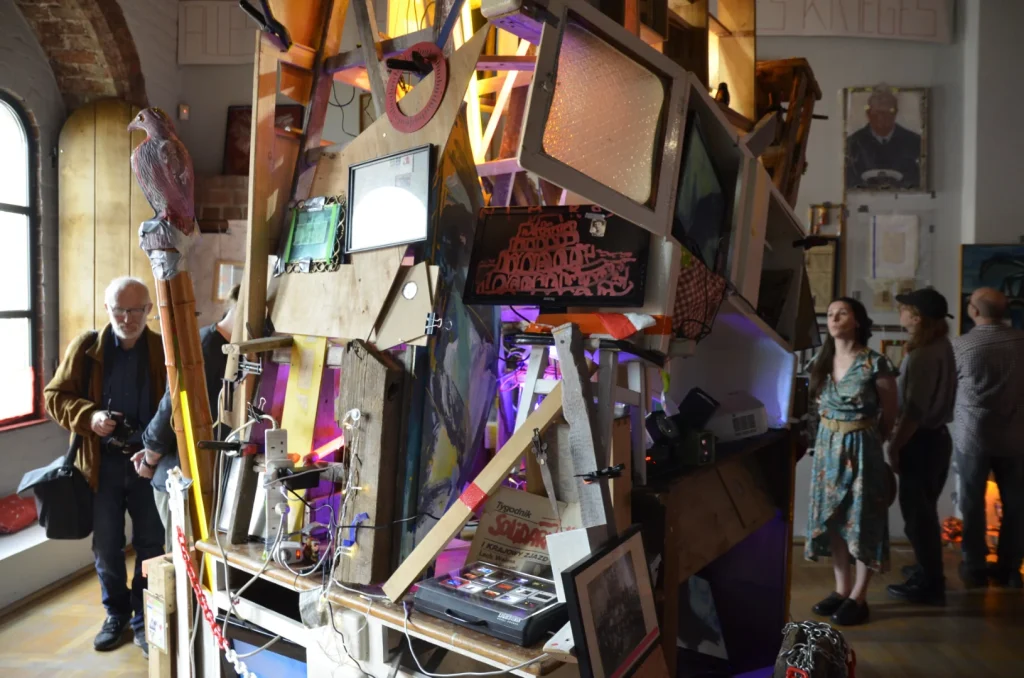
Prowizorium: The Endurance of Szczecin
Eighty years ago, Szczecin was “liberated.” It was incorporated into the Polish state. The “Matrix” was restored. Many things have been said and written about Szczecin’s complex history. One thing is certain: we have enjoyed peace in this corner of Europe for the same number of years.
In celebrating our city’s birthday in the spirit of all celebrations, with joy and reflection, our intention was to provide a total spatial experience that engages all the senses and guides the viewer through Szczecin’s stratified reality – the PROWIZORIUM exhibition, as a project not only about the history of Szczecin, but also about the temporality of everything – identity, space, memory.
“From all the corners of the world, from the rowan roads, where the forest is burnt and the wind is tired, the night and the front (…)”1 people chose to come to these “promised lands” to change their fate. And yet, there were also those who came to Szczecin by fate. All of them ended up in PROWIZORIUM, a “zombie city,” which for the next 80 years became something it never was, and in a bizarre way, identified with what it had always been – one of the greatest social experiments of the 20th century.
Prowizorium became home to our ancestors. A bit like the American settlers, they came and set up a Polish town here. Their children and their children’s children were born here. And now, here we are!
Despite the stories close to our hearts: the ones about Boleslaw Chrobry, Bogislaw X, Bolesław the Wrymouth, or King Leszczynski who called Szczecin their home, we are aware that someone was here before us.2 There was an Armageddon here, the biggest Armageddon imaginable that resulted in a total change of the entire culture.
The people who came here survived their Armageddons before. They came here with baggage that was often materially modest, but spiritually and emotionally filled to the brim.
Everything that took place had one reason: Joseph Stalin.
Stalin Polonised Szczecin and the whole of West Pomerania. In doing so, he completed the work of Chrobry and “conquered” Pomerania for Poland. In a sense, Stalin is the father of modern Szczecinians, albeit a pathological father. In those strange early post-war years, Piotr Zaremba, the city’s first and legendary mayor, described the time of solidification of Polish Szczecin as a PROWIZORIUM, or ‘a makeshift stage, a provisional measure.’
We artists, living here as the third generation, got the impression that what was meant to be only a provisional measure actually became the Prowizorium, defining the course of Szczecin, its art and its culture, for the next 80 years following the war in Poland. This provisional measure determined the course of relations between Szczecin and West Pomerania with Warsaw. One has to remember that there were no Polish autochthons here. Among the motherland’s children who returned to it, this one was the least Polish. The city’s separateness was highlighted by a kind of isolation and unfamiliarity, or a provinciality cut off entirely from the very large Polish urban centre. To this day, walking around nighttime Szczecin, one gets the impression that there is a low population density here– a bit like in Scandinavia. Too few people for a city of this size.
Since the beginning of Prowizorium, there have been artists here who came from various directions. There were outstanding ones who lived here, such as Konstanty Ildefons Gałczyński (1947-49) or Marian Tomaszewski (1945-51), but also those who could be outstanding on a national scale if they were not here: Sławomir Lewiński (1919-99), Tadeusz Eysymont (1924-91), or Bruno Tode (1956–). There were also those, like Władysław Hasior (1928-99), who came here temporarily but ended up staying.
Szczecin also introduced valuable innovations in Polish culture: from platform shoes and techno music, to X-man, Czesław Niemen, Fama Festival, Duma Pomorza, and the Festival of Polish Contemporary Painting. It is a port city, a “seaside” city, but also a city of melancholy. Once a city of trade, heavy industry and cross-border entertainment, it was also a city of car thieves, money changers, but also of the Maritime Academy, the University of Technology, and one of Poland’s windows to the world. It is a city whose undefined borders were left decided until the 1990s.
Szczecin is a city of descendants of brave but sad people – those who had to or wanted to leave their world when their brothers and sisters remained in their homeland.
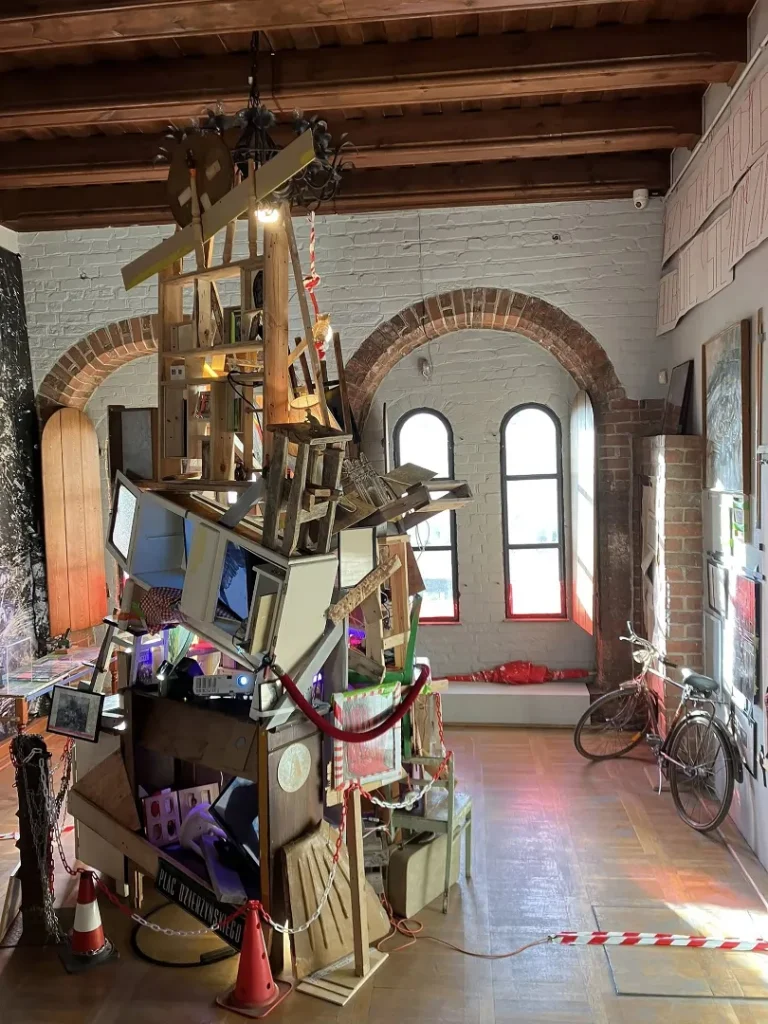
Szczecin is a city of descendants of brave but sad people– those who had to or wanted to leave their world when their brothers and sisters remained in their homeland.
As a Szczecin-based group, Konik Studio wants to express all the thoughts about our city, about its strange identity and about ourselves; the identity which is soaked-in here, talked about here, inspires our art and culture. In our common Prowizorium, we pinch, like with fingernails, the skin of the subject of the Recovered Territories, or if you prefer, the Western Territories (perhaps a nicer term?). This topic is one of the last undiscovered, great Polish topics. Poland is different when you look from the Węgliniec station, and different from Radom Główny. The Recovered Territories is a “newer Poland,” a very big one, and this “old Poland” does not really know it, and certainly does not know its history. The new Poland does not know its own history either; it has many different iterations.
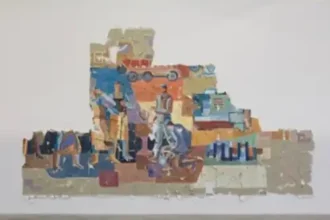
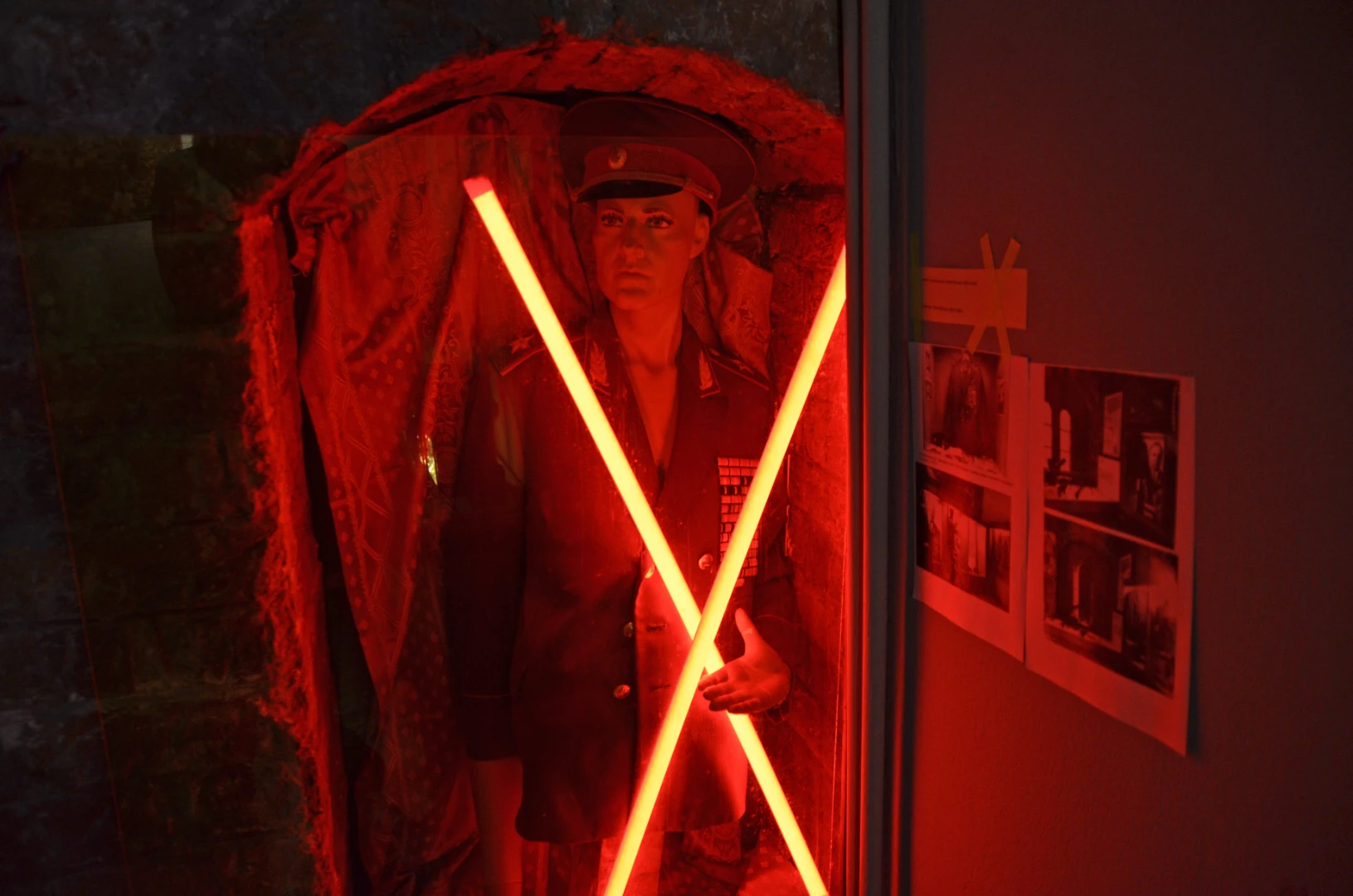
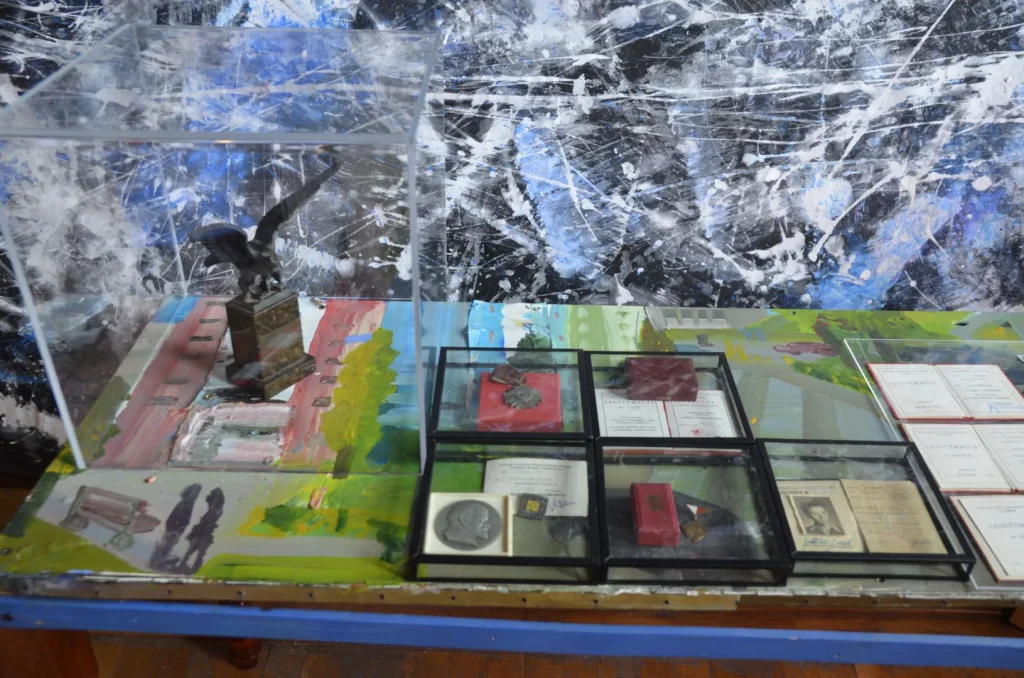
In many ways, the exhibition tells a story about the city and the artists. Why? Because despite the vast heritage of the past 80 years, there is very little awareness of the heritage of these lands. The exhibition attempts to fill this need, to bring together our collective action through an arrangement of works and artifacts from the collection of the National Museum in Szczecin, both the Szczecin History Museum and the Museum of Contemporary Art, alongside installations-hybrids from the Konik Studio universe, and organically related installations of works and objects by local contemporary artists.
Prowizorium, therefore, is a community action.3 It is a collective celebration that the city still stands proudly with its back straight. Even the very place where this exhibition was arranged – the Old Town Hall – marks survival after the turmoil of war. The town hall has always been a sign of the city’s strength and self-government, of its independence from the powers of Dukes and of the Church. This is where we give voice to the people, artists and art throughout the generations from the post-war period to now.
This stratified reality of ours sometimes arranges itself—as in the crystal ball of a fairy (which perceptive artists often are)—into a clear, coherent whole: a wounded, bristling, and partially amnesiac construct of a non-corporeal yet embodied spirit, with all its existence refined. This is a story about Szczecin and its art, about the transitional state that has come to endure. This is a celebration, both conscious and joyful, but also full of reflection on a city that is still not quite our own, yet is already our home.
This is a story about Szczecin and its art, about the transitional state that has come to endure. This is a celebration, both conscious and joyful, but also full of reflection on a city that is still not quite our own, yet is already our home.
Prowizorium: The Old Town Hall
Once the turmoil of war was over, your windows were sealed with bricks. You had no roofing; just a facade with a Baroque gable towering over your walls. Your eyes had seen too much; your panes scattered from the chaos of wartime events; your interior deserted. And when things calmed down and everything was cleaned up, your flaking walls held the whole building upright. Now they called you the “Town Hall.”
You’ve witnessed, you’ve shown, and you’ve survived. You have been a part of the Polish Szczecin for eight decades now. People used to gather in you to serve justice; now they gather in you to see what is left. And how you have been filled anew!
This year actually marks the 50th anniversary of your body made functional again, this time, as the Szczecin History Museum. Your new body– rebuilt, renamed, and refilled, will also be part of the celebration.
A lot has changed over the last 80 years, since you looked with empty eye sockets at the rubble around you and wondered what would happen next. Our perspective is that of third-generation Szczecinians– residents of a city that you love unconditionally, even though it feels like you get slapped for every kiss. In this room, in the Town Hall, we set up a hybrid installation, hastily assembled from whatever is at hand. This is our kind of object – ordered chaos – in a way, a personification of the city itself: a temporality that has never faded into the “common sense” of its inhabitants, a perpetual “makeshift,” although set on a foundation of stone slabs with inscriptions of past inhabitants.
Footnotes:
- Lyrics by Agnieszka Osiecka, music for which was composed by Krzysztof Komeda. ↩︎
- Bolesław I Chrobry (967-1025), ruler of Poland from the Piast dynasty. Bogislaw X (1454-1523), a Pomeranian duke of the Gryffin dynasty. Bolesław III the Wrymouth (1086-1138), prince of Poland. Stanislaw Leszczynski, twice king of Poland, stayed in Szczecin at the castle (present Pomeranian Dukes’ Castle) in 1711. ↩︎
- ‘Community action’ was popular during the communist era. It was work performed unpaid for the benefit of society, on non-working days. Most frequently, it was held by schools or workplaces. On the one hand, it was a form of exploitation, on the other, a pleasant way of creating ties with peers and colleagues. Most of the participants in such works remember the experience positively. ↩︎
Credits:
The three-part exhibition, Prowizorium, opened on May 22, 2025, as a joint venture of Konik Studio’s artist-curator duo, Katarzyna Zimnoch and Paweł Kleszczewski, in collaboration with Andreas Menhard, Prof. Eryk Krasucki, Marek Lawlor, Krzysztof Kuźnicki, Bartłomiej Hajkiewicz, Doktor Szpera, Sławomir Zmaciński and Edyta Woźniakowska, and Edyta Woźniakowska. The exhibition and public programming were carried out with Małgorzata Peszko and Dr. Anna Lew-Machniak of the National Museum in Szczecin — Szczecin History Museum. It is on view until September 28, 2025
About the authors:
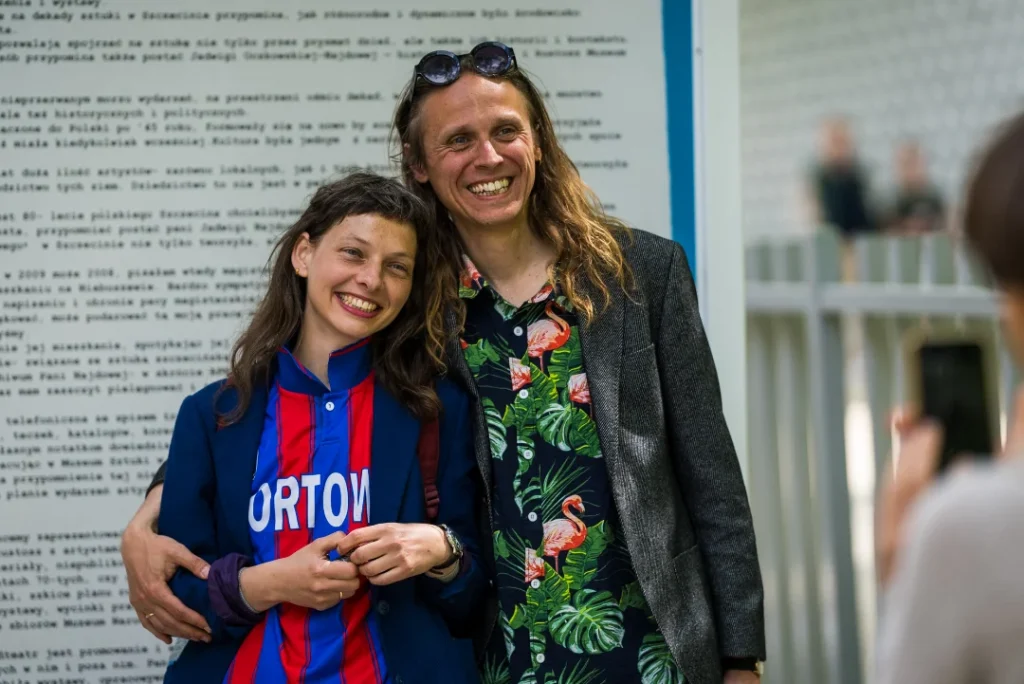
Katarzyna (Kasia) Zimnoch and Paweł Kleszczewski are a duo of filmmakers, curators, and visual artists. They graduated from the Faculty of Fine Arts at Nicolaus Copernicus University in Toruń. In 2013, they founded Konik Studio in Cavan, Ireland, which they moved to Poland seven years later. Their work has been presented at over a hundred international film festivals and art exhibitions, winning awards and distinctions, including the Best Animation Award at the 29th Fano Film Festival in Italy, the Best Animation Award at the 20th Clones Film Festival in Ireland, the Silver Sack from O!Pla Polish Animation, and special distinctions from the Ale Kino!, Szczecin Film Festival, and Opolskie Lamy festivals in Poland. Among the duo’s numerous distinctions are scholarships from the Ministry of Culture and National Heritage (2023 and 2024), and the Network Scholarship from the National Centre for Culture (2020). At the turn of 2023 and 2024, the National Museum in Szczecin organized a major monographic exhibition, “Konik Studio Timeline,” showcasing the duo’s ten-year output. Currently, the artists live and work in Szczecin, where they curate the STAR and Amfiteatr galleries.