

Quiet Embraces: Edgar Arceneaux’s Shards at 68projects
On view: 10 Sep – 25 Oct 2025
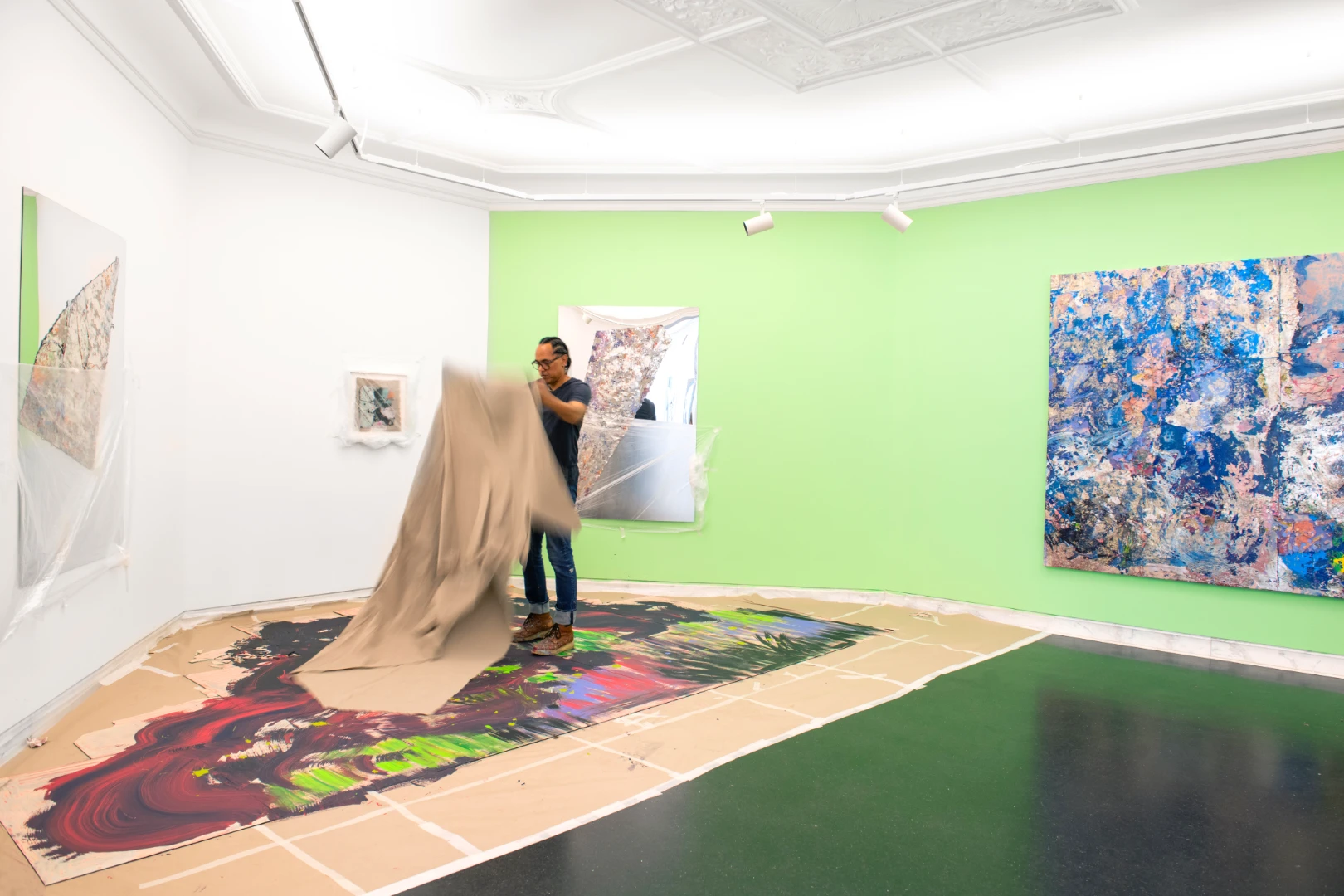
He talked in his usual calm, familiar voice. It’s the voice I remember from UC Riverside where he had freshly started teaching art theory classes. Now, years later, by chance in Berlin, I was bringing my own students to his talk. He chose his words carefully while on his knees to skin another layer of paint and metallic matter. Pausing in between his words, he looked thoughtfully at us, then back to his work. “How can I be him, but also me?” he asked conclusively, after telling the story of being raised in the image of his father whose name he bears, and for whom his aging mother, at the peak of her battle with dementia, consistently mistook him for.
The question of difference and resemblance, the understanding that one carries in their body the past legacies of others and the simultaneous wish to find oneself underscores Edgar Arceneaux’s latest series of work in Shards. As with his previous work, these deeply personal inquiries reveal larger sociopolitical and epistemological questions. How do the echoes of our pasts seep into the present in new and maybe even unexpected ways? What do these layers of meaning reveal to us about who we are and what may become?
As one of six siblings, Arceneaux grew up in a close and loving family with a strong matriarch. But that same woman who sustained her family, in her aging years, depended on her adult kids to take turns caring for her. He recalls bathing his mother one day, lifting her body into the bathtub and seeing the belly in which she bore six babies, “shriveled like a raisin,” he says.
Arceneaux has been working with mirrors for at least twenty years, but began focusing more closely on mirrors as a material after the COVID-19 Pandemic. This time period coincided with his mother’s declining health, when he decided not to make art the way he was used to. “I decided to reorient my practice,” he explained, and added “I decided to take a leap and follow where the material would lead me.”
Unexpectedly, Arceneaux turned to chaos theory and the mathematician, Mitchell Feigenbaum, who stated that if you take something and repeat it over and over again, you’ll begin to see endless possibilities emerge.
The question of difference and resemblance, the understanding that one carries in their body the past legacies of others and the simultaneous wish to find oneself underscores Edgar Arceneaux’s latest series of work in Shards.
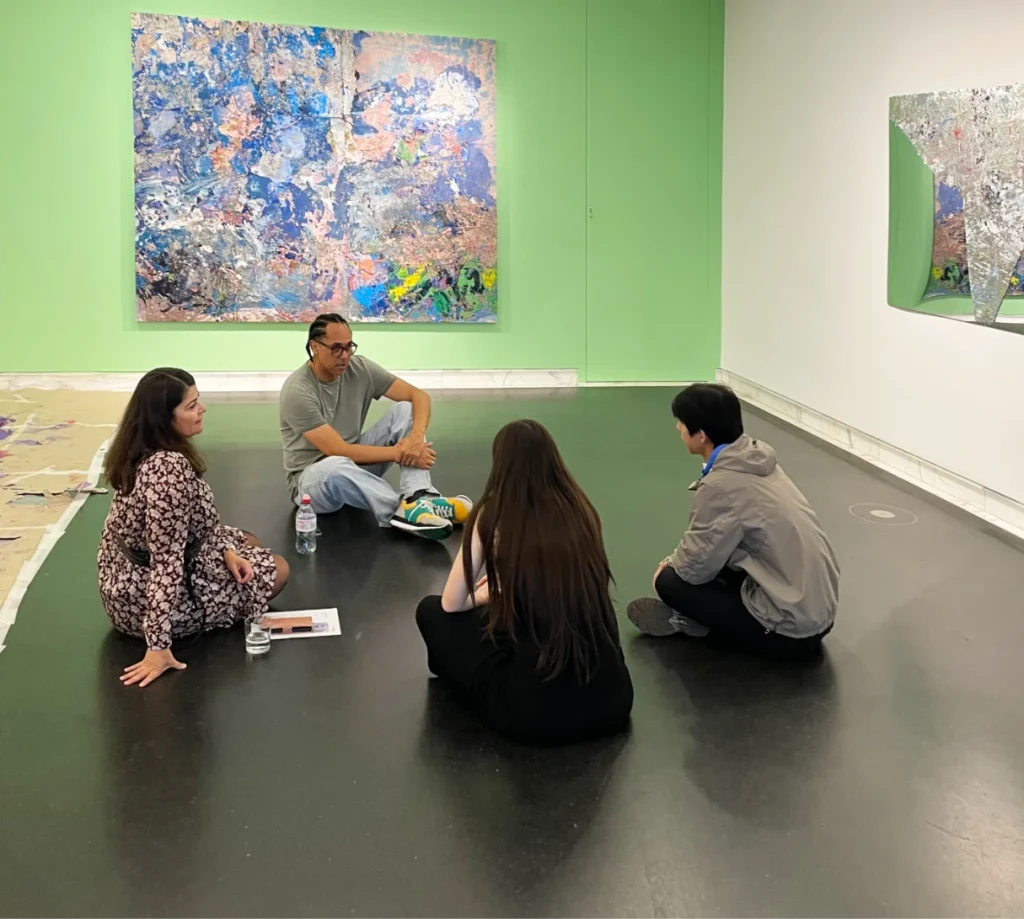
“The chance encounter, the coincidental, the serendipitous allows one to take counter-intuitive leaps,” he says thoughtfully, pacing his words. “When we think of History with a capital H, that is official, recorded history, we always find excluded things. US history in particular is full of obscured and erased stories.”
The act of repetition as a chance encounter to uncover things left out of sight, or the idea of serendipity more precisely, is what intuitively guided Arceneaux’s interest in mirrors. In his previous works, such as The Library of Black Lies (2013-18), mirrors were used to fragment and disrupt the sense of spatial continuity toward a critique of history and historiography. “The chance encounter, the coincidental, the serendipitous allows one to take counter-intuitive leaps,” he says thoughtfully, pacing his words. “When we think of History with a capital H, that is official, recorded history, we always find excluded things. US history in particular is full of obscured and erased stories.”
Arceneaux’s past projects are very clearly research-driven. A Book and A Medal (2014) for example, was based on the FBI releasing the so-called ‘suicide letter’ to Martin Luther King Jr., the year he was to receive the Nobel Peace Prize. But five months after the letter was released, his daughter Bernice King released her own letter, going against her family for attempting to sell their father’s books and the Nobel medal. Arceneaux explains, “Not only were these materials valuable for the family on a personal level, but they were now of historical and archival value, and also of capital value as commodities to be traded for profit.” Looking back on his research-based practice, Arceneaux concludes, “every relationship is triggered by chance.”
Whereas his practice to date always depended on a personal connection with a larger historical subject, in Shards, he chose to be guided by the material process alone.
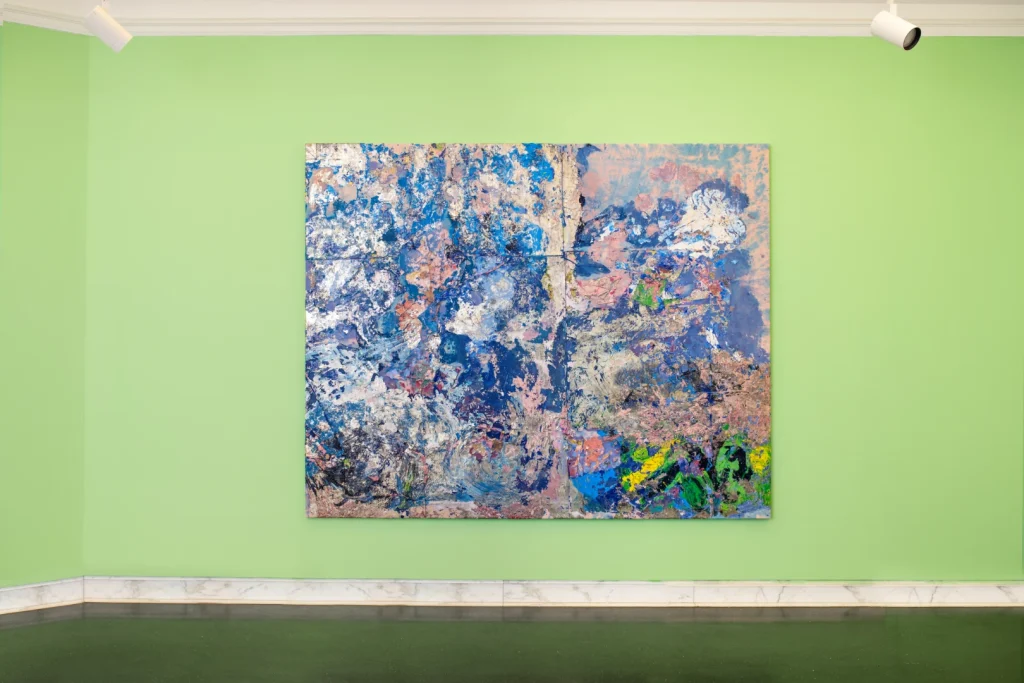
Whereas his practice to date always depended on a personal connection with a larger historical subject, in Shards, he chose to be guided by the material process alone. Putting aside the search for meaning, mirrors in Shards function first and foremost as a material. The process of skinning the mirrors reveals quite literally what’s hidden underneath, transforming the hard metallic matter into a soft leathery texture bound on canvas with pigment. The mirrors, then, not only trouble our relationship with the body, but also our sensory expectations. As he later came to discover, the process was preparing him for his mother’s eventual transition. “Though I was avoiding telling a story, the paintings were telling me what was happening.”
Shards presents viewers with mirrors, both broken and skinned, of various scales: one suspends from an iron bar near the ceiling like a flag; another drapes off the surface of a canvas; one is framed in two parts with hand-written notes like the pages of an annotated book. Each glimmers like specs of stardust, having been skinned and reworked to lay bare their underside. There is almost an archeological quality to the artist’s process. He lets what was in the background come forward, not knowing exactly what will emerge over time. The end result of scraping the metallic surface enacts a kind of serendipity in that the backside of the mirror becomes the first image the viewer encounters, just as the canvas’s reverse side and the paint that seeped through it rise to the foreground in the finished work. In this process of reversals and repetition is another chance encounter: “The colors of the paintings change over time, absorbing matter in the air, the history of the locale, and the DNA of their environment. They’ll continue to change until the paintings are sealed,” he adds profoundly. In a method akin to an excavation of past layers is also a chance encounter to record our living, breathing, emerging present.
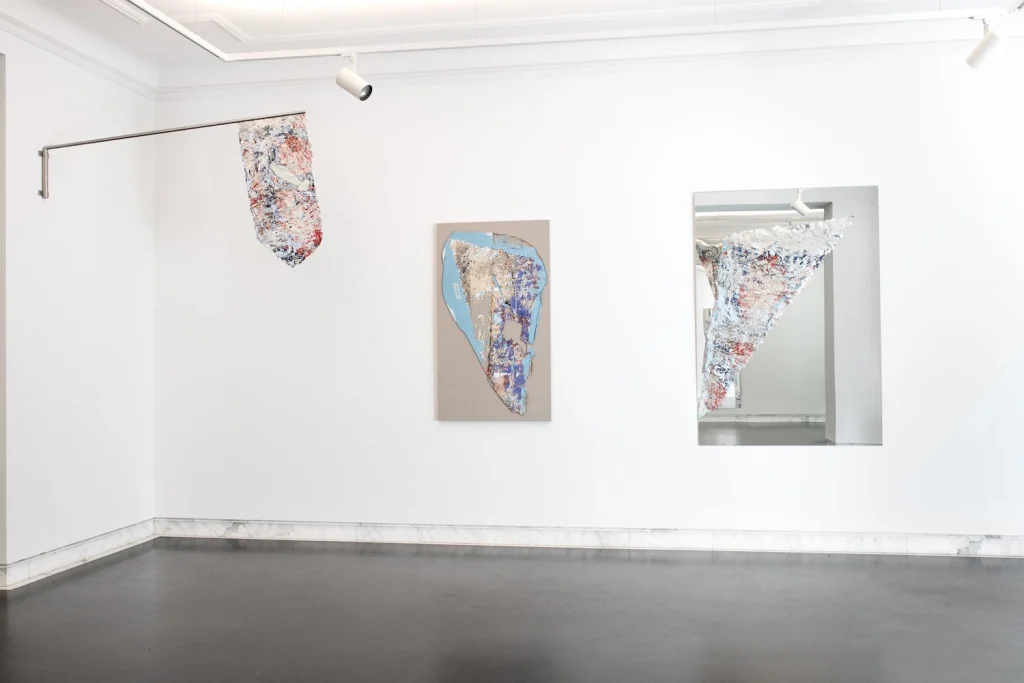
“The colors of the paintings change over time, absorbing matter in the air, the history of the locale, and the DNA of their environment. They’ll continue to change until the paintings are sealed,” he adds profoundly. In a method akin to an excavation of past layers is also a chance encounter to record our living, breathing, emerging present.
Aesthetically, the works in the exhibition are bold and confident with vibrant colors among jagged glass edges and radio fractures. “People often talk about violence when they look at broken glass,” he says somewhat defiantly, “but I like to see these radiofractures as quiet embraces, where the grooves of the cracks try to meet themselves where they were.” On the other hand, the vibrant colors of reds and blues echo the violence attacking the artists’ hometown of Los Angeles. “I had in mind fire and ICE,” he laments, referencing the recent events unfolding in California. The reds and blues remain defiant yet poised, suggestive of a survivor’s rueful joy.
Despite the desire to put stories away, we find ourselves surrounded by them– in the slow labor of mourning a mother’s passing, in confronting hostile attacks on our communities, in the search for who we are, and in the small acts of care that bind us together. The skinned mirrors in Shards prepare us to see more than ourselves here and now. They offer reflection on past legacies and suggest possibilities to move forward. Like quiet embraces, the exhibition invites us to take unexpected leaps across the artist’s technical craft and metaphoric complexity. In this convergence, Arceneaux’s mirrors come to the surface as thresholds, where grief and resilience, fragility and possibility, coalesce into one another.
Shards opened at 68projects by Kornfeld on September 10, 2025, as part of the Berlin Art Week. The exhibition marks Arceneaux’s debut with the gallery and is the culmination of his summer residency at 68projects, organised in collaboration with Villa Aurora & Thomas Mann House.
Shards is on view through October 25, 2025 at 68projects by KORNFELD in Berlin.
Edgar Arceneaux
https://studioedgararceneaux.com
Los Angeles-based artist Edgar Arceneaux is a celebrated multidisciplinary artist working across drawing, installation, film, and performance exploring layered histories, language, and identity. Edgar Arceneaux’s work has been shown internationally at renowned institutions, including the Whitney Museum of American Art in New York, the Hammer Museum in Los Angeles, the Museum of Contemporary Art Detroit, the MIT List Visual Arts Center in Cambridge, and the San Francisco Museum of Modern Art. In Europe, his work has been presented at venues such as the Palais de Tokyo in Paris, Kunstverein Hannover, and Hamburger Bahnhof in Berlin. His works are part of major public and private collections, including the Museum of Modern Art (MoMA) in New York, the Deutsche Bank Collection, and the Studio Museum in Harlem. The artist lives in Pasadena and is Associate Professor at the University of Southern California in Los Angeles. He is also the co-founder of the Watts House Project.
About 68projects
68projects by KORNFELD is an internationally recognized project space in Berlin, founded in 2014 by Galerie KORNFELD. Located in the city’s culturally vibrant Charlottenburg district, 68projects serves as an open platform for artistic exchange—embracing everything that is new, foreign, and familiar.
The project space presents a dynamic program of solo and group exhibitions, often curated in collaboration with both international and local curators. At the heart of 68projects is its international artist residency programme, which invites artists to live and work in Berlin for several weeks or months. In addition, 68projects maintains a longstanding annual collaboration with Villa Aurora & the Thomas Mann House, strengthening its commitment to transatlantic cultural exchange and interdisciplinary dialogue. As a space dedicated to supporting both emerging and established voices, 68projects stands for artistic freedom, cultural curiosity, and the creation of meaningful connections across borders.
Special thanks to Dr. Tilman Treusch and the team at KORNFELD Galerie Berlin, and to artist, Louis Cameron.

Vuslat D. Katsanis
Dr. Vuslat D. Katsanis specializes in comparative literature, film, and visual culture with a focus on Turkish and global migrant cultural production and critical theory. She is the co-founding director of the MinEastry of Postcollapse Art and Culture (MPAC), an independently run art and research space based in Switzerland.