


Edward Hirsch – Conversation & Three Poems
for the series, The American Wing
curated by Carlie Hoffman and Tiffany Troy
Carlie Hoffman & Tiffany Troy: In this mini-interview and folio of poems, Chicago-raised poet Edward Hirsch considers how to approach the question of what is American poetry through his lived experiences overseas, which brings into perspective both the insatiable American greed and the countervailing impulses to articulate a perception or feeling in lyrical form. It is curious how often poets are most themselves (and here, American) when they are out of place (like in Krakow at 6 a.m.). How would you describe the origins or influences of your language and voice as a writer?
Edward Hirsch: Like Saul Bellow’s character in The Adventuries of Augie March, “I am an American, Chicago born—Chicago, that somber city—and go at things as I have taught myself, free-style…” I started reading and writing poetry seriously in college—like all autodidacts, I read it helter-skelter, out of order—and fell in love with the eloquent tradition. You name ‘em, I read ‘em. Like a sponge, I absorbed what I read. But it took me a long time to internalize my influences, to use them to articulate my own experience. Ever since, I have been trying to write poems that only I could write, that seem addressed to me. The language I have hit upon is an American idiom that reaches for clarity and eloquence.
CH & TT: In your view, what can poetry offer people today? In “Mergers & Acquisitions,” the Schumpetarian march towards creative destruction undergirds “a childhood fever.” Is poetry about bringing to light “a lost radiance”?
EH: Poetry can do many things, but one of the main things it does is to put us in touch with our inner lives. It helps us to name and clarify experience. It helps us to understand ourselves, our consciousness. Wallace Stevens put it wonderfully when he concluded that poetry has “something to do with our self-preservation.” The classroom may be a good place to talk about poetry, but poetry doesn’t exist for the classroom. On the contrary, as Stevens argues, “the sound of its words, helps us to live our lives.” That’s what I believe. Some poems terrify, others console. Some estrange experience, others confirm it. Some poems show us that we have lost our radiance, others try to reclaim it.
CH & TT: There is a real breadth to your poems, which bring in the history of migration and immigration that makes America possible. Writers often build their own creative canon over time. Which poets, writers, artists, or musicians have shaped yours?
EH: There are far too many to name. I have tried to answer this question in a series of prose books, like How to Read a Poem and Poet’s Choice and 100 Poems to Break Your Heart. I will say that in my early twenties, I started to move outside the English and American canon, to find an alternative to the coldness of Anglo-American modernism. That’s when I discovered other models in poets like Nazim Hikmet from Türkiye and Miklós Radnóti from Hungary. I put myself to school on the great Russian poets, Anna Akhmatova, Marina Tsvetaeva, and Osip Mandelstam, and the post-war Polish poets, Czeslaw Milosz, Zbigniew Herbert, and Wislawa Szymborska. I love a few French surrealists, such as Robert Desnos and Paul Éluard, but my heart belongs to the Spanish language surrealists, Federico García Lorca and César Vallejo. Paul Celan permanently unsettled my ideas about poetic language. Those poets changed my life.
CH & TT: Is there a poem or poetry collection you believe everyone should read at least once—and why?
EH: Every American should read Walt Whitman and Emily Dickinson. It will help them think about what it means to be an American (Whitman) and to have a soul (Dickinson). At least that’s what they did for me.
Harold Bloom argued that Shakespeare invented the human. That’s probably overstating it, but one gets the gist. Dante is also inexhaustible.
CH & TT: What guidance would you give someone reading poetry for the first time?
EH: Find yourself a quiet spot and turn off the television set. Let the sound of the words work inside you. Don’t worry too much about understanding every word, every line. T. S. Eliot was onto something when he said, “Genuine poetry can communicate before it is understood.” Take it easy. A written poem is meant to be read. As a reader, you are its destination.
CH & TT: What are your hopes for the future of American poetry and its place in our culture?
EH: That’s too large a question to answer in full, but let’s start by saying that our job as poets is to preserve the language. Personally, I savor our mongrel English tongue and the way that American poets have employed our vernacular. Pick up a poem by Frank O’Hara (“Having a Coke with You”) or Gwendolyn Brooks (“We Real Cool”) and you immediately feel the vitality. Marianne Moore boasted that our poems are written “not in Greek, not in Latin, not in shorthand, / but in plain American which cats and dogs can read.” A demotic linguistic energy—what William Carlos Williams calls “the speech of Polish mothers”—is one of the pleasures of the American poetic project. Let’s keep it going.
CH & TT: What is American Poetry?
EH: American poetry is the first true poetry of democracy in world literature. It reminds us that our country is a plurality, one and many, a culture of individuals—“Individualism is a novel expression, to which a novel ideal has given birth,” de Tocqueville explained in Democracy in America (1840)—that is also a collective, a Commons. We are ever balancing an ideal of self-reliance with a binding sense of the equality of souls.
American poetry continually revises its language to keep up with a changing American reality. It also participates in a conversation about American life. So, too it holds us to our foundational premise that all people are created equal. It critiques our society when we let ourselves down, but it also recognizes our unique possibility as a nation.
As an American poet and critic, I tend to be on the upbeat, ever optimistic that our country can do better. I love the promise in two lines from Wallace Stevens’ poem “Evening Without Angels”: “Where the voice that is in us makes a true response, / Where the voice that is great within us rises up.” Stevens suggests that this voice cannot be contained or repressed. It belongs to all of us. We all have access to it. It is a divinity that lives within ourselves. We are part of a greater music.
KRAKOW, 6 A.M.
(for Adam Zagajewski)
I sit in a corner of the town square
and let the ancient city move through me.
I sip a cup of coffee, write a little,
and watch an old woman sweeping the stairs.
Poland is waking up now: blackbirds patrol
the cobblestones, nuns rush by in habits,
and the clock tower strikes six times.
Day breaks into the night’s reverie.
The morning is as fresh and clean
as a butcher’s apron hanging in a shop.
Now it is pressed and white, but soon
it will be spotted with blood.
Europe is waking up, but America
is going to sleep like a gangly teenager
sprawled out on a comfortable bed.
He has large hands and feet
and his dreams are innocent and bloodthirsty.
I want to throw a blanket over his shoulders
and tuck him in again, like a child,
now that his sleep is no longer untroubled.
I’m alone here in the Old World
where poetry matters, old hatreds seethe,
and history wears a crown of thorns.
Fresh bread wafts from the ovens
and daily life follows its own inexorable
course, like a drunk weaving slowly
across a courtyard, or a Dutch maid
throwing open the heavy shutters.
I suppose there’s always a shop-girl
stationed in the doorway, a beggar taking up
his corner post, and newspapers fluttering
from store to store with bad news.
Poetry, too, seeks a place in the world—
feasting on darkness, but needing light,
taking confession, listening for bells,
for the first strains of music in a town square.
Europe is going to work now—
look at those two businessmen hurrying
past the statue of the national bard—
while her younger brother sleeps
on the other side of the ocean,
innocent and violent, dreaming of glory.
MERGERS AND ACQUISITIONS
Beyond junk bonds and oil spills,
beyond the collapse of Savings and Loans,
beyond liquidations and options on futures,
beyond basket trading and expanding foreign markets,
the Dow Jones industrial average, the Standard
& Poor’s stock index, mutual funds, commodities,
beyond the rising tide of debits and credits,
opinion polls, falling currencies, the signs
for L. A. Gear and Coca Cola Classic,
the signs for U. S. Steel and General Motors,
high-grade copper, municipal bonds, domestic sugar,
beyond fax it and collateral buildups,
beyond mergers and acquisitions, leveraged buyouts,
hostile takeovers, beyond the official policy
on inflation and the consensus on happiness,
beyond the national trends in buying and selling,
getting and spending, the market stalled
and the cost passed on to consumers,
beyond the statistical charts on prices,
there is something else that drives us, some
rage or hunger, some absence smoldering
like a childhood fever vaguely remembered
or half-perceived, some unprotected desire,
greed that is both wound and knife,
a failed grief, a lost radiance.
A SMALL TRIBE
The legend
of a small tribe
who crossed the steppes
to become Eastern European
eyeglass grinders
with weak eyesight,
horse traders, deserters
from the Russian army,
peddlers, impractical merchants,
men who cried
at the sad stories of women
in tenements, who made
their mothers laugh
over steaming cups of coffee
at the kitchen table,
social democrats
who argued with anarchists
and communists
failed businessmen
who snuck into Carnegie Hall
to hear Rubinstein playing Chopin
and then stood on a soap box
in Union Square shouting for justice
in the Spanish Civil War,
who loved used bookstores
and the musty back stacks
of old libraries
but started a drug store in Rochester
or sat on his suitcase
waiting for the train
to misfortune
selling shirts on Maxwell Street,
asthmatics, non-assimilators
whose daughters
married developers
who never developed
and scrap metal dealers
looking for an honest advantage,
a gambler who beat the house
and lost everything
three times, a box salesman
who could not contain himself,
a scribbler, my favorite
was a daydreamer
who bought a new hat
every year for Passover
so that he could stand outside
the temple,
which he refused to enter,
though he loved the songs
and wanted to be close to the prayers
About the Author:
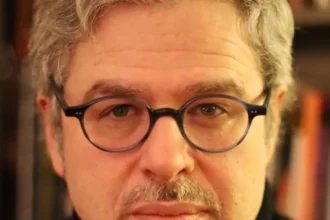
Edward Hirsch is a celebrated poet and peerless advocate for poetry. A MacArthur fellow, he has published ten books of poems and eight books of prose. He has received numerous awards and fellowships, including the National Book Critics Circle Award, a National Endowment for the Arts Fellowship, the Rome Prize, a Pablo Neruda Presidential Medal of Honor, and the American Academy of Arts and Letters Award for literature. He serves as president of the John Simon Guggenheim Memorial Foundation and lives in Brooklyn.