

Naoko Fujimoto – Conversation & A Poem
for the series, The American Wing
curated by Carlie Hoffman and Tiffany Troy
Carlie Hoffman & Tiffany Troy: Your work is shaped by the experience of writing across languages and follows the footsteps of Japanese poetry forms (such as the zuihitsu or haibun) and visual forms (such as the manga or emaki), to tell your personal, familial, and Japanese national history from the United States.
How would you describe your approach to writing and the influences on your voice as a poet?
Naoko Fujimoto: I am a Japanese female poet. English is my second language. I was an exchange student at Indiana University South Bend, where I learned how to write. My writing has progressed from my first book, “Where I Was Born” (Willow Books 2019), to “of Women” (Tupelo Press 2026). I am becoming comfortable being me as an author. My journey will continue.
CH & TT: In your view, what can poetry offer people today? What personal meaning does poetry hold for you?
NF: Poetry is like a cup of affogato—a vanilla scoop drowned in an espresso. After the last sip would coat our tongues with vanilla bean, coffee bits, or lukewarm cream, let’s keep walking.
CH & TT: What guidance would you give someone reading poetry for the first time?
NF: Like reading a menu in a foreign country, just point out and taste it. Enjoy the experience.
CH & TT: What are your hopes for the future of American poetry and its place in our culture?
NF: We are waking up to reflect on writers’ genders, nationalities, neighborhoods… They are realizing that they are the only person to write about it. I want them to celebrate who they are and also embrace those outside of their communities.
CH & TT: Writers often build their own creative canon over time. Which poets, writers, artists, or musicians have shaped yours?
NF: I build my creative muscles by reading authors from all over the world in Japanese and English. I listen to a range of music from classical to current. I had never known of Bad Bunny until the Super Bowl, and now I am fascinated by Puerto Rican culture. The community at RHINO Poetry has inspired me through their editorial involvement. We discuss poems and art, and sometimes have literary boxing matches. This free exchange of thought is healthy and necessary for progression.
Writer’s Note:
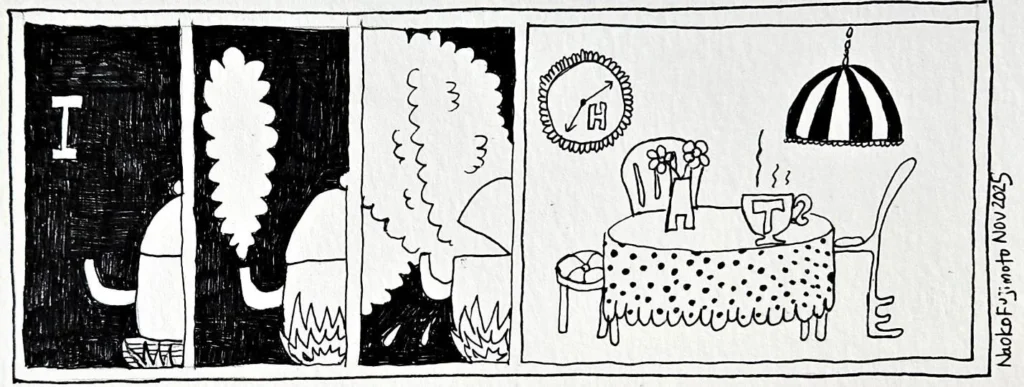
My new project is a hybrid of Zuihitsu and Manga-comics. I named it ManZui after Haibun (haiku and bun-sentences) in Japanese. Haibun usually has a short paragraph before a haiku, so I followed the style (but interestingly, haibun refers to haiku and sentences, but the two words were flipped). Zuihitsu is longer than one short paragraph, like haibun; therefore, I chose my project ManZui. There is no title for this piece because Haibun usually does not have one. If you need to address this title, which should be [An unripe peach softened after three days.], with brackets. I chose this format from some of the traditional poems without titles.
[An unripe peach softened after three days.]
An unripe peach softened after three days. It was solid like its own pit on a rack at a local supermarket. My palm held the fuzzy skin and placed it into a plastic bag. The skin was as cold as an air-conditioned row at the butcher shop, as if I had picked up a marble baseball from a frosted field. This almost artificial fruit would take four thousand, three hundred, and twenty minutes to be a juicy edible. When my husband said, “I will leave my office now.” I poured olive oil into the cast-iron frying pan. He would take twenty minutes to be home. A slight smoke came from the skillet, and then sliced onions and chopped cabbage were sizzled on it. When the vegetables were pliant, I added bunashimeji mushrooms. I covered the stir-fry and saw a clock. Ten minutes had passed.
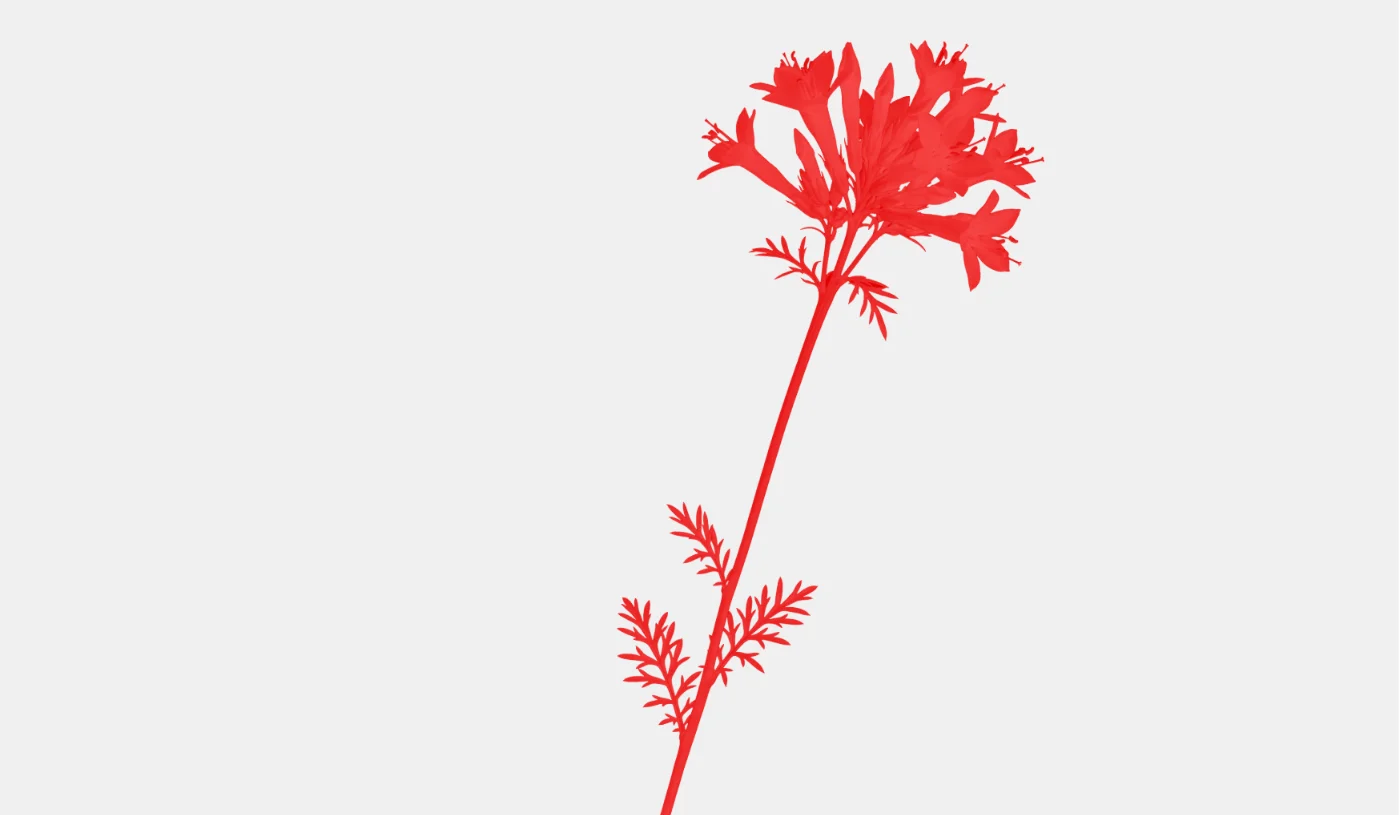
How endless to wait for someone. Once, Akazome Emon wrote a poem for her sister, whose partner had never shown up. The moon tilted over Orion at the top of the sky and sank into the dawn. It shone on arched, long leaves, shadowed rugged roots and trunks. Red spider lilies swayed and rustled in the wind. The light streamed through leaves and glowed weakly on the ground. The azure haze crept into the garden. The moon moved a fifteen-degree angle every hour, so her sister might say, “The moon was on the tip of my forefinger, but now it moved toward the thumb.” Waiting for more than a ninety-degree angle was her job; meanwhile, a modern woman could fly from Tokyo to the nearest foreign country. If she decided to go to Taiwan, she could have had tea and come back to Tokyo. With an additional thirty minutes, she could have bought a box of pineapple cake for her man, and said, “How delightful to bite it before the morning sun beamed into the room, My Dear.” Instead, the ancient woman waited. I waited. I waited for a time-angle of a peace sign on the hand, but there was no peace in my mind. I decided to slice cucumbers, add rice vinegar, and soy sauce. I ground sesame seeds and sprinkled Bonita flakes.
I realized I had not changed the water in the vase. “Lavenders can be great dry flowers,” my mother said, but I did not like dried corpses in the kitchen. They lived after they were cut for a while, but the weathered flowers were without spirits. Somewhat, I could clearly imagine those hanging potpourri bouquets catching fire. It started as an innocent spark from deep-frying pork, then one little flare spread beyond what I was capable of putting out. I tried not to think of it and looked at the extinguisher. Small lavender petals were scattered on the counter and floor. I trimmed stalks and some leaves, then I found a tiny green dot that moved around. It clawed under a nearly dying petal; soon, the petal fell. It spat the thread to stretch under the leaf, then swung. This tiny creature went to the front, prepared to die. I muttered, “Spider,” but nobody heard me. I was alone in the kitchen. I did not have children. No other human was at the house. I was currently waiting for my husband, who left about twenty minutes ago. The spider struggled to find a safe, quiet floor. With a blink of its million eyes, his safe place was removed. It spirally clawed from the top stalk toward my fingers. I was not afraid of a spider, but I did not want it to get lost in the carpet. It would be so tragic after its perfect life on lavender before its potpourri state. I opened the window and tossed all the flowers. They landed softly on the top of the bushes.
Then, my mother called after she changed the lightbulbs in her living room. I turned on my laptop screen and turned up the volume. It was so bright that her lampshade’s silhouette was distinctly shadowed on the ceiling. She said, “I don’t have to change them until seventeen; perhaps, twenty-five years later. This would be my last time in my life.” I did not know how to respond. I could have said, I’m cutting vegetables. I’m busy. My father slept in his bedroom. My mother used to wait for him to come back from his office, but he has not been mobile in the last fifteen years after the stroke. My father often asked, “Did Mom come back yet?” I replied, “You asked the same question fifteen minutes ago. Can’t you leave her free from changing your diaper?” His eyes were wide open in his skinny skull. He mumbled, “Give me a cup of tea,” but I said, “You spilled all over the bed fifteen minutes ago. Can you wait until Mom comes back?” My father’s effeminate voice got on my nerves as if he were a deflating goat. Over the laptop screen, my mother hysterically suggested, “If you are making vinegar cucumber, you must do jyabara-cut like an accordion. Who changes the lightbulb if I die first?” I heard my father’s snoring. My mother’s frustration was transmitted from the laptop screen, and she hung up one-sidedly, saying, “I am picking up the newspaper, so bye.”
The cucumbers in the ball were vinegary cursed. My husband could have been home by now, but his car had not pulled into the garage yet. It had been ninety minutes since he contacted me. I circled my apartment, looking for something to do to detach from the brightness of my mother’s lightbulbs. One cat’s toenail, whisker, and crumbled rice were on the carpet. I wondered about the spider. The stir-fried vegetables oozed their water into the pan on the stove. I served small helpings of rice on one plate and tossed the vegetables with chopsticks. It was no longer warm, but my stomach was full. I could have waited for my husband, but I ate some in the kitchen. I placed plates on the table with a glass of apple cider, and I sat down. Then, my husband called me to swap our cars in the garage. “I stopped by to get a coffee creamer and batteries at a store,” he said. I showed the cold dinner plate, he added, “You can microwave them.” I relocated the peach into a Rantaishikki-baske from Fukuoka Prefecture. It was once a gift that my mother received from her mother-in-law. The specialty basket did not end up in my mother’s kitchen. As ever, the peach was tense. The skin had discoloration. The blue craters were patched on the split curves—a large hailstone might have hit the peaches; perhaps, the unusually hot sunshine burnt the skin.
About the author:
Naoko Fujimoto was born and raised in Nagoya, Japan, and studied at Nanzan Junior College. She was an exchange student and received a BA and MA from Indiana University. She is the author of the poetry collections We Face The Tremendous Meat On The Teppan, Where I Was Born, and Glyph: Graphic Poetry=Trans. Sensory, as well as four chapbooks. She is associate and translation editor of RHINO and translation editor of Tupelo Quarterly. She organizes an online community at Working On Gallery and is a Bread Loaf Translation full scholarship recipient and the 2023 Visiting Teaching Artist at the Poetry Foundation.
https://www.naokofujimoto.com/