


Sean Singer – Conversation & Two Poems
for the series, The American Wing
curated by Carlie Hoffman and Tiffany Troy
Carlie Hoffman & Tiffany Troy: As poetry is woven into the very fabric of everyday life, your role as a poet becomes not just a creator, but a witness whose first task is to listen intently. Can you tell us more about the influences of your language and voice as a writer?
Sean Singer: I always wanted to be a writer ever since I could read and write. It’s been a lifelong practice and way of organizing chaos into form. Poems exist in the fabric of everyday existence. The job is to listen for them and increase the technical and psychological capacity to capture them. I like to live in the many-layered periphery, looking in from the outside. A rich inner life means the past and future can coalesce through language. This language is a tool to get as close as possible to reality, to reach out and touch it.
CH & TT: In your view, what can poetry offer people today? What personal meaning does poetry hold for you?
SS: Because people can’t always get the truth from journalism, institutions, the university system, social media, or from people they know, poetry can be the best remaining tool to maintain compassionate imagination. To merely survive as a poet in society is a political statement. The poet’s job is to describe the invisible ligatures and bonds among heretofore disconnected things. The poet’s job isn’t judgment, but a passionate balance of critique and celebration. Since almost no one reads poetry, there is a freedom to say and think anything.
CH & TT: Is there a poem or poetry collection you believe everyone should read at least once—and why?
SS: I have been coming back to Jack Gilbert’s The Great Fires. In search of “the heart,” Gilbert was fundamentally accepting of imbalance in favor of energy, and of accepting imperfection instead of putting things in a poem just because you know they work. His is a process of discovery, not of invention. Poets who are not Romantic poets may not feel the need to discover anything about romantic love. Gilbert thought you could teach people how to write poetry, but you can’t teach them how to have poetry. He claimed he once worked on a poem for twelve years before he found it. The Great Fires is really about not being beholden to anything, being unsellable, wanting beauty because it is there to be wanted.
CH & TT: What guidance would you give someone reading poetry for the first time?
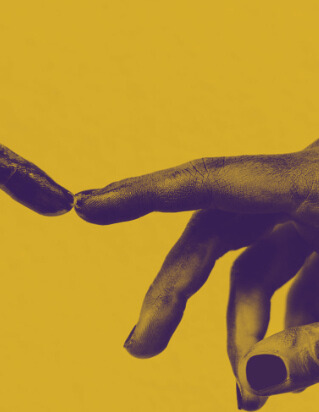
SS: Poetry is not a puzzle that needs to be decoded. It’s an experience, often as physical as it is mental. You wouldn’t look at a rock, a river, a leaf, or a pinecone, and say, “I don’t get it.” You simply engage with it on its own terms. The poem is like a handshake; it is a joint activity between the writer and the reader. Its meaning demands creativity from the reader, so it becomes an intimate experience.
Two Poems
by Sean Singer
WHALE
The deep to be hoary: In the 19th Century, most of the whaling industry was centered around Nantucket Island, whose population were pacifists. Men would leave home for whale hunts for a year or more while women would run the island in their egalitarian society. In the sperm whale populations they were hunting, male whales hunt several miles deep, while the female remain in large groups, and run their society.
The light is oceanic green, and makes hexagonic
light on the platform, with claws and gewgaws of light.
Each side of the monolith forms a point,
and when the moon shines coldly
from the cowl of space (a bell, liquid, as sound expands
and gets thicker in the sea).
Now a sea song
[Amazing Grace, traditional]:
Descending like a cork on her waves
Floating on her water wall…
Although the darkness made us slaves
To the moon’s arresting call.
I could not break from its cold grasp
So bound our paths would be
Each drifting sound her liquid bell
Made us the whale-dense sea.
Each bottle fell to the sailors’ bones;
A house on the oceans’ floor
And inside her bricks which opened there
I saw a rising velvet door.
A grove of spikes: When the Quaker hunter
espoused nonviolence, and stuffed his musket,
sharpened his hook, with its long sisal
and hemp rope, into a puffing heart
bigger than an oat-fed baby, he turned
in the dewlight like a battering ram.
True intoxication gurgled up in a thermos
of adventure. They’d go out from Massachusetts for years.
They were looking,
but their prey were listening.
A sperm whale’s ear is bigger
than a fist and it hears twofold noises:
the telescopic part hears squawks.
The enlarging cathedral part
hears echolocation—
Squawk—related to the whortleberry.
Correction…a hoarse squall, never from a horse.
Sometimes known as night heron, with a creak,
a screech, a ghost eating caviar.
Utter like a public-address system,
like a bimaculated duck, with windup gears.
Next to the inflatable balloons, there’s the echolocation.
(See under: bat versus manmade devices)
Radio signals sent and reflected back,
from the altimeter to the moth. (See under:
torpedo guidance, silent films, Buster Keaton doing marimba)
Concealed in space: Spermaceti whale males
dive 3,936 feet. Females dive to at least 3,280 feet.
They dive for over an hour. Squid beaks are inside
the stomachs. Picture a gray rose bigger
than a transcendentalist’s room up in the eaves, like a matrix
echoing its math-maze of osmotics.
Dr. Johnson, in the 1755 Dictionary:
A network is any thing reticulated or decussated,
at equal distances, with interstices
between the intersections.
That’s why the image of wooden networks
banging a reggae less a private ventricle
than sound immemorial to the order of air,
is a membrane gliding like soapstone
to bodies minced has sixty times’ air’s
intensity! And it’s all underwater: a blue ghost
sucking the fieldfare of smoke: Blueaproned, bluetrampled, bluemantled,
and blueglimmering home.
Jaw bones in an arch: When the whales eat,
they eat in a herd’s harem, a solitary bull
joins a school of 10-40 adult females
plus their calves, the length of a breeding season.
But the big squid are smoothed red
lengthwise-jettisoned like a jet,
which, wholly isolated in dark, has pink saucers
and terraqueous chitin, but don’t bite
the minute semitransparent threshing of flesh
mounting the portico of its mouth inside her mouth.
Sperm whale uses his head’s oily buoyancy
with his bloodflow, turning the oil to wax
to a snowy chamber
convulsing dried blurred ink, extracting air between globules.
When I die I want to feel like jumping
through the keyhole in your door—
nitrogen narcosis—and be sent in a single infatuation
to the sea. Because I have my own “transidiomatic affinities.”
The female leads herself into dark
realities of whale moments, intermitting between
her occupation of calf-care, in the Sargasso’s alcove,
fastening her hearing
to the echoes’ vault. The male hears it
and resurfaces,
saturated with squid-ink, refusing the evidence
of tiny holy eyes,
melting clerical burnished flames,
at the rim of each echo.
Savage disorder when we enter nature:
The gate creaks among the weeds,
we forget why we’ve come to begin with
and with a downward glance the muscles
in our necks tighten as if a blood-red ribbon
has been tied to the oaken door.
It is a door which restricts entry—
interior predetermination—and eyes
the mass of the next room,
where the speechless, unspeakable
echoes rest, in the vast, interspaced code.
[Reprise. Amazing Grace coda]:
The sonic waves from a mother whale
Travel through the oceans’ space
Each darkening sound of metallic hail
Receives amazing grace.
Light: skin’s desert fragment torn
like a dime, where there’s a fist
where skin is a whisper, whenever
the moon makes its dim
sink in the lake’s basin: a train’s
stiff haul in the night.
Light: lemon pinwheel, when the rind
waxes a flittery forced timesheet
that’s torn then punched, making a cannon
filled with iron pill
when it’s swallowed they fly
like a yellow eel and smoke rings it.
Soap: removing its surface from itself,
with bubbles like a cauldron,
the air moves away from it
in spheres composed of a shine
driven in fabric swirling like a window
approaches to a jump, and bursts.
Soap: not a filth magnet, to get through,
like a cupboard’s color,
reversing its convulsive prefabricated texture,
this brick closes around its pores
with its wire stairs and brushes.
Perfume: even though we live in an amber-solid whorl,
we breathe that floating mechanism
by which amber unlocks its petals
and fauna, dancing as a tinge
upon the resin in its document.
Perfume: a coloratura askew like a cascade
within a spotlight makes impending change when she is rubbed:
notably electric, along the Baltic shores,
entombed in aloe-wood.
All its life, a river mimics the sea,
the one with the upturned moonrise,
and is an instrument calling washable smells,
and light, and clean bricks pouring velvet
incapable of trembling.
Head: beyond the blanket scaffolding
is the massive pulpy anvil. Etched in barnacles
is the steam engine script from an ancient language,
Macrocephalus of the Long Words,
which is its name.
Used for light, soap, and perfume,
its oil moves like foam.
Head: a cathedral, I have said, and a pulpy ghost,
white as a stiletto, and within its coils
are energies which harden, and glitter and palpitate.
In lampshade lace and photographic liquid,
its group song
pleats tiger trim, swell satin, pink ash,
feathery chenille surround, and felt velvet
and it eases as the water table tilts, dimensional.
Humped herds of buffalo by tens of thousands:
Whales are superior to us.
They emit their undersea and trans-watery signals
with their thoughts
larger than a bus, which is like communicating
through telepathy.
Evil walking at midnight: a low, harboring call
meaning to get away from a ship.
Bell shines like: a hull painted green…well,
don’t hang around. Don’t want you hanging around.
Ice sled sinking: I take the waves by the reins
and am an accident waiting to happen, when my weight follows.
Scooping the clam: our troubles are over
when dry land tempts with its crow call.
Introspective strum: Whales are superior
to us. They move in darkness,
and in its blanket of cold
their head wax hardens and liquifies
like the manufacture of pianos, with 18 rock-hard
inner and outer maple rims pressed and wrestled
with amplified soundboard into a shapely dome.
In the open sea, there is sound.
The complex motions of whale wax
within the globules in the whale head
transmit and surround the front and back
as a soundboard in space, and move through water
like a grave carved from the graphite drums
registered within our ears, of pillbox size or smaller.
But the superior whale ear, ensconced in bony
auditory bulla and connected with tissue-drawn
sound to the jawbone and its cavalcade to the brain
larger than everyone we love.
Its immense, curling organ is the drum itself—
massive tympanic bone, cradling the instructive twofold
inner ossicles called malleus and incus.
Like the instrumentalist’s revolving vane
their involucrum opens with satisfactory vibrato, with its spinning
motor ascending from f like a yarn-wound yawn,
it is sustained and heard. If a boat is in front of this sound
it will crack, disperse, and become an only orphan in the dark.
It is not well known how boat-barnacle-stripping chemicals
cause deafness in our whales, when they do not receive
echoes, as in the blue-black caverns of their planet,
and beach themselves. When the fatty enormous structure
washed onto Chilean sands, it was an unknown organ,
though its skin no longer covered the great tympani
and drumrolls of that oratorio many miles down.
If something from our disregard for their planet
disrupts their elastic ligament and synostosis,
they are deaf hulls and the air-filled rotational axis
is unplugged, the stage goes blank, the cellulose
in the film bubbles and burns.
Music encoded in perforations:
In the lacquered, electroplated positives
known as the “mother,” of early grooved masters,
there are limited numbers of discs that can be made.
The stamper wears out. The pressing breaks
into a shard.
What is more beautiful than mammals who remain
at the origin of humanity, beneath the waves,
beneath the normal levels which subside and surface
over moving ridges and troughs, between one
and the next as undulation, livelier than breath?
Where should we go on the convex of land,
between the hollows, where the rounded snow
of water reduces itself from the wind’s action,
and we’re alone beside the leviathan, as phenomenon?
Under the cyma or ogee molding of the great arch,
not of whalebone or cathedral carving,
but the universal, zigzag ornament of waves?
These are the rhythmic alternations of disturbance
and recovery, like sound, like light, like perfume,
with particles transmitted like messages in the air.
Along the nerve we move restlessly.
ANCESTORS WHO CAME TO NEW YORK HARBOR FROM
AN EXTINGUISHED PAST
Ellis Island is a little ochre stone
at the bottom of a cloud.
I’m not a furrier staring at the fox-colored
sunset. I’m not a women’s shoe salesman
going from happiness to unhappiness
and then from unhappiness back to happiness.
Clothed in black wool like black castles
sparks flew off their lapels in a blossoming town.
Think of Jews envying chocolates and cheeses,
their eyes speaking piles of lady’s-shoe-heelism
then become worms in an absent city floating
in the inky tea and a silver evening.
On Kazimierz street there’s a bar called Singer.
Its sofa pillows, leafy wallpaper, and velvets
remind us that we constantly peer
into fathoms of unfathomednesses.
A slender girl in mulberry stockings
has proven that the dead have a homeland
among the arcades. She’s a clairvoyant
of human vapor, the grey spine of a pencil.
About the author:
Sean Singer is the author, most recently, of Today in the Taxi (Tupelo Press, 2022), winner of the 2022 National Jewish Book Award for Poetry. His earlier collections are Honey & Smoke (Eyewear Publishing, 2015, finalist for the 2011 National Poetry Series), and Discography (Yale University Press, 2002), winner of Poetry Society of America’s Norma Farber First Book Award and selected by W.S. Merwin for the Yale Series of Younger Poets. Sean holds an MFA from Washington University in St. Louis and a Ph.D. in American Studies from Rutgers University-Newark, and has been awarded fellowships and grants from the National Endowment for the Arts and the Massachusetts Cultural Council. He shares poetry curations and essays on craft at his Substack, The Sharpener.
Website: https://www.seansingerpoetry.com/