

Niloufar Abdolahi’s “Like Leaving” – In Search of Redemption Beyond Home
Niloufar Abdolahi’s 2026 short film “Like Leaving” explores the weight of immigration through a family of three (soon to be four) as they prepare to depart Iran. More aptly, the film is about women, home, and family, where the love for one’s country is met with the painful thought of departure.
The film’s original title, “Mesle Raftan” (مثل رفتن) in Farsi, derives from the Arabic word, mis̠āl ( مثال), to emphasize the idea of an example or likeness, where one thing stands in for, but does not replace, the other. It’s a hypothetical situation where the idea acts as the thing: for it is like leaving—not leaving—that marks the yearning for one’s homeland, whether or not one physically departs from it. It is with this poetic awareness of the turbulent synergy between attachment and estrangement that the Los Angeles-based Iranian filmmaker tackles the problem of home and exile in her film. “For Iranians, it is poetry, especially sufi (mystic) poetry, that provides the paradigmatic worldview and language of exile, embodying a variety of journeys, returns, and unifications,” writes Hamid Naficy, scholar of Iranian exilic cinema, as he argues why the desire to return to one’s homeland is an everlasting but unrealizable ideal.1 And yet, Abdolahi’s “Like Leaving” seems to complicate this formula, for it is not just the impossible desire to return, but the impossibility to leave in the first place that defines one’s relationship with home. Even in the search for a sense of redemption elsewhere, one is inevitably and irredeemably bound toward home.
Abdolahi’s “Like Leaving” seems to complicate this formula, for it is not just the impossible desire to return, but the impossibility to leave in the first place that defines one’s relationship with home. Even in the search for a sense of redemption elsewhere, one is inevitably and irredeemably bound toward home.
When I met with Abdolahi over a video call, she connected from her sunny Los Angeles home. “I love Turkish language, culture, food, people, everything, but we can see how Türkiye is turning into Iran,” she tells me, nodding to my own separation from my homeland. “We will be happy when the neighbor’s light is on; it will enlighten our house too,” she follows with a proverb.
Reflecting on her own experiences, Abdolahi laments the incredible difficulties of living in exile:
“When Nazy [the film’s leading female] decides to stay in Iran, despite arguments with her husband, she reasons: What about my art? What about my career? What about my being, personality, language, the person I have become all these years? And she thinks: What about my daughter? Will leaving give her the bright future that she needs? What does the future look like? No matter what decision they make, they can’t be sure that it’s the right one. Either way, they’re helpless.”
Her sensitivity reminds me of Nâzim Hikmet Ran, the acclaimed Turkish poet and a great lover of his country, who spent his entire life in exile. His poem, “On Living,” begins with the paradoxical line— “Living is no laughing matter:/ You must live with great seriousness2.” When you think about where life takes you—where you end up scattered, here or there—the element of choice, let alone the right to live a joyous life, becomes irrelevant. What remains is an endless accounting: justifying your decisions, proving your experiences, sorting your papers, and claiming your right merely to exist.
As the US and Israel continue to wage war on Iran and wreak havoc in the region, those of us living away from our homelands are left to wonder what will remain. The weight of our grief grows unbearable as the struggle is not only against wars waged on our places of birth, but against the deeply rooted injustices that have crippled these lands, and likewise, against the rage of xenophobia in our host countries that keeps us perpetually foreign. For Said, “our age—with its modern warfare, imperialism, and the quasi-theological ambitions of totalitarian rulers—is indeed the age of the refugee, the displaced person, mass immigration.”3 Exile is the condition of life. It is “the unhealable rift forced between a human being and a native place… its essential sadness can never be surmounted.”4
When Abdolahi began filming in the summer of 2025 in Tehran, Israel unexpectedly started bombing Iran. The Twelve-Day War posed several production challenges, including the inability to get filming permits due to the heightened security measures.
“The war broke out, and after two, three days, people started to leave Tehran and go to smaller cities to stay safe. You couldn’t shoot a movie because there were bombings everywhere. So we waited. We didn’t know how long it would take. And I thought, okay, now the goal is to stay alive. We can decide what to do after that.”
The increased checkpoints and the random searches necessitated everyone to be more careful. When Abdolahi couldn’t get the necessary permits, one of her friends stepped in. He had the permission to shoot for another TV series, and he brought that permission to her set: “If they ask anything, we will say that we are shooting scenes for that TV show,” she reminisced.
But rather than addressing an ongoing war, Abdolahi chose to focus on the universal themes of family and home. “I wanted to show there is a problem. There’s a problem that people are forced to leave their country. That was my first intention,” she says, and clarifies, “it’s the ruling regime in Iran and its policies that have created the situation that forces people to leave,” she adds. The live news coverage of Trump’s meeting with Netanyahu on the television in the background, as the family packs their belongings in boxes for the movers, represents the everyday violence afflicting the people of Iran. They don’t stop to listen. The threat of a bomb dropping on your home is both immediate and routine.
Still, the triad, “Women, Life, Freedom,” is what the Iranian women protestors taught the rest of the world, and this is the spirit of hope that Abdolahi’s film demands. “I love Iran,” she says, “my heart is still there.”
“Women, Life, Freedom,” is what the Iranian women protestors taught the rest of the world, and this is the spirit of hope that Abdolahi’s film demands. “I love Iran,” she says, “my heart is still there.”
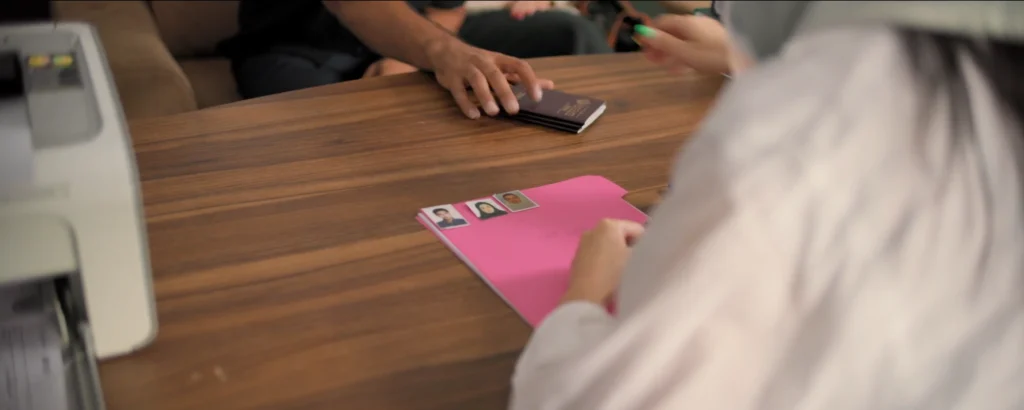
Whereas Hollywood and Eurocentric media continue to simplify and misrepresent South West Asia and North African cultures, particularly through the portrayal of Iranian women as weak victims without voice or agency, more thoughtful representations of these diverse cultures remain necessary. Abdolahi’s film acknowledges the power of Iranian women.
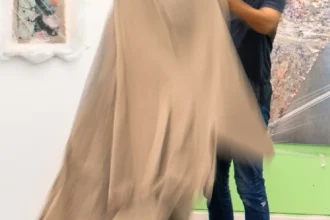
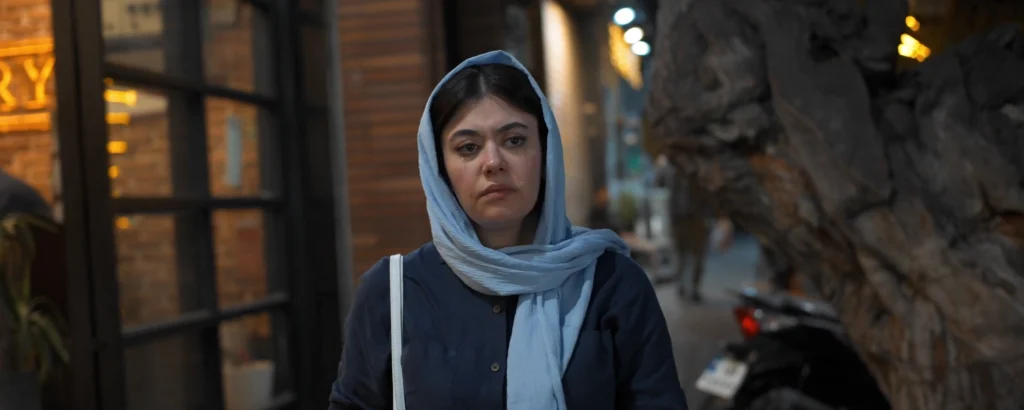
A close-up shot of a female travel agent’s neon green and yellow nail-polished hands opens the film. She is sorting through passports and paperwork, which she places in a bright pink folder as she assures the family they are all set to go. Already, the splashes of vibrant colors contrasted against the dreadful situation of their immigration sets the tone of the film. It also establishes an understanding that the women in this film have a zest for life, and a certain beautiful, confident poise, later echoed in the bright yellow sunflowers the little girl holds, or in the bold red lipstick the female student wears. Whether it’s about the expecting mother’s calligraphic practice or her school-aged daughter’s cheerful dancing and painting, the girls and women in this film are proficient and accomplished. They are also in control— unlike the sole male character, the father, whose quick temper and lack of organization are flaws the women manage.
The issue of women’s rights is not going to resolve without systemic change. Yet Abdolahi remains gentle on Reza, the short-tempered father in the film: “I just wanted to show his desperation. I know how these men work tirelessly in Iran, and it’s never enough. The wife works, the husband works, and it’s still never enough. In his mindset, he’s doing something good for his family by trying to leave,” she explains.
Calligraphy, specifically, has deep cultural significance in Iran. Calligraphy is an art that takes many years to master. “You have to take classes and pass exams in Iran,” explains Abdolahi, “the hand that writes that word, ‘sun’ in Farsi, is my hand, because the actor couldn’t write. So that was my handwriting. I took the classes. I know how long this process is and how much effort you have to give to become a master of calligraphy,” she continues. For Nazy to have acquired mastery and be faced with departure would feel like losing everything. When her student asks if she can continue the classes online, she is quick to say no. How can this practice be replicated online?
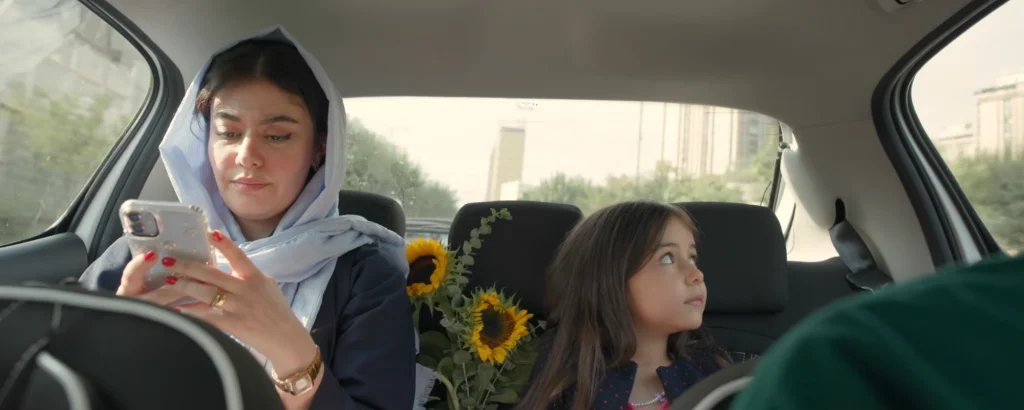
The women in “Like Leaving” are grounded— they are creative life forces, skillful practitioners, makers of homes, and they are full of life, beauty, and confidence.
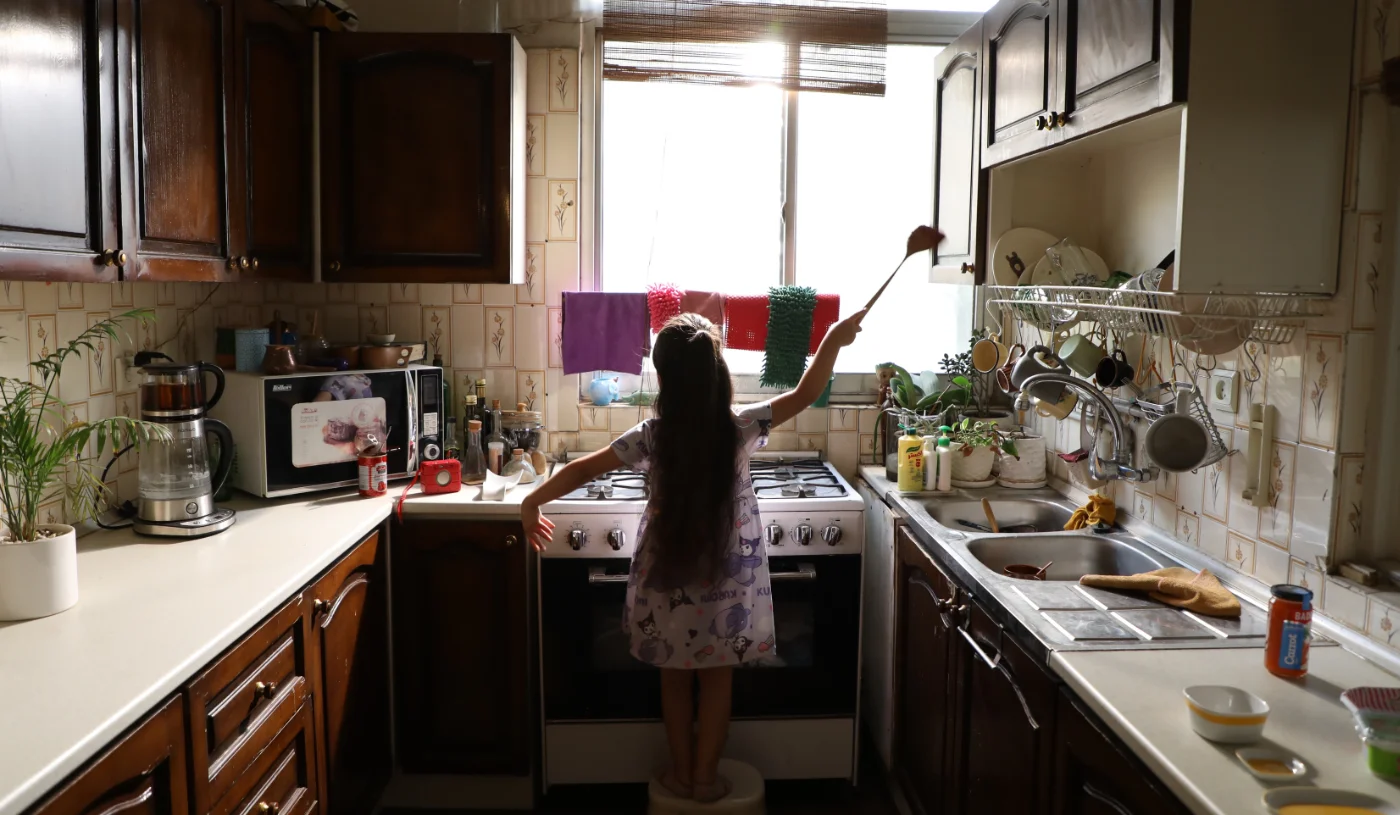
The women in “Like Leaving” are grounded— they are creative life forces, skillful practitioners, makers of homes, and they are full of life, beauty, and confidence. When the young girl in the film sees her parents fight, she decides to step in. Having seen her mother serve what is presumably her father’s anti-anxiety medication, she decides to serve him with more than enough to temper his anger. “I love that scene when she is watching her parents through the door, and she sees them argue and makes a decision in her own mind,” Abdolahi tells me with a smile. In this way, the film highlights how women learn to navigate their circumstances. The little girl sees her mother’s struggle and chooses to stand with her. She also loves her father and spends the rest of the evening coloring by his side. “My hope for those little girls is that they can fix things. And they can. They are smart, they are wise, they see the fight and they take action,” she asserts.
Indeed, the women in the film set the course of action and the man follows. It is the woman who directs the movers on what to do; the woman who organizes the paperwork and keeps her home; the woman who masters the arduous practice of calligraphy; and the woman who will give new life.
“Like Leaving” (2026) has appeared at the Worldwide Women’s Film Festival and at the Los Angeles International Film Festival. This is the director’s second short film, after “Blue Tangerines” (2020), about an interfaith love story in Iran.
———————-
Title: Like Leaving (مثل رفتن / Mesle Raftan), 2026
Director, Writer, Producer: Niloufar Abdolahi
Cast: Navid Salahi, Samaneh Shoaei, Ava Bakhshi
Runtime: 12:28
About the filmmaker:

Niloufar Abdolahi is an Iranian-American filmmaker based in Los Angeles. Born in San Diego and raised in Iran, she studied Film and Media Studies at the University of California, Irvine. Her work explores themes of displacement, identity, and the emotional landscapes of exile and belonging. Abdolahi began her creative journey through screenwriting and independent filmmaking while also working in cultural and media environments in Iran. She was part of the executive team involved in organizing the Tehran International Short Film Festival and has collaborated with creative teams across media and storytelling projects. Her short films include “Blue Tangerines” (2020) and “Like Living” (2026), which reflect her interest in intimate human stories shaped by migration, memory, and the search for home.
Footnotes
- Naficy, Hamid. “The Poetics and Practice of Iranian Nostalgia in Exile.” Diaspora: A Journal of Transnational Studies, vol. 1 no. 3, 1991, p. 285-302. ↩︎
- Hikmet, Nâzım. Poems of Nâzım Hikmet. Translated by Randy Blasing and Mutlu Konuk, Persea Books, 2002. ↩︎
- Said, Edward. Reflections on Exile and Other Essays, 2nd Ed, Cambridge: Harvard UP, 2001, p.357. ↩︎
- Said, p. 173. ↩︎

Vuslat D. Katsanis
Dr. Vuslat D. Katsanis specializes in comparative literature, film, and visual culture with a focus on Turkish and global migrant cultural production and critical theory. She is the co-founding director of the MinEastry of Postcollapse Art and Culture (MPAC), an independently run art and research space based in Switzerland.